Tesla Cybercab Launches in Austin With No Steering Wheel, No Pedals, and Built-In Starlink
Tesla has officially opened rides in the Cybercab, its fully autonomous robotaxi designed without a steering wheel or pedals. The public rollout began at 5 PM in Austin, Texas, with service covering the current Tesla Robotaxi operating area.
The Cybercab is not just another electric vehicle. It represents Tesla’s most aggressive step yet toward a driverless transportation network, combining autonomous driving software, a simplified two-passenger cabin, built-in Starlink connectivity, and a design focused on mass production. Tesla is also offering bulk fleet purchase requests, signaling that the company wants the Cybercab to become more than a ride-hailing experiment.
Tesla says Cybercab is built to be one of the safest vehicles on the road. At the launch, company executives highlighted more than one million unsupervised robotaxi miles already completed by the platform. Tesla continues to rely on a camera-based AI driving system rather than depending on a wide mix of sensors, arguing that real-world driving requires prediction, context, and decision-making that hardware alone cannot provide.
One example shared during the event involved a Cybercab smoothly yielding to an elderly pedestrian crossing a busy street, showing how the vehicle interprets movement and reacts in real time.
Inside, the Cybercab includes a full airbag system with front, knee, seat-mounted side, inner side, and curtain airbags. Both doors also have mechanical releases that work independently of power, giving passengers a backup exit method in an emergency.
Tesla has added an Occupant Classification System using a radar module placed above the dome lights. This system detects whether a seat is empty, occupied by a child seat, a larger child, or an adult, then adjusts front airbag behavior accordingly. The Cybercab does not include LATCH or ISOFIX anchors, so child seats must be secured with seatbelts.
The Cybercab cabin is designed around comfort, simplicity, and short urban trips. The vehicle has a 16.5-inch step-in height, 43.4 inches of legroom, 38.3 inches of headroom, and 50.1 inches of hip room. It stands 55.4 inches tall, measures 69 inches wide, and offers 5.7 inches of ground clearance.
Cargo space is surprisingly practical for a compact robotaxi. The trunk provides 20.2 cubic feet, or 572 liters, of storage and is rated for up to 220 pounds. Tesla says that is enough room for two checked bags and two carry-ons, or a folded stroller and a folded wheelchair.
The seats recline independently, though they move forward and backward together. Tesla recommends passengers stay buckled during the ride and keep seat recline below 35 degrees.
The vehicle uses eight exterior cameras for autonomous driving, plus a ninth cabin-facing camera. The interior camera is used to check for cleanliness and forgotten items between rides. A green indicator on the touchscreen shows when the cabin camera is active.
Tesla has also built personalization into the Cybercab experience. When a rider enters the vehicle, the car can automatically restore cabin temperature, seat position, and media accounts from the passenger’s cloud profile. The Robotaxi app works as a remote extension of the vehicle over the local network, allowing riders to start media before getting inside.
To make pickup easier, the Cybercab uses a matching light system. A light color on the vehicle’s front lightbar corresponds with the color shown in the app, while an in-app compass helps guide passengers to the correct car.
Tesla describes the Cybercab interior as a “second living room” that can be used for entertainment, work, or relaxation. The vehicle integrates Grok voice assistance, activated by saying “hey Grok,” allowing passengers to control ride and vehicle features hands-free.
The interface runs on Epic’s Unreal Engine, giving the touchscreen a more advanced visual experience. Each seat includes a USB-C port and independent airflow control. For privacy, signed-in media accounts are wiped from the vehicle after each trip ends.
Tesla plans to use dynamic pricing for Cybercab rides, with fares adjusting based on supply and demand. The company expects wait times to improve as more vehicles enter the fleet.
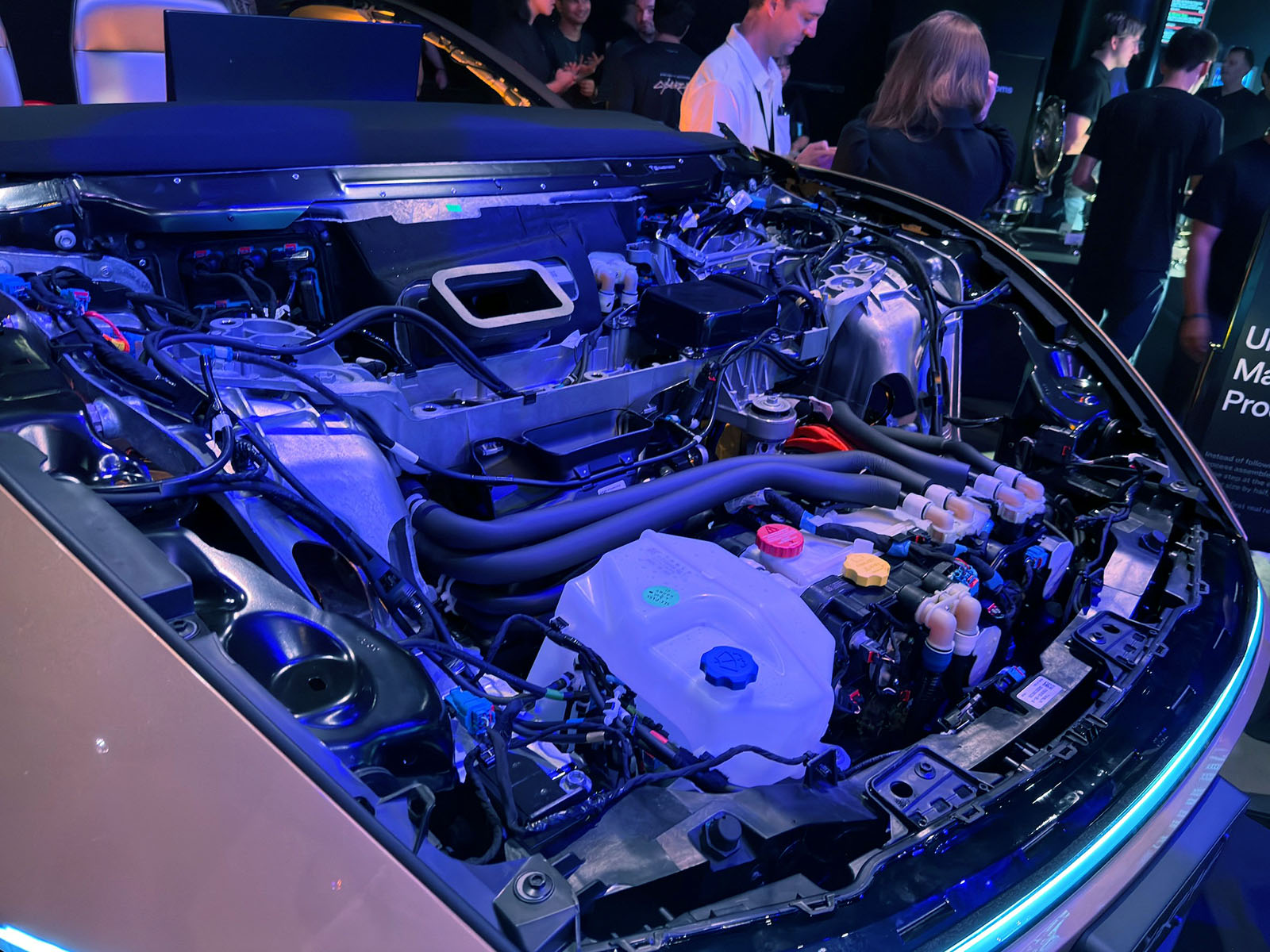
The Cybercab is also important from an engineering standpoint. It is the first Tesla vehicle to use brake-by-wire with no brake fluid. It is also the first to feature Tesla’s Supermanifold V3 thermal system, which combines high- and low-voltage controllers, reduces unnecessary refrigerant lines, and is claimed to be 38% more efficient. Tesla also says the system is designed to be 80% automatable during manufacturing.
The drive unit is optimized for two-passenger trips, which Tesla says represent more than 80% of rides. It uses a simplified bar-wound stator and is said to be 18% smaller and 25% lighter than leading rival EV drive units. Tesla designed the unit for automated assembly in under 10 seconds.
Aerodynamics also play a major role in the Cybercab’s efficiency. Tesla claims a drag coefficient below 0.2, helping explain the vehicle’s smooth, futuristic shape.
Production relies on Tesla’s “unboxed” manufacturing process, a parallel modular assembly method that moves away from the traditional single conveyor belt. According to Tesla, this approach cuts the production line footprint by about 50%, increases output, and reduces cycle times. The Cybercab’s simpler design should make it easier and faster to assemble than a conventional vehicle.
The exterior panels use a reaction injection molding process with recycled material. This allows Tesla to avoid a traditional paint shop, lowering complexity and potentially reducing production costs.
Charging remains one of the more interesting areas of the Cybercab rollout. Tesla’s long-term goal is wireless charging through inductive pads with ultra-wideband alignment. However, because that infrastructure is not yet widely available, current Cybercabs use a standard NACS port and can charge through Tesla’s existing Supercharger network.
In the future, Supercharger sites could potentially be upgraded with wireless charging pads, allowing Cybercabs to operate with even less human involvement.
With the launch of the Cybercab in Austin, Tesla is moving closer to its vision of autonomous ride-hailing at scale. The vehicle’s steering wheel-free design, AI-based driving system, personalized cabin features, efficient engineering, and fleet-focused production strategy all point toward a future where robotaxis could become a major part of everyday transportation.