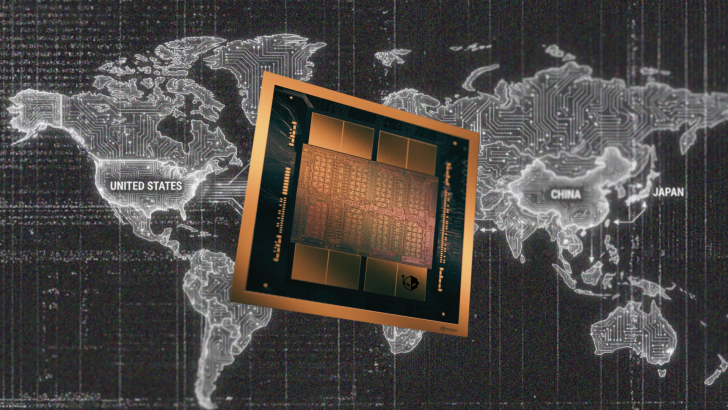
Even though NVIDIA’s Blackwell AI chips can’t be exported directly to China under current U.S. restrictions, some of China’s biggest AI players appear to be getting access to that cutting-edge performance anyway—by renting it.
A growing “GPU rental” approach is gaining momentum among major Chinese tech companies that urgently need more computing power to train and run advanced AI models. Instead of trying to source restricted high-end chips through traditional purchase channels, these firms are increasingly turning to overseas cloud and “neocloud” providers to lease access to powerful NVIDIA hardware hosted outside China.
According to reporting cited by the Financial Times, Tencent is using NVIDIA B200 AI chips via Datasection, a Japanese neocloud provider. Datasection reportedly has around 15,000 NVIDIA Blackwell processors available and is said to hold rental contracts worth more than $1.2 billion from a single large customer tied to Tencent through a third-party relationship. The arrangement highlights a strategy that is described as legal, but politically sensitive, because it allows Chinese companies to tap into top-tier AI computing despite export controls.
What makes this especially notable is the level of hardware involved. Datasection’s infrastructure reportedly includes NVIDIA’s latest Blackwell lineup, including the B200 and even the B300, deployed across facilities in Japan and Australia. That matters because access to state-of-the-art GPUs remains one of the biggest bottlenecks for training frontier-scale AI systems. Without enough advanced accelerators, it becomes far harder to compete at the highest end of model development.
This is also not just about Tencent. The same general model—renting compute located overseas—has been associated with other Chinese AI heavyweights as well, including Alibaba and Baidu. The underlying reason is simple: the performance available through these rentals can be well beyond what’s accessible in the domestic Chinese market.
Analysts suggest this rental approach may become more attractive over time, not less. One view described by the Financial Times, attributed to an analyst at Bernstein Research, is that companies might prefer continuing to rent high-end compute rather than buying whatever AI chips they can acquire within China. The logic is that even if certain NVIDIA Hopper-class options like the H200 are available, Blackwell parts such as the B200 and B300 offer a significant performance leap—making overseas rental access a compelling path for organizations that want the most capable AI training infrastructure.
In short, while export rules aim to limit direct shipments of leading AI hardware, the demand for GPU compute is pushing companies toward creative alternatives. The “rent Blackwell abroad” model is quickly becoming one of the most important ways Chinese tech giants can keep pace in AI—without physically importing the chips.