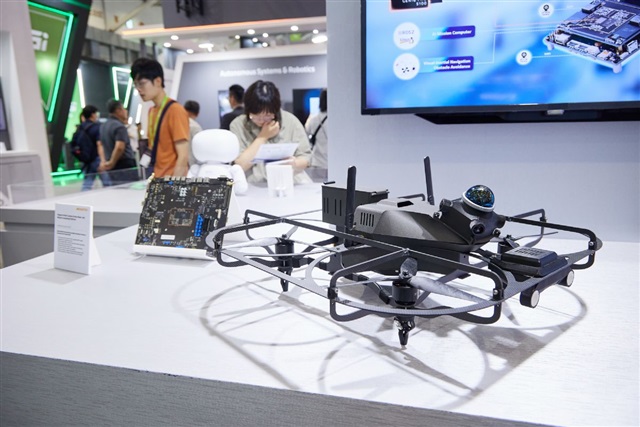
Taiwan’s drone industry is gaining new momentum as global manufacturers look for alternatives to China-based supply chains. The shift is opening fresh opportunities across the island’s growing unmanned aerial vehicle ecosystem, from finished drone makers to the chip companies that provide the technology inside them.
Downstream players such as Thunder Tiger and Taiwan’s Aerospace Industrial Development Corporation are continuing to secure new orders, highlighting rising demand for Taiwan-made drone systems and related aerospace solutions. Their progress reflects a broader change in the global drone market, where buyers are placing greater emphasis on supply chain security, trusted manufacturing partners, and reliable component sourcing.
At the same time, upstream suppliers are quietly becoming some of the biggest beneficiaries of this trend. Taiwan’s semiconductor companies, sensor makers, communications component suppliers, and precision electronics firms are increasingly important to drone production. Modern drones require advanced chips for navigation, image processing, flight control, wireless communication, and artificial intelligence functions. As demand grows, these suppliers are finding themselves in a stronger position within the international drone supply chain.
The move away from China-linked sourcing is not happening overnight, but it is steadily reshaping the industry. Governments, defense contractors, commercial drone operators, and technology companies are all paying closer attention to where key parts are made. Concerns over geopolitical risk, cybersecurity, export controls, and supply disruptions have encouraged many companies to diversify production and reduce dependence on a single country.
Taiwan is well positioned to benefit from this transition. The island already has deep expertise in semiconductors, electronics manufacturing, industrial automation, and aerospace engineering. These strengths give local companies a competitive edge as drone makers seek dependable partners capable of delivering high-quality components at scale.
For companies like Thunder Tiger and AIDC, the expanding order book signals growing confidence in Taiwan’s ability to support both commercial and defense-related drone applications. Thunder Tiger has a long history in remote-controlled aircraft and unmanned systems, while AIDC brings aerospace manufacturing experience and engineering capabilities that can support more advanced aviation projects.
Beyond the headline manufacturers, Taiwan’s drone supply chain includes a wide range of specialized firms producing motors, batteries, control systems, cameras, communication modules, printed circuit boards, and flight software. This layered ecosystem could become increasingly valuable as the global market for drones expands into logistics, agriculture, infrastructure inspection, emergency response, mapping, and national security.
The rise of Taiwan’s drone sector also aligns with a larger push to build more resilient technology supply chains. As companies reassess where they source critical hardware, Taiwan’s role as a trusted electronics and chip hub gives it a powerful advantage. Drone makers looking for secure, high-performance components may increasingly turn to Taiwanese suppliers as they redesign their procurement strategies.
While competition in the drone market remains intense, Taiwan’s combination of semiconductor strength, precision manufacturing, and aerospace know-how gives it a clear opening. If local companies continue to win orders and deepen collaboration across the supply chain, Taiwan could become a more influential force in the global unmanned systems industry.
The latest gains suggest that Taiwan’s drone sector is no longer just a niche opportunity. It is becoming part of a larger global shift toward diversified, secure, and technology-driven supply chains, with Taiwanese chipmakers and aerospace companies playing a growing role in the future of drone manufacturing.