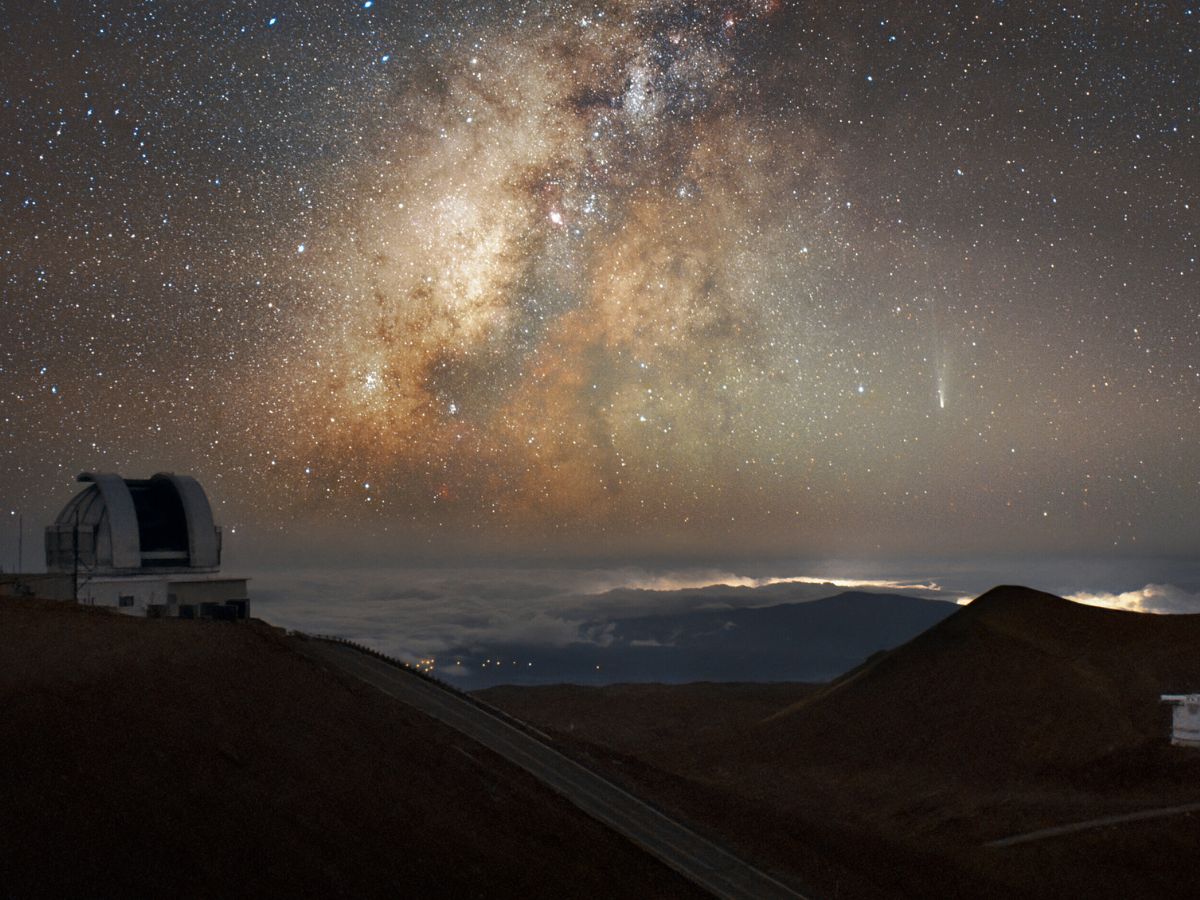
Stargazing always comes with a bit of luck. Each year brings its share of celestial events, but what you can actually see depends heavily on timing, dark skies, and clear weather. Lately, skywatchers have been treated to an especially memorable run: an interstellar visitor passing through the solar system, multiple comets making appearances, and the Geminids meteor shower preparing to hit its peak. Now, one breathtaking image is adding to the excitement, capturing Comet Lemmon alongside the Milky Way above Hawaii.
What makes this kind of photo so striking isn’t just the scenery—it’s the comet itself. Comets are famously unpredictable. As they travel near the Sun, their icy surfaces can flare, fade, or even break apart, sometimes changing dramatically in a short amount of time. That unpredictability is part of what makes comet watching so compelling, and it’s also why a well-timed photograph can feel like a rare win for both astronomers and casual stargazers.
Comet C/2025 A6, better known as Comet Lemmon, has been visible in the night sky over the past few weeks, giving observers a limited window to spot it. Even then, it hasn’t been an easy target. Visibility depends on several conditions, including how bright the comet appears, how dark the sky is, and where you’re viewing from.
That’s why this particular shot stands out. Taken in November 2025 from the summit of Mauna Kea in Hawaii, it captures Comet Lemmon at a time when its brightness was comparable to Uranus. From such a high-altitude location—one of the world’s most famous stargazing sites—the sky can look exceptionally clear and deep, making it possible to see the comet and the Milky Way side by side in the same frame.
There’s another reason the moment feels special: Comet Lemmon won’t be back anytime soon. Its return is expected in about 1,350 years, meaning the next opportunity to observe it won’t come until the year 3375. For anyone looking up at the night sky today, this is truly a once-in-a-lifetime comet.
For astronomy fans searching for the best current sky events, Comet Lemmon’s appearance is a reminder of why people still chase dark horizons and high peaks. When the timing is right, a single image can capture both the vast structure of the Milky Way and a fleeting visitor from the outer reaches of our solar system—here for a moment, then gone for more than a millennium.