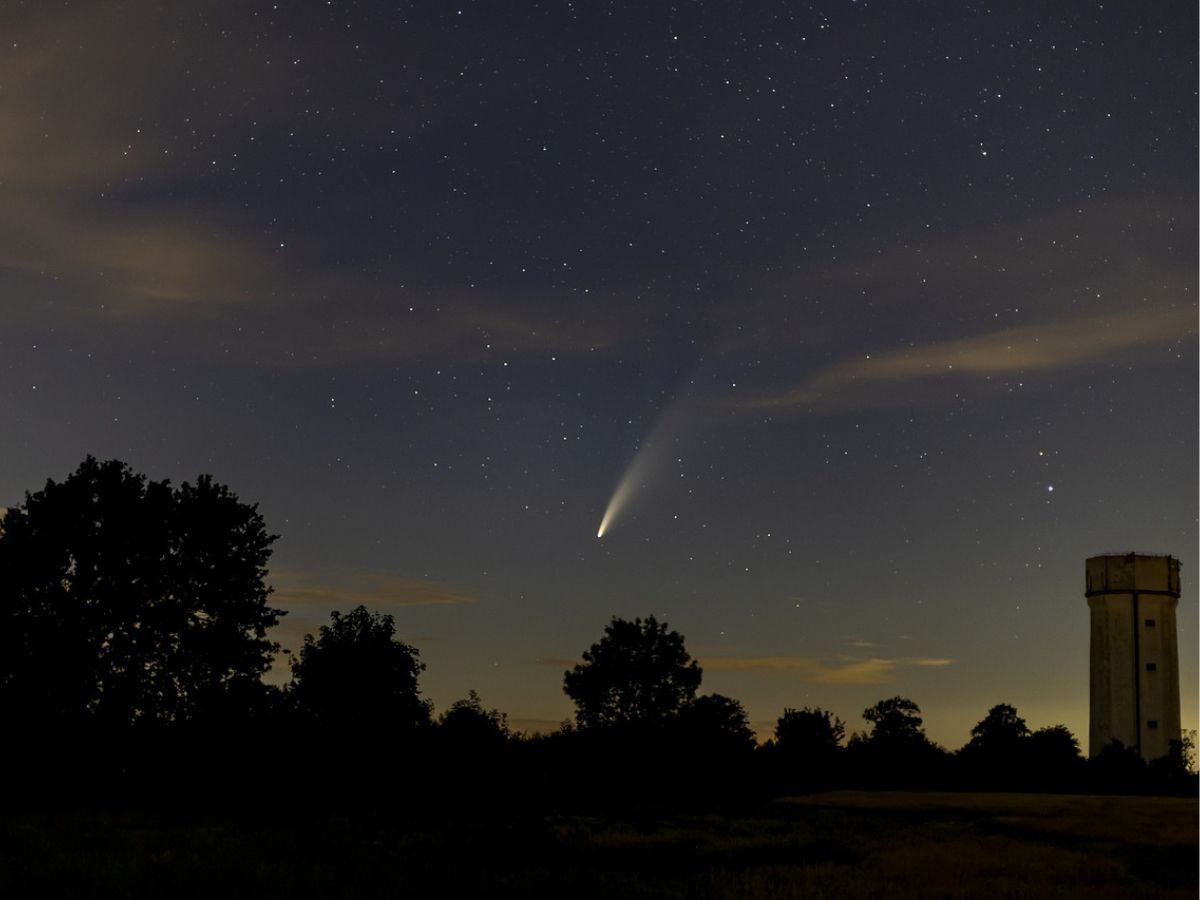
The night sky has been busy lately, and October could deliver a rare treat: two comets visible around the same time. With dark skies and a little planning, you might spot both with your own eyes—or at least catch them easily with binoculars.
Comet C/2025 A6 (Lemmon) has been steadily brightening since its discovery on January 3, 2025 by the Mount Lemmon Survey. After hovering at a brightness too faint for casual observers, it has climbed to around magnitude 8.5 since August and is forecast to reach about magnitude 3.9 on October 21, 2025. That puts it on the edge of naked-eye visibility under very dark, moonless skies, similar to what many experienced with NEOWISE. Your best chance to find it is shortly after dusk, looking toward the bright star Arcturus and the nearby star Izar. As always, the darker your viewing location, the better the view.
A second visitor, Comet C/2025 R2 (SWAN), could share the stage. Discovered by Vladimir Bezugly, this long-period comet swings around the Sun roughly every 22,554 years. On October 21, it’s expected to pass about 0.27 astronomical units from Earth and may reach around magnitude 4 near the star Spica. That’s potentially visible to the naked eye in pristine conditions, but comets are notoriously unpredictable. They can surge in brightness—or fragment and fade—without warning. Plan to use binoculars or a small backyard telescope to improve your odds.
Quick tips for seeing the comets:
– Seek out the darkest sky you can find and avoid city lights.
– Start watching shortly after dusk for C/2025 A6 near Arcturus and Izar; look for C/2025 R2 near Spica on October 21.
– Give your eyes 20–30 minutes to adapt to the dark and lower your phone brightness.
– Bring binoculars; even a basic pair makes a big difference.
– Check a stargazing app or star chart the day of your viewing for precise positions.
A note on brightness: the lower the magnitude number, the brighter the object. Magnitude 3–4 can be visible to the naked eye from dark sites, while magnitude 8–9 typically requires binoculars or a telescope. Because comet activity can change quickly, consider this a promising forecast rather than a guarantee.
Mark October 21 on your calendar. If skies cooperate, you could witness a rare double-comet showcase—an autumn sky spectacle worth staying out a little later for.