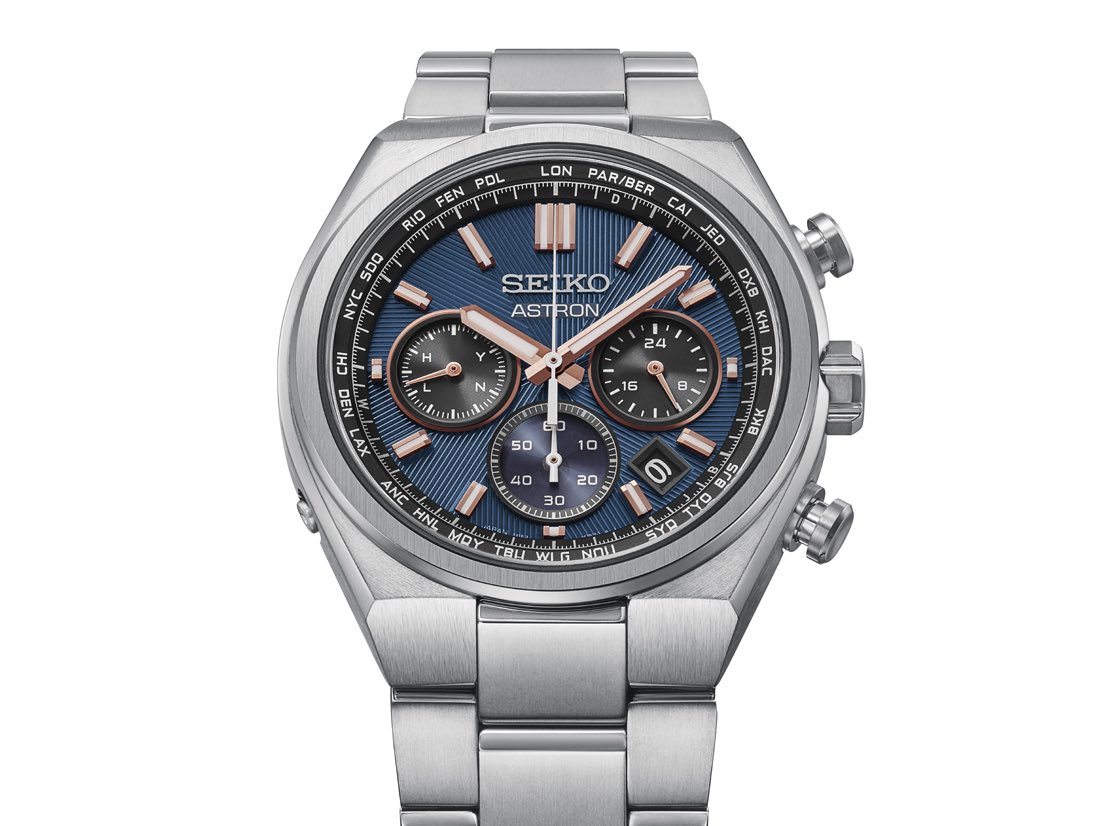
Seiko is giving its Astron Nexter collection a fresh boost with four new GPS solar watches built for travelers and everyday wear alike. The new lineup includes the HAC001, HAC002, HAD001, and HAD002—each combining solar power with automatic time and time zone adjustment, all wrapped in lightweight titanium for comfortable all-day use.
Across all four models, Seiko leans into a cohesive look: deep blue dials, a contrasting chapter ring, and what the brand calls a Pure Titanium case finished with a DiaShield coating for added surface protection. The standout feature is the Astron’s ability to automatically set the correct time wherever you are by connecting to satellites, with additional radio signal correction support across major regions. That means the watches can keep themselves accurate without constant manual resets, even as you move between time zones.
The HAD001 is the most feature-packed of the group. It uses a chronograph-style, three-register layout and adds a world time display for 25 cities via the outer chapter ring. Inside is Seiko’s Caliber 8B92, which supports a 1/5-second stopwatch, a 24-hour hand, and an automatic calendar that runs all the way through 2099. Despite the extra information on the dial, it stays sleek on the wrist at 10.6mm thick and an impressively light 90g thanks to its titanium construction. You also get a sapphire crystal with Super Clear Coating, LumiBrite on the hands and indices for low-light readability, and 10ATM water resistance (100 meters).
For those who want strong travel functionality with a slightly calmer dial, the HAD002 offers a more restrained two sub-dial setup. It runs on Caliber 8B63 and includes a 24-hour subdial for tracking a second time zone, plus a retrograde day-of-the-week indicator and a date window at 3 o’clock. Like the HAD001, it supports world time across 25 time zones and can receive time signals in regions such as the US, UK, Japan, China, and Germany. It’s a touch heavier at 93g, while keeping the same titanium build, sapphire glass, and 10ATM water resistance.
If you notice a black inner bezel with lettered markers, it isn’t just decorative. That scale is part of the GPS and radio-controlled timekeeping system. During syncing, the second hand moves to those markers to show reception status and signal strength, giving you a quick visual cue that the watch is connecting properly.
On the more minimalist side, Seiko is also introducing the HAC001 and HAC002. These models focus on a cleaner time-and-date presentation while still delivering automatic time correction via radio signals and a perpetual calendar. Both are powered by Caliber 7B62 and come in an octagonal case design. The HAC001 is the larger option at 39.6mm wide (45.4mm lug-to-lug), while the HAC002 is a more compact 36mm—ideal for anyone who prefers a smaller footprint on the wrist. Like their HAD siblings, they also include the lettered inner bezel tied to the timekeeping system.
Battery life is another major selling point. Because all four Astron Nexter watches are solar-powered, Seiko says they can run for up to 9 months on a full charge even when stored in the dark, or up to 2 years when placed in power-saving mode.
Availability and pricing are set for Japan first, with sales beginning in April. Pricing starts at 176,000 yen (about $1,107) for the HAD001. The HAD002, HAC001, and HAC002 are each priced at 165,000 yen (about $1,038).