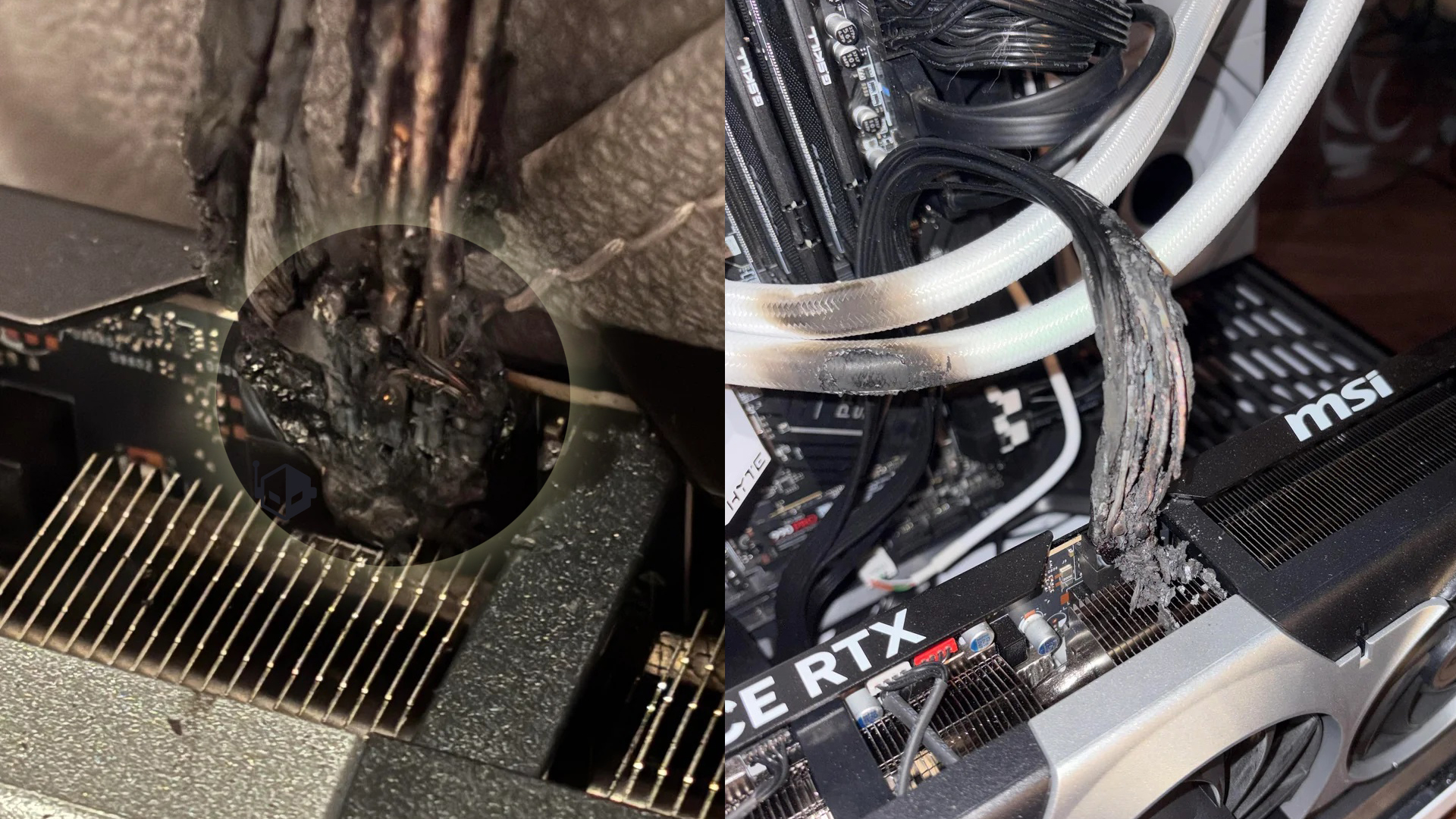
A shocking new report is raising fresh concerns about 16-pin GPU power connectors after an RTX 5090 reportedly suffered an extreme connector failure that left the plug completely charred and nearly unrecognizable.
While stories about 16-pin connectors melting have become increasingly common in recent GPU generations, most incidents tend to involve minor deformation—slight softening of the plastic housing, discoloration, or partial melting on the cable end or the graphics card socket. This case appears to go far beyond the typical “melted connector” scenario. According to photos shared online, the connector didn’t just warp or fuse—it looks burned to the point of severe charring, with damage extending into the cable itself.
The user who posted the incident said the RTX 5090 had been in use for about nine months before failing suddenly on Christmas Eve. Based on the images and description, the damage wasn’t limited to the cable-side plug. The graphics card’s power socket also appears to have suffered heavy heat damage, suggesting the failure involved significant heat buildup at the connection point long enough to deform and burn surrounding materials.
That’s where the biggest concern comes in: a properly operating, certified PC component shouldn’t be producing open flames under normal conditions. Even in failure scenarios, most consumer electronics are designed to minimize the chance of fire and contain heat-related damage. When a connector burns this aggressively, it naturally triggers questions about whether the issue stems from poor contact, a manufacturing defect, cable quality, connector tolerances, or some combination of factors.
The owner also provided an important detail: they were not using a third-party adapter. Instead, they said they used an ATX 3.1-compliant power supply (PowerSpec 1050 GFM) along with the native 12V-2×6 cable included with the PSU. That matters because earlier connector controversies often centered on adapters and improper seating. In this case, it’s being presented as a “native cable” setup rather than an add-on solution.
From the available pictures, there doesn’t appear to be an obvious sharp bend right at the connector—another factor commonly discussed with 16-pin power cables. However, it’s unclear whether the photos were taken after the GPU was removed from the system or whether the card had been mounted in a vertical orientation, which can sometimes affect cable routing and strain near the plug.
The cable reportedly left burn marks on nearby AIO tubing as well, pointing to substantial heat exposure in the case. The owner said they did not attempt to unplug the cable from the GPU—something that may be nearly impossible if the connector has melted together. They plan to seek support through the retailer where the PC was purchased. Notably, they indicated that other components appear unaffected, including the power supply.
For RTX 5090 owners and anyone using a 12V-2×6/16-pin GPU power connector, this is a reminder to take connector seating seriously and periodically check for warning signs like discoloration, a burning smell, instability under load, or visible deformation. Even if cases like this remain rare, severe failures draw attention because the risk isn’t just a dead GPU—it’s potential damage to other components, nearby tubing and wiring, and overall system safety.