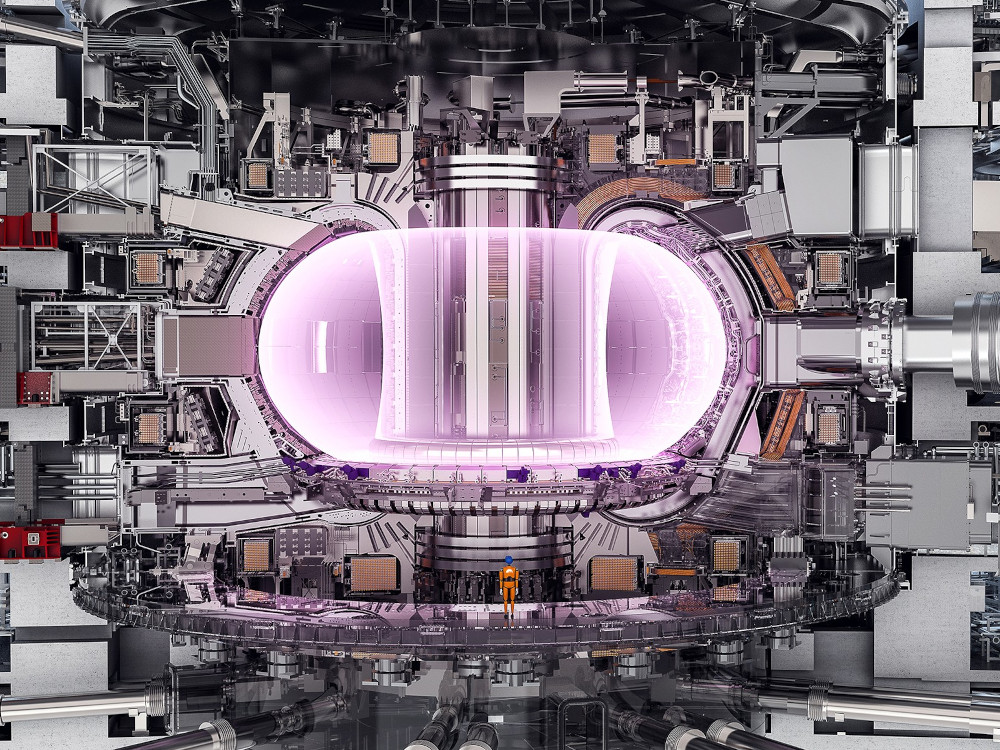
The world of nuclear fusion has witnessed what is being called “the most important thing in the last 30 years,” thanks to advancements in plasma capture technology, which is essential for nuclear fusion reactors like the ITER project in southern France. This remarkable progress hinges on the development of a super magnet capable of producing a permanently stable magnetic field with an impressive strength of 20 Tesla, dwarfing the short-lived 3 Tesla magnetic fields found in state-of-the-art magnetic resonance imaging (MRI) machines used in the medical field, and exponentially stronger than the Earth’s surface magnetic field which is around 0.00005 Tesla.
A critical aspect of achieving viable nuclear fusion is not just performance but efficiency as well. Energy surplus generation necessitates the use of a superconductor made from a new material known as REBCO, an acronym for rare-earth barium copper oxide. This innovative material does not require the extreme cooling conditions other superconductors do; functioning at 20 Kelvin (-423 °F / -253 °C) compared to the 3 Kelvin (-454 °F / -270 °C) of traditional superconductors. Although still incredibly cold, this represents a significant reduction in cooling requirements, analogously making capturing ninety instead of a full hundred chickens in a vast forest significantly easier.
The use of REBCO eliminates the need for costly insulation between cables, offering more leeway for improved cooling efficiency and optimal magnet placement. To validate this approach, the team constructed a robust 20,000-pound (9-ton) magnet, incorporating a full 200 miles of superconductor to match the scale necessary for actual implementation. The system’s performance during testing matched expectations, holding up to all stress tests and functioning successfully even in critical conditions such as power fluctuations and complete outages. While there may have been some melting, all test outcomes remained within anticipated parameters, lending confidence to the accuracy of computations and predicted material behavior.
The key takeaway from this groundbreaking project is that, in addition to the need for ample superconductive material, engineering a stable and efficient fusion reactor is within reach. This could symbolize a monumental leap forward in the quest for harnessing the power of nuclear fusion, offering a glimpse into a future powered by this promising technology.