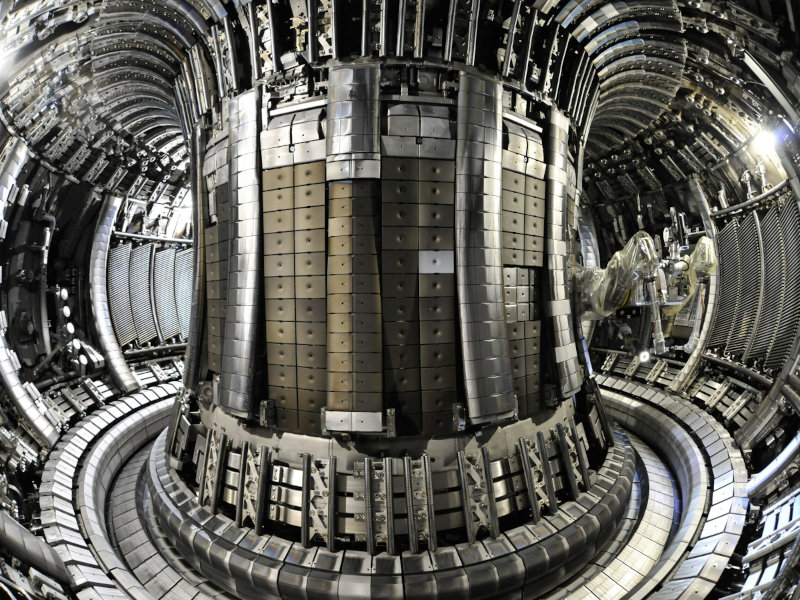
In a remarkable feat of scientific advancement, researchers at the Joint European Torus (JET) have made history by setting a new world record for energy yield in a magnetic fusion nuclear reactor. Utilizing just 0.2 milligrams of fuel, they managed to generate a staggering 69 megajoules of energy.
This latest milestone supersedes a previous achievement two years prior, where they produced 59 megajoules with the same minuscule amount of fuel. While the number might seem significant, to put it into perspective, it equates to about two days’ worth of electricity usage for a detached house or enough heat to warm up a room for a single day. Astonishingly, the deuterium and tritium fuel mix used in this process has the energy potency of 2 kilograms of brown coal.
When we consider the massive scale of global coal consumption, which was roughly 8.3 billion tons in 2022, the potential for nuclear fusion becomes even more compelling. This vast quantity, if combined, would form a cube with an edge length of 1.3 miles annually. Conversely, nuclear fusion would only need approximately 800 tons of fuel to satisfy the same global energy demands, creating a cube a mere 10 yards long at the same density.
The longevity of our planet’s deuterium and tritium reserves, which are extracted from a lithium isotope, is estimated to last for a millennium.
There are, however, still challenges to overcome before nuclear fusion can become a mainstream energy source. Generating the requisite plasma at JET consumes considerably more energy than is produced. Furthermore, the extraction of the essential fusion fuels is a complex process.
The JET fusion reactor located in Culham, southern England, is limited by its size and can only create so much plasma at any one time. This limitation is slated for change with the initiation of the ITER project, which stands for “the way” in Latin. ITER is designed with the ambition of achieving an energy surplus for the first time, based on extensive nuclear fusion research conducted globally.
Despite the exciting progress, the future of ITER, including its planning and construction, is still underway, without a clear schedule for its final completion and operation. The potential of nuclear fusion as a sustainable and powerful source of energy is evident, but its practical application still lies ahead on the horizon.