Phison Unveils PCIe Gen6 SSD Controller With Up to 28 GB/s Speeds and New AI Hardware Ecosystem
Phison is pushing storage performance into a new era with its latest PCIe Gen6 technology showcase. At Computex 2026, the company presented its next-generation SSD controller, new enterprise SSD designs, PCIe 6.0 signal solutions, and an in-house AI accelerator card built for future data center and AI workloads.
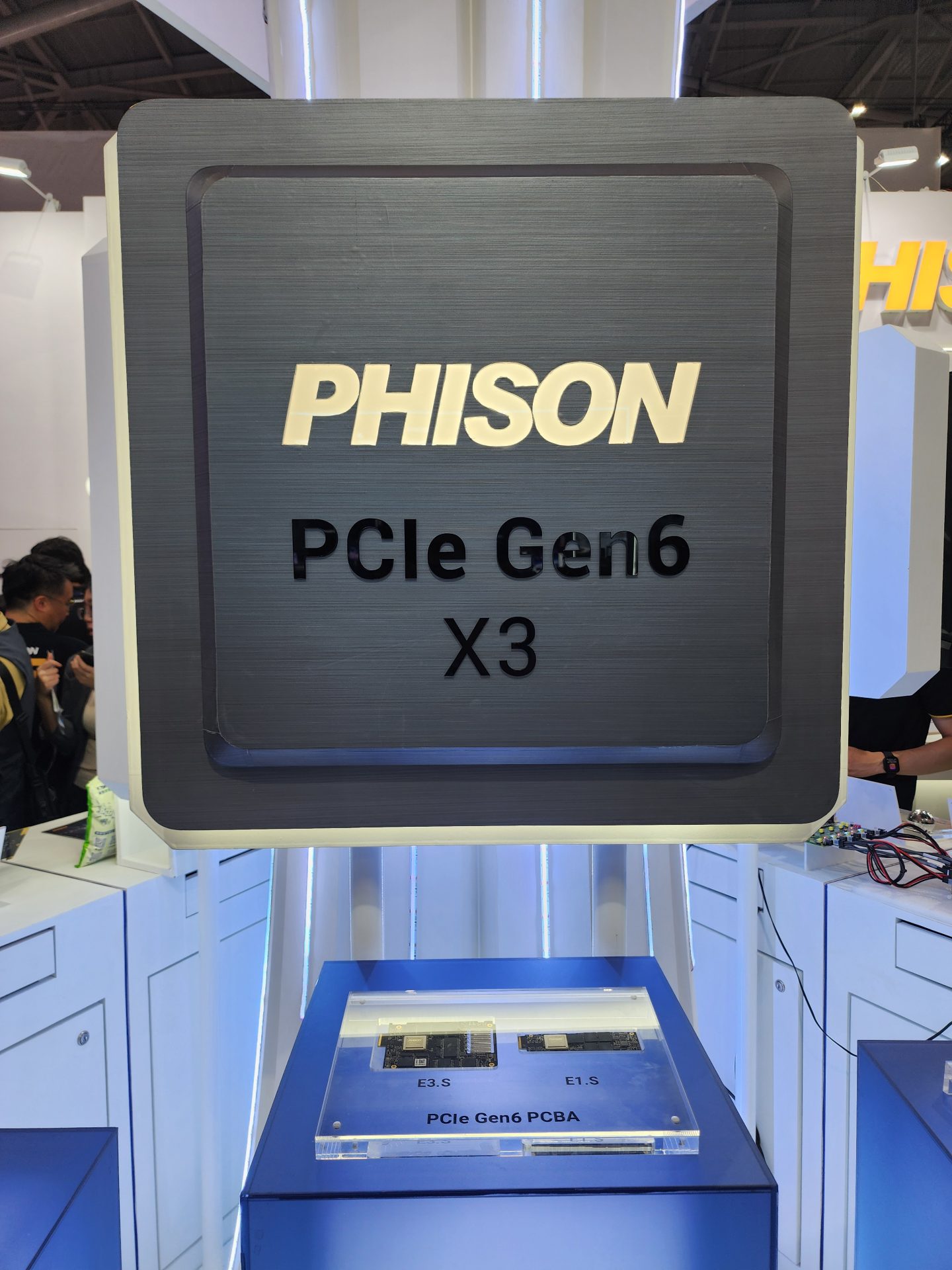
The highlight of the announcement is the Phison PS5303-X3-66, also referred to as the X3 controller. This is Phison’s first PCIe Gen6 SSD controller, designed to deliver twice the transfer rate of current PCIe Gen5 solutions. With AI servers, cloud platforms, and high-performance computing systems demanding faster data access, PCIe Gen6 storage is expected to become a major upgrade for next-generation infrastructure.
Phison also displayed early SSD products based on the new X3 controller. These drives are part of the Pascari PCIe Gen6 SSD family and will be available in E3.2 and E1.S form factors, both commonly used in enterprise and data center environments. The showcased drives include onboard DRAM and use SK Hynix H25T3TG88G DRAM modules.
The PS5303-X3-66 controller supports PCIe Gen6 x4 connectivity and the NVMe 2.3 standard. It is also compliant with OCP v2.6, making it suitable for large-scale server deployments. One of the most impressive claims is capacity support of up to 2 petabytes, positioning the controller for extremely dense storage systems.
Security is another major focus. The controller supports several enterprise-grade security technologies, including TCG Opal 2.3, DOE, IDE, Caliptra, and CNSA 2.0. It also supports SR-IOV with 64 physical functions, helping improve virtualization performance and resource sharing in modern data centers.
Performance figures are equally ambitious. Phison expects the X3 PCIe Gen6 SSD controller to reach up to 28 GB/s in sequential read and write speeds. Random read and write performance is projected to reach up to 6,800K IOPS. These numbers would place Phison’s PCIe Gen6 SSD platform well ahead of today’s fastest PCIe Gen5 drives.
Efficiency is also a key part of Phison’s pitch. The company says its upcoming fastest PCIe Gen6 SSDs will operate at around 7W while delivering major performance gains. Phison also highlighted the efficiency of its current PCIe Gen5 SSD solutions, claiming they can operate below 5W, specifically around 4.5W, while still reaching transfer speeds of 14.9 GB/s. By comparison, competing high-end Gen5 solutions are said to operate closer to the 7W to 8W range.
Beyond SSD controllers, Phison is preparing a broader PCIe 6.0 ecosystem. The company demonstrated new Retimer and Redriver ICs designed to improve signal quality and system stability at very high transfer speeds.
One of these products is the PS7261 PCIe 6.0 Retimer. This 16-lane Retimer supports real-time telemetry analysis, PAM4 eye diagram visualization, and LTSSM monitoring. These features are designed to help engineers evaluate signal quality, link stability, and system connectivity during high-speed PCIe 6.0 data transmission.
Phison also showed the PS7161 Linear Redriver. Developed in collaboration with Molex, this solution was demonstrated inside an Active Copper Cable. The goal is to extend high-speed transmission distance while maintaining signal stability, which is especially important for dense server systems and advanced AI infrastructure.
The company’s showcase did not stop at storage. Phison also revealed its in-house AI NPU chip, codenamed Topaz. The Topaz AI accelerator card uses a PCIe Gen6 x4 interface and includes eight Topaz NPUs on a single add-in card.
Each Topaz NPU is a quad-core neural processing chip manufactured on TSMC’s 6nm process. Each chip delivers up to 40 TOPS of AI compute performance and supports LPDDR5 and LPDDR5X memory at speeds of up to 8533 MT/s. With eight NPUs on one card, the full accelerator delivers up to 320 TOPS of AI compute performance.
Phison’s Computex 2026 showcase makes it clear that the company is preparing for a future where storage, connectivity, and AI acceleration are deeply connected. The PS5303-X3-66 PCIe Gen6 SSD controller targets extreme storage performance, while the company’s Retimer, Redriver, and Topaz AI hardware show a wider strategy aimed at next-generation servers, AI platforms, and high-performance computing systems.
As AI workloads continue to grow, faster storage and more efficient data movement will become increasingly important. Phison’s PCIe Gen6 platform is designed to meet that demand with higher bandwidth, better efficiency, stronger security, and a complete ecosystem built for the next wave of enterprise computing.