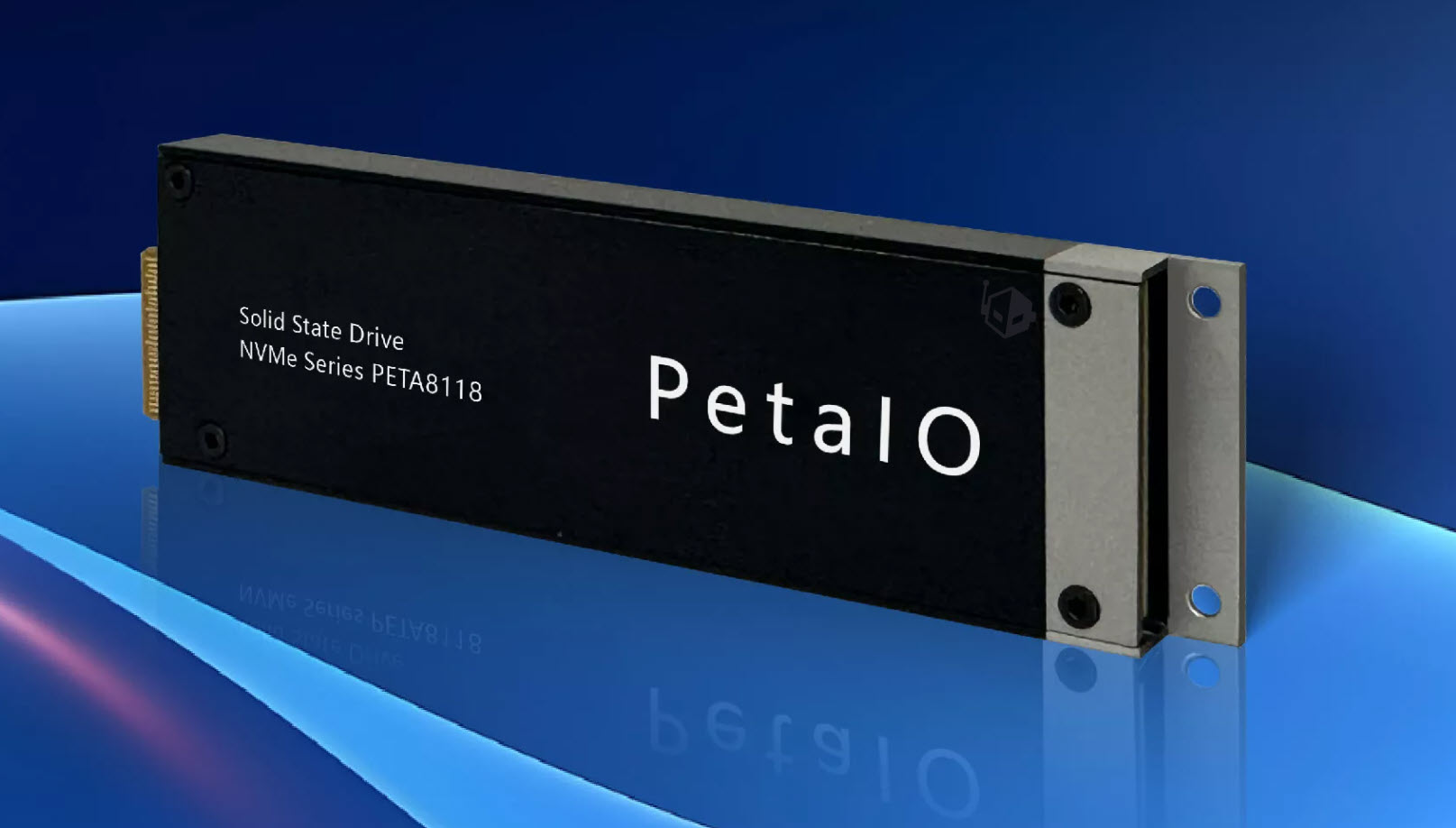
PetaIO, a storage solutions company based in Nanjing, China, has revealed plans for a new wave of next-generation PCIe Gen6 SSDs aimed squarely at data centers, AI infrastructure, and other high-performance enterprise workloads. The headline figure is speed: the company says its upcoming PCIe 6.0 drives are targeting sequential read performance beyond 28 GB/s, putting them in the top tier of what’s expected from the first Gen6 storage platforms.
The announcement surfaced around MemoryS 2026, where PetaIO positioned its upcoming SSD lineup as more than a simple bandwidth upgrade. The company is pairing PCIe 6.0 with AI-focused optimizations and CXL 3.0 compliance, reflecting a broader industry shift where storage, memory, and accelerators are increasingly designed to work together as a unified data pipeline for large-scale AI.
At the center of PetaIO’s Gen6 push is a new flagship SSD controller called Titanium Himalaya. According to the company, the controller is being developed on a 6nm process node and is designed to power PCIe Gen6 enterprise SSDs with a strong emphasis on both raw throughput and latency-sensitive, massively parallel AI access patterns.
Alongside the claimed 28+ GB/s sequential read bandwidth, PetaIO says Titanium Himalaya is optimized for AI inference and vector retrieval workloads, two areas where fast random access and consistent responsiveness can matter as much as peak sequential transfer rates. The controller is advertised as reaching up to 50 million IOPS for 512B random reads, with ultra-low latency stated at 2.7 microseconds. If these targets hold up in shipping products, the platform would be positioned for demanding scenarios like large-model serving, retrieval-augmented generation pipelines, and data-heavy GPU clusters where storage performance can become a bottleneck.
PetaIO also describes its broader direction as a combination of PCIe 5.0, CXL, and AI-oriented “memory semantic fusion storage” concepts. In practical terms, the company is pointing to CXL as a way to expand memory resources at high bandwidth—potentially enabling TB-scale memory expansion—while also providing extremely large storage pools. PetaIO mentions capacities up to 256 TB in the context of pooled, low-cost storage resources aimed at IDC and AIDC environments (traditional and AI data centers).
One of the core problems PetaIO is targeting is the so-called “memory wall,” where GPU compute capability can outpace the ability to feed models with data quickly enough. The company suggests its approach can support more efficient caching of key model data (such as KV cache) and better integration into high-performance networking environments, which are common requirements in modern AI clusters.
PetaIO hasn’t shared a firm release date or detailed product lineup yet. However, based on the positioning of the controller and the focus on enterprise AI infrastructure, the first PCIe Gen6 SSD solutions from the company appear to be timed for upcoming server and AI platform rollouts expected toward the end of the year.
With PCIe Gen6 SSDs shaping up as the next major jump in enterprise storage—especially for AI and hyperscale data centers—PetaIO’s announcement signals that domestic Chinese storage vendors are actively preparing to compete in the Gen6 era with controllers and platforms built for high bandwidth, extreme IOPS, and ultra-low latency.