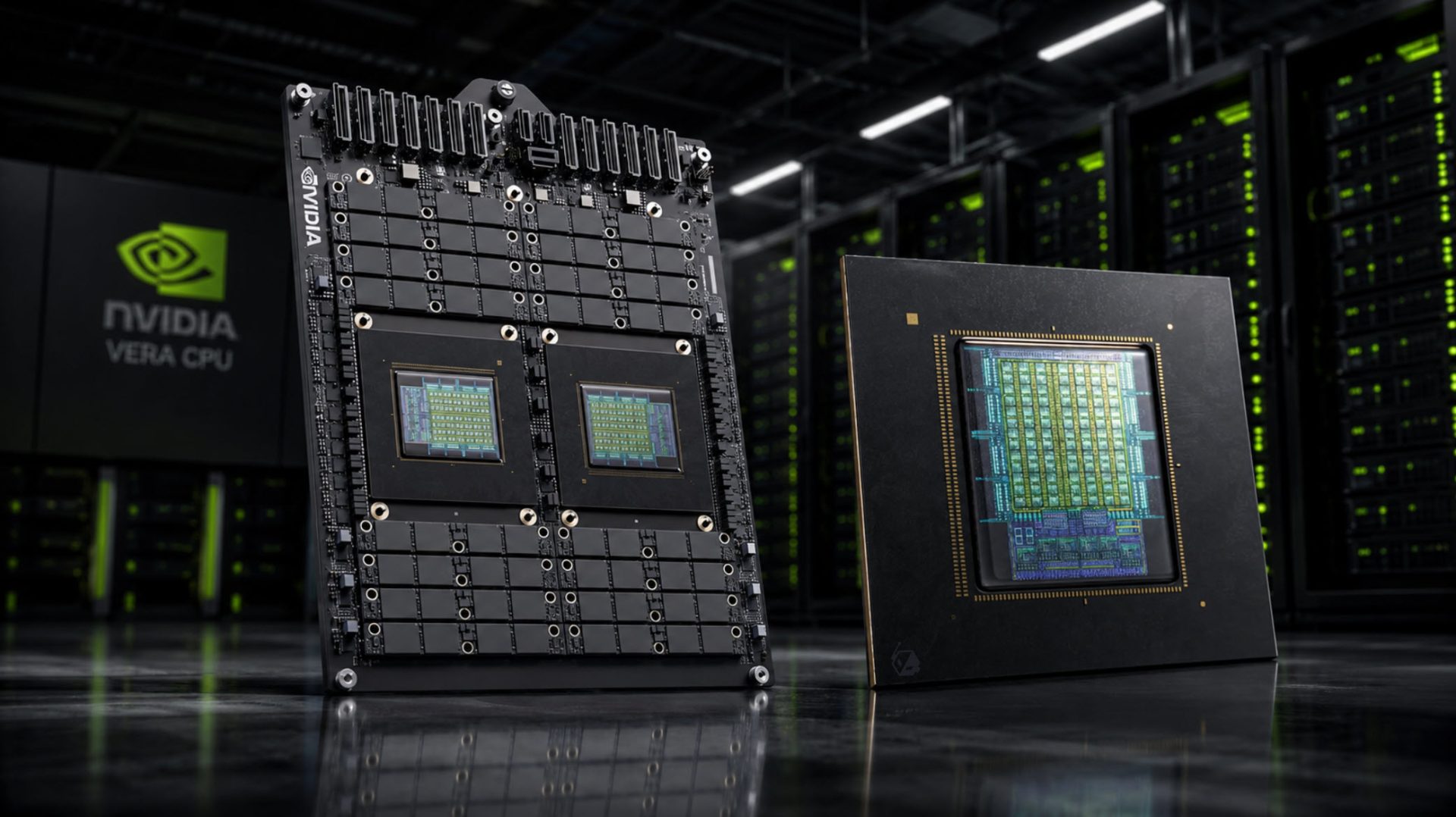
NVIDIA Vera CPU benchmarks show major performance leap over Grace and top server rivals
NVIDIA’s next-generation Vera CPU is already making waves in the server market, and early benchmark results suggest the company may be preparing for a much bigger role in data-center computing than ever before.
The new NVIDIA Vera processor, built around 88 custom ARM-based Olympus cores, has delivered a major performance jump over the company’s previous Grace CPU. In a broad set of early Linux server tests, Vera posted an average performance gain of 63% compared to the 72-core Grace processor. That is a significant generational upgrade and a strong sign that NVIDIA’s CPU ambitions are moving well beyond supporting its GPU platforms.
Vera is a key part of NVIDIA’s upcoming Rubin AI platform, which is designed for next-generation artificial intelligence workloads, including inference and agentic AI. The company has already said Vera CPUs are in full production, with early systems being delivered to major AI-focused companies such as OpenAI, SpaceX, Anthropic, and Oracle.
What makes Vera especially important is that NVIDIA is not positioning it only as a companion chip for AI accelerators. The company is also preparing to offer Vera as a standalone CPU product, placing it in direct competition with established data-center processors from AMD and Intel.
The first performance numbers are impressive. Across the tested workloads, the 88-core Vera CPU was not only 63% faster than Grace, but also came out 10% ahead of AMD’s EPYC 9575F, a 64-core Zen 5 server processor running at up to 5 GHz. Vera also showed a much larger advantage over Intel’s Xeon 6980P, a 128-core Granite Rapids chip, beating it by around 55% in the same overall performance comparison.
These results suggest NVIDIA’s custom ARM CPU design is becoming highly competitive in the server space. While x86 processors from AMD and Intel have long dominated enterprise and cloud computing, AI-driven workloads are changing the priorities of the market. Modern AI infrastructure needs powerful CPUs to feed accelerators, manage data movement, and handle complex inference workloads efficiently.
NVIDIA has claimed that Vera can deliver 50% better performance than Grace, twice the performance per watt, and four times the rack density compared with traditional x86 CPU systems. The early benchmark results appear to support the performance side of those claims, though one major question remains unanswered: power efficiency.
The initial tests did not include performance-per-watt data, reportedly because power measurements were not allowed to be published. That means it is still too early to fully judge how Vera compares to AMD EPYC and Intel Xeon chips in real-world efficiency. Since the tested Vera hardware was also described as early pre-production silicon, final retail or production systems may receive additional tuning for power use, thermal behavior, and overall performance.
Even with that limitation, Vera’s early showing is important. The processor demonstrates that NVIDIA can build a high-performance ARM server CPU capable of challenging some of the fastest chips currently available from traditional CPU leaders. If NVIDIA can pair this performance with strong efficiency and tight integration across its AI ecosystem, Vera could become a serious threat in the data-center CPU market.
The timing also matters. Demand for AI compute continues to grow rapidly, and CPUs are becoming increasingly important for agentic AI systems, inference servers, cloud platforms, and large-scale AI infrastructure. NVIDIA already dominates the AI accelerator market with its GPUs, and a competitive server CPU gives the company even more control over the full AI hardware stack.
However, the competition will not stand still. AMD is preparing its next-generation EPYC Venice processors based on the Zen 6 architecture, with a launch expected in the second half of 2026. Intel is also working on its Diamond Rapids server platform, while Qualcomm and Arm are developing their own data-center-focused CPU solutions for future AI workloads.
For now, NVIDIA Vera appears to be one of the most powerful ARM-based Linux server processors tested so far. If these early benchmark results translate into production systems, NVIDIA could soon become a much more influential player in the server CPU market, challenging AMD and Intel in a segment they have controlled for decades.


