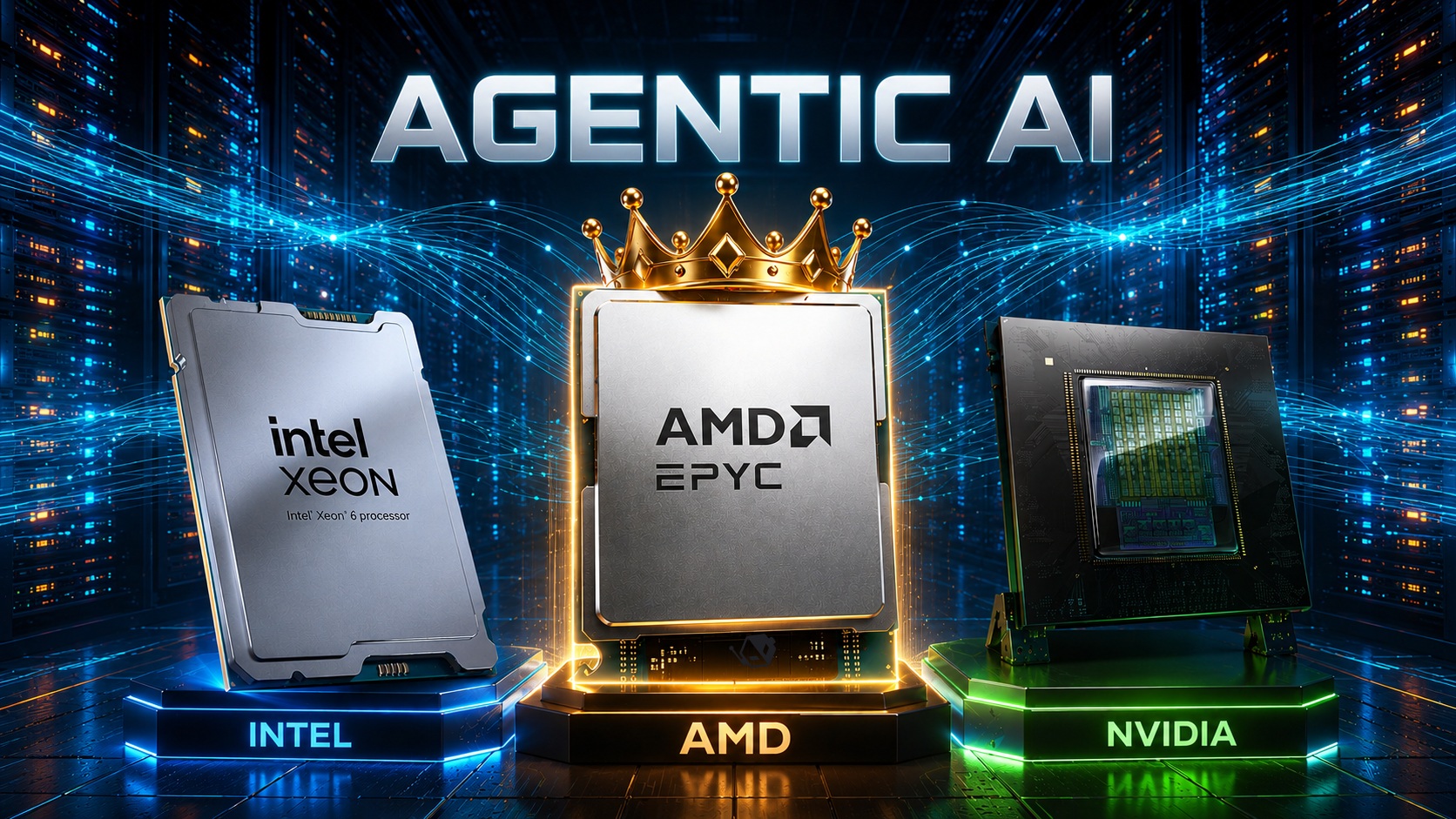
AMD EPYC Venice Benchmarks Point to Big Gains Over NVIDIA Vera and Intel Xeon in Agentic AI Workloads
AMD is turning up the heat in the AI server CPU race with fresh benchmark claims for its EPYC processors, including its next-generation Venice chips based on the Zen 6 architecture. According to AMD’s latest internal performance estimates, its current and upcoming EPYC CPUs deliver major rack-scale advantages over NVIDIA Vera and Intel Xeon processors in workloads tied to agentic AI infrastructure.
Agentic AI is becoming one of the biggest drivers of data center investment. As AI systems grow more autonomous and complex, hyperscalers and enterprise customers need massive CPU throughput to support multi-gigawatt AI factories, orchestration layers, databases, web services, caching, middleware, and other supporting workloads around GPU-heavy clusters.
That demand has created an intense battle between AMD, Intel, and NVIDIA. NVIDIA is expanding its CPU ambitions with Grace and Vera, Intel continues to push Xeon for AI infrastructure, and AMD is leaning heavily on the success of its EPYC server CPUs. AMD has already begun mass production of its next-generation Venice EPYC lineup, which will use Zen 6 cores and target high-density AI and cloud deployments.
In its latest performance comparison, AMD modeled a 100kW rack-level scenario to show how its EPYC platforms scale against competing CPU solutions. The company compared two AMD platforms against Intel and NVIDIA offerings:
AMD EPYC 9965, based on Turin, with 192 Zen 5 cores
Next-generation AMD EPYC Venice, based on Zen 6, with 256 cores
Intel Xeon 6980P Granite Rapids-AP, with 128 cores
NVIDIA Vera CPU, with 88 Olympus cores
AMD tested performance across several enterprise and AI-adjacent workloads, including general-purpose compute, Java server-side throughput, web serving, key-value storage, in-memory caching, analytics, and relational database processing.
The workloads used in AMD’s comparison included SPEC CPU 2017 Integer Rate, a SPECjbb2015-derived Java workload, NGINX web serving with WRK, redis-benchmark, Memcached with memtier_benchmark, and TPROC-C on MySQL as an OLTP database proxy.
Based on AMD’s estimates, the current EPYC Turin platform already delivers a major lead. AMD claims its Turin-based EPYC CPUs provide up to 2.37 times the performance of NVIDIA Vera and around 1.6 times the performance of Intel’s Granite Rapids-AP Xeon in these rack-scale agentic AI workloads.
The projected advantage grows even larger with Venice. AMD estimates that its next-generation 256-core Zen 6 EPYC processors can deliver up to 3.30 times the performance of NVIDIA Vera in the same 100kW rack model. AMD also notes that Intel’s Granite Rapids-AP still shows a 1.46 times advantage over NVIDIA Vera in its comparison.
The key point AMD is making is that higher core density within a fixed power envelope can translate directly into greater throughput. For AI data centers, this matters because not every workload runs on GPUs. Large-scale AI systems still rely heavily on CPUs for transactional processing, data movement, web services, caching, scheduling, storage coordination, and middleware.
Rack-scale density is another major part of AMD’s argument. The company says its current EPYC platforms can deliver more than 27,000 cores at rack scale, while the upcoming Venice generation is projected to exceed 36,000 cores. By comparison, AMD says NVIDIA Vera-based rack-scale systems offer around 22,500 cores.
That gives AMD a claimed density and value advantage, with 2.18 to 2.90 times more cores per socket while operating at approximately 1.18 to 1.41 times the system power. In short, AMD is positioning EPYC as a stronger option for customers that want maximum CPU throughput in a constrained power and rack footprint.
AMD is also emphasizing single-threaded performance. While core density is crucial for large-scale throughput, single-core speed still matters for latency-sensitive and lightly threaded workloads. AMD claims its 64-core Venice processors can deliver a 27% per-core performance advantage over NVIDIA’s 88-core Vera configuration. The company also projects that 96-core Venice models can offer an 11% single-core performance lead over Vera.
These numbers are AMD’s own internal estimates, so they should be viewed with the usual caution until independent testing becomes available. Still, the message is clear: AMD wants to show that x86 server CPUs remain highly competitive in the AI era, especially in the infrastructure layers surrounding accelerated AI systems.
NVIDIA’s Vera CPUs are expected to become a serious challenger in the server CPU market, particularly as NVIDIA pushes deeper into full-stack AI platforms. However, AMD is arguing that EPYC continues to offer strong advantages in density, throughput, power efficiency, and per-core performance for rack-scale AI deployments.
AMD is also preparing more CPU options for the agentic AI market, including inference-optimized EPYC solutions designed to improve cost efficiency. One such platform is expected to use LPDDR5X memory, which could help AMD broaden EPYC adoption in AI inference and data center environments where bandwidth, efficiency, and total cost are key buying factors.
With Turin already shipping and Venice moving toward next-generation deployments, AMD is making a clear pitch to AI infrastructure buyers: EPYC is not just a general-purpose server CPU family, but a central building block for the next wave of agentic AI data centers.