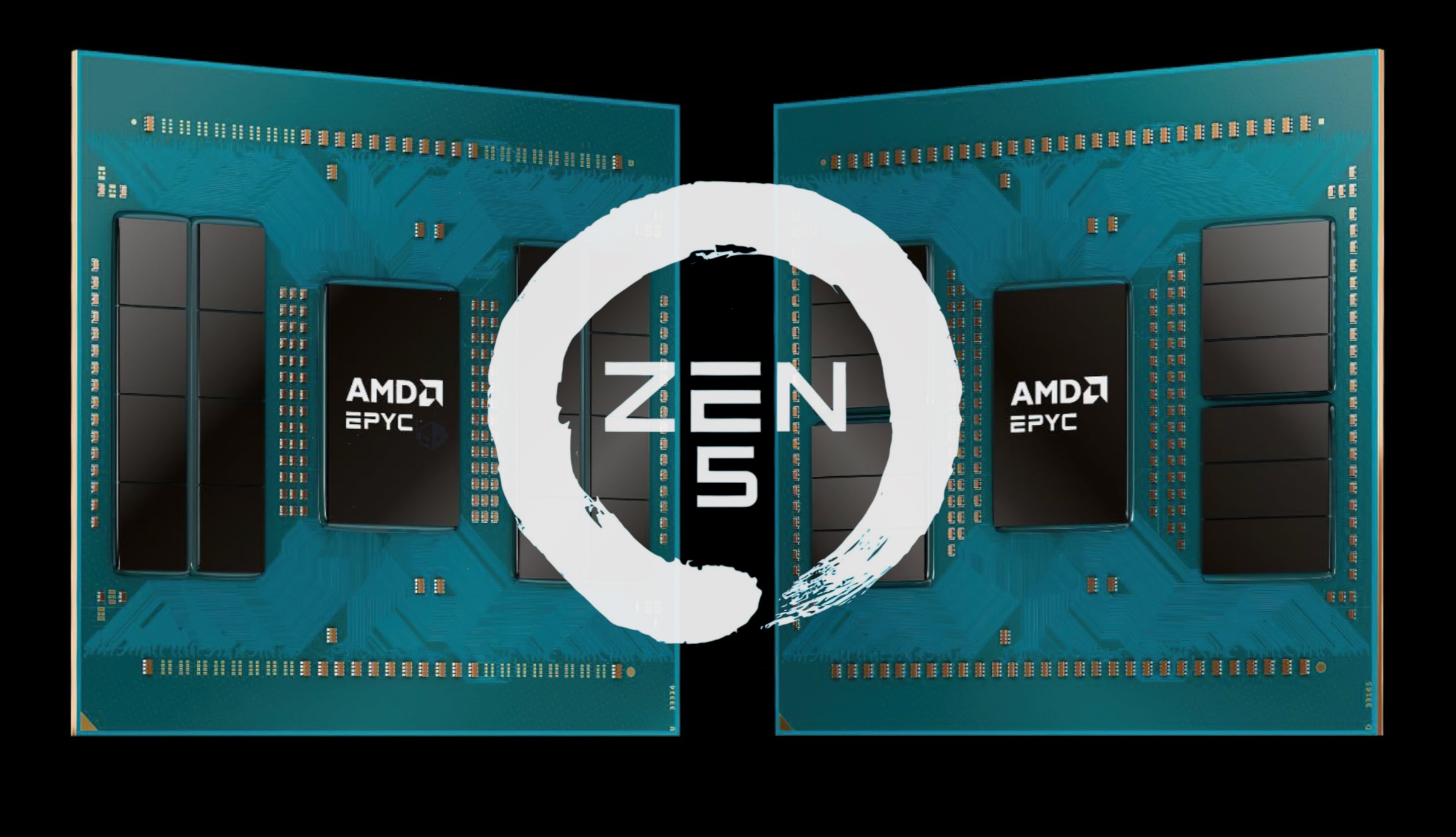
AMD has unveiled its latest powerhouse in the data center arena: the 5th Gen EPYC CPUs, known by the intriguing codename “Turin.” This launch marks a significant leap forward in server technology, powered by the cutting-edge Zen 5 core architecture. AMD continues its tradition of delivering impressive generational upgrades, further strengthening its position in the highly competitive data center segment.
Since the debut of its EPYC series, AMD has made a remarkable journey, capturing over a third of the server market share, a notable climb from a mere 2% in 2018. With the EPYC CPUs becoming the go-to choice for over 950 cloud instances and 350 OEM platforms, it’s no wonder tech giants globally are turning to AMD for their computing needs.
The 5th Gen EPYC “Turin” family, part of the EPYC 9005 series, aims to achieve three primary objectives: solidify its server CPU dominance, drive efficient modernization, and establish an AI leadership platform from start to finish. To reach these lofty goals, AMD is harnessing the power of its latest Zen 5 core architecture.
The Turin lineup is divided into two main solutions. The first is a 4nm variant utilizing up to 16 Zen 5 Compute Core Dies (CCDs), offering as many as 128 cores and 256 threads. This “Scale-Up” version is designed for high-performance tasks, while the “Scale-Out” variant incorporates 3nm Zen 5C cores with up to 12 CCDs, reaching an impressive 192 cores and 384 threads.
One of Turin’s standout features is its capacity to integrate up to 17 chiplets, packing a whopping 150 billion transistors. These chips include AVX-512 support with a comprehensive 512-bit data path and clock speeds reaching up to 5 GHz. Additionally, the CPUs can be configured in one-processor (1P) or dual-processor (2P) servers to tailor to diverse infrastructure needs.
AMD claims a substantial improvement in instructions per clock (IPC), with Zen 5 offering a 17% surge for Enterprise and Cloud platforms and an impressive 37% jump for High-Performance Computing (HPC) and AI operations compared to the previous generation.
At the pinnacle of the lineup, the EPYC 9965 boasts 192 cores and a mammoth 384 MB of L3 cache, priced strategically at $14,813—significantly undercutting Intel’s equivalent offering. Meanwhile, the EPYC 9755, equipped with 128 cores and 512 MB of L3 cache, sells for $12,984, marking a distinct economic advantage over Intel’s alternatives.
AMD also presents frequency-optimized variants with core counts ranging from 8 to 64 cores. For instance, the EPYC 9575F features 64 cores and can achieve speeds up to 5 GHz, catering to tasks that require fewer cores but higher frequency.
The EPYC CPUs are also designed for seamless upgrades, utilizing the same SP5 socket as their predecessors, allowing a straightforward transition for those currently using the Zen 4 series. Memory configurations continue to impress with 12-channel memory support, speeds up to 6400 MT/s, and capacities reaching 6 TB per socket, ensuring cutting-edge performance across a variety of workloads.
Security remains paramount for AMD, with innovative features like Trusted I/O, FIPS 140-3 certification in progress, and Hardware Root-of-Trust support. This makes the Turin family not only powerful but also secure for enterprise-level applications.
Performance-wise, AMD’s 5th Gen EPYC CPUs outshine their competitors across various benchmarks, boasting a 2.7x lead over Intel’s 5th Gen lineup in the SPEC CPU 2017 Integer Throughput tests. AMD showcases remarkable gains in video transcoding, business applications, databases, and image rendering, demonstrating the Zen 5 architecture’s versatility and strength in handling modern-day computing demands.
With Turin, AMD cements its place at the forefront of server technology, delivering unparalleled performance and efficiency, setting a new standard for what data center CPUs can achieve. As AMD forges ahead, it’s clear that the future of data centers is not just powerful but also efficient and secure, paving the way for new technological advancements and innovation.High-Performance Computing (HPC) tasks are receiving a significant boost with the release of the new AMD EPYC 9965x processors. These performance jumps are evident in applications such as Ansys LS-DYNA, Altair Radioss, Ansys Fluent, and Altair AcuSolve. Notably, in Dense Linear Solver and Modeling & Simulation workloads, the EPYC 9965x showcases a performance improvement ranging from 2.1 to 3.9 times when compared to Intel’s Xeon CPUs, and over twice the performance of AMD’s previous 4th generation EPYC “Genoa” CPUs.
In the realm of Artificial Intelligence (AI), AMD highlights a substantial uptick in performance, attributed largely to the AVX-512 512b capabilities. These enhancements offer up to a 3.8 times increase in AI computational power. Additionally, the faster EPYC 9575F model, operating at 5 GHz, promises a 28% increase in speed for GPU orchestration tasks.
AMD continues to assert its leadership in Total Cost of Ownership (TCO) efficiency with the new Turin line. This latest EPYC offering is geared towards data centers aiming to modernize efficiently. AMD states that organizations can potentially scale down from 1000 older server units to just 131 new servers powered by the EPYC 9965 CPUs without sacrificing performance. This consolidation offers a seamless transition while maintaining compatibility with the existing x86 architecture, robust tools, and a mature ecosystem.
The benefits of the AMD EPYC Turin platform extend further, providing up to 68% savings in power consumption, an 87% reduction in server space, and a 67% decrease in TCO over three years. This space-saving can be redirected to enhance AI and computational capacities by over 1.1 million AI TOPs with just 416 GPUs and by providing a 2.5 times compute performance gain from the new 640 CPU racks.
AMD’s EPYC processors are also being positioned as a key component in AI hosting for both AMD Instinct and NVIDIA MGX/HGX platforms. Configurations featuring the EPYC 9575F 5 GHz chip show promise with up to a 20% boost in AI inferencing and a 15% improvement in AI training tasks. For NVIDIA integrations, MGX solutions can house up to 16 AI accelerators, while HGX solutions can feature up to 8 accelerators paired with as many as two EPYC CPUs.
The alliance between AMD and NVIDIA highlights a collaborative effort to pair AMD’s computing prowess with NVIDIA’s accelerators, offering configurations with 32, 48, and 64-core EPYC CPUs to maximize performance.
In summary, the 5th Generation EPYC “Turin” processors from AMD are set to disrupt the market once again, delivering exceptional performance and value. While AMD has not yet released performance benchmarks against Intel’s Xeon 6900P series, further details are anticipated to emerge as both processors become more accessible in the marketplace. This launch appears poised to redefine industry standards and propel advancements in computing capabilities.