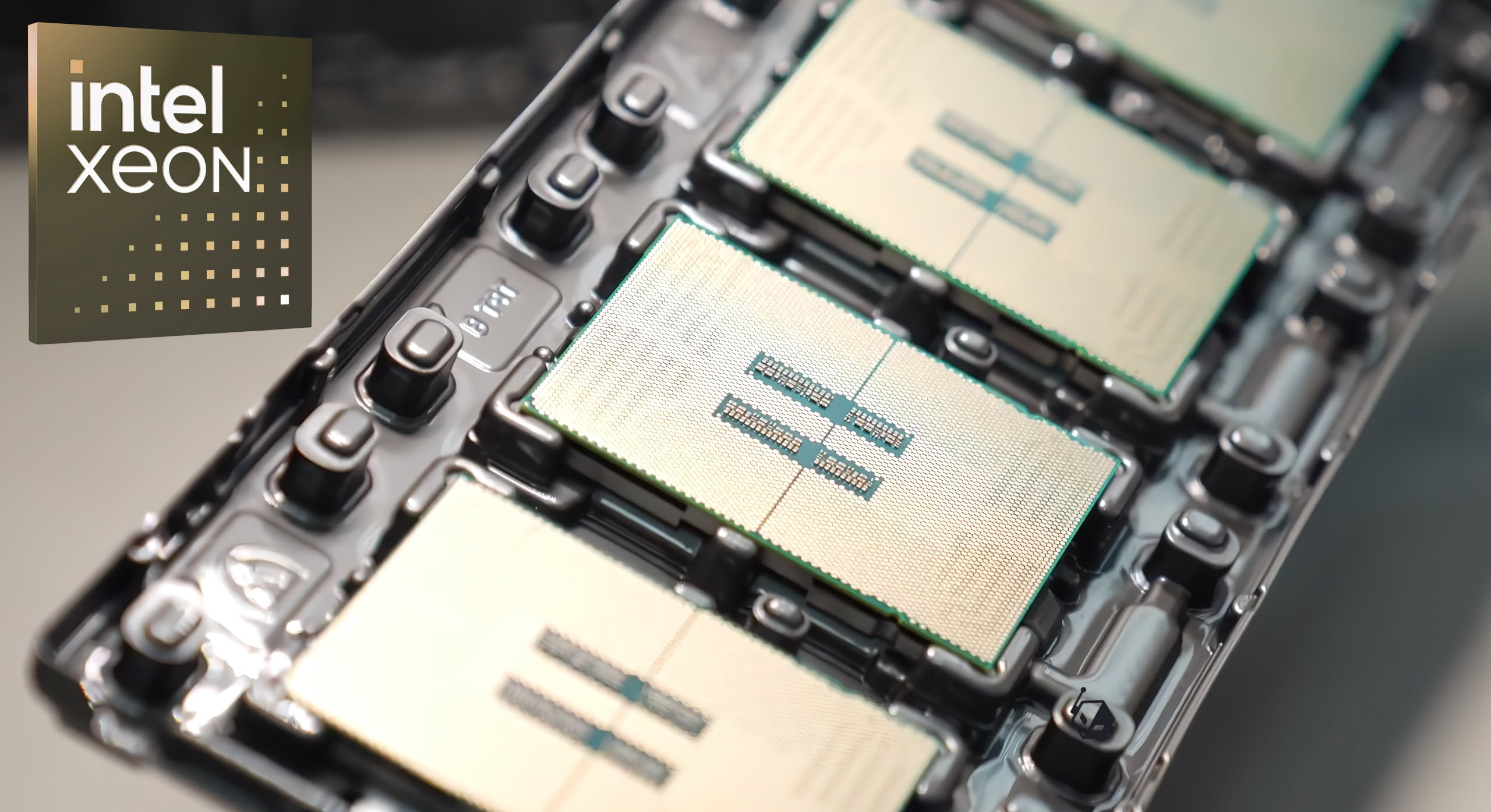
Intel is primed to upgrade the data center market with its upcoming Xeon 6900P “Granite Rapids” CPU, a powerhouse equipped with 120 performance cores (P-Cores) and a generous cache setup, as revealed in recent benchmark sightings.
Intel Xeon 6900P “Granite Rapids”: A Glimpse into the Future of Computing
The latest discovery from benchmark databases unveils Intel’s formidable next-gen Xeon processor, codenamed “Granite Rapids.” According to the data, this CPU boasts a staggering 120 cores and 240 threads, and it’s designed for dual-socket platforms, doubling this count when utilized to its full potential.
A Closer Look at the Xeon 6900P Specifications
Specific details reveal that the Xeon 6900P “Granite Rapids” CPU comes with an impressive setup— 240 MB of L2 cache and 504 MB of L3 cache total to a robust 744 MB combined. Compared to its predecessor—the Emerald Rapids—this represents a significant leap in memory cache, which is essential for improving data retrieval speeds and overall performance. The contrast in cache capacity among different Xeon generations showcases Intel’s commitment to enhancing data processing capabilities:
– Granite Rapids (Top Configuration): 128 Cores, 256 Threads, with 504 MB L3 and 256 MB L2 cache.
– Emerald Rapids (Top Configuration): 64 Cores, 128 Threads, with 320 MB L3 and 128 MB L2 cache.
– Sapphire Rapids (Top Configuration): 56 Cores, 112 Threads, with 105 MB L3 and 112 MB L2 cache.
Engineering Sample Insights
The Xeon 6900P spotted is an engineering sample, which typically means it’s a pre-final-release version used for testing and development. The sample was clocked at a base frequency of 1.80 GHz, lower than its planned base clock of 2.10 GHz detailed in other leaks. It’s important to note that engineering samples may not perform at the same level as the release version of a CPU, as they are not yet fully optimized.
Powering Dual-Socket Platforms
The Geekbench discovery shows the CPU in action on a dual-socket platform with two CPUs, which effectively scales the computing resources to an impressive 240 cores, 480 threads, and a total of almost 1.5 GB of cache. Such a configuration demands considerable power, speculatively around 1000W for the two processors. The reference evaluation platform supports a substantial 2 TB of memory along with the latest DDR5 modules, hinting at the massive memory bandwidth and speed the system can handle.
Competition and Release Timeline
Intel’s Xeon 6900P series aims to compete head-to-head with AMD’s offerings, including their next-gen Turin CPUs, which will come in 128-core Zen 5 and 192-core Zen 5C variants. Intel is prepared to square off against AMD’s standard Zen 5 SKUs with Granite Rapids and plans to take on the 192-core Zen 5C SKUs with another chipset, Sierra Forest, which will offer up to 288 cores. The introduction of the Xeon 6900P “Granite Rapids” CPUs is highly anticipated this quarter, and industry observers are eagerly waiting for further announcements.
Potential Xeon 6900P CPU Options
Several configurations for the Granite Rapids processors have been mentioned, spanning various core counts, base clock speeds, cache sizes, and thermal design power (TDP) ratings:
The introduction of the Xeon 6900P “Granite Rapids” CPU signifies a major stride forward in processor technology for data centers. With its substantial core count and cache configuration, it’s poised to set new benchmarks in enterprise computing efficiency and capability. The tech world is watching as Intel prepares to unleash its next-generation Xeons, eagerly anticipating the impacts on cloud computing, artificial intelligence, and large-scale data analytics.