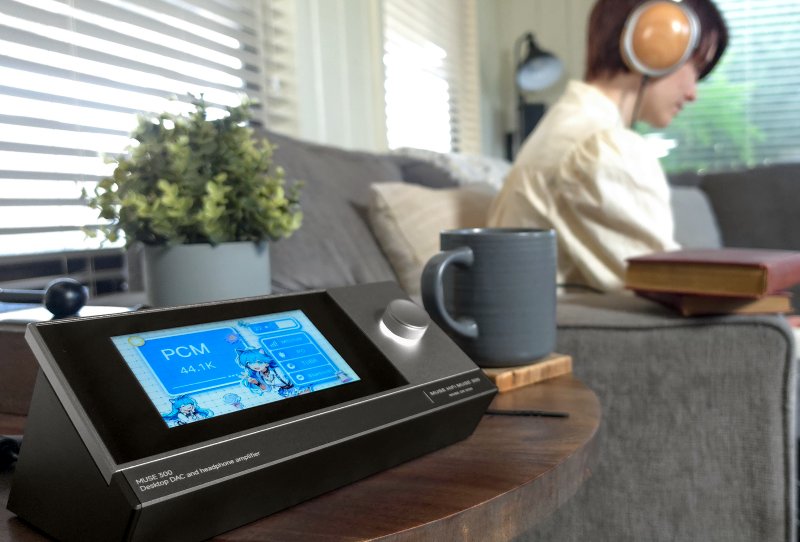
Muse HiFi is preparing to launch the Muse 300, a desktop DAC and headphone amplifier that could become one of the most eye-catching audio products for enthusiasts in 2026. Shown at CanJam Singapore, the device has already drawn attention for its unusual combination of high-end audio hardware, a built-in operating system, and a large color display.
The Muse 300 is being promoted as the world’s first desktop DAC/headphone amplifier with a dedicated operating system. Instead of relying on traditional vacuum tubes, it aims to recreate a tube-like listening experience through hardware tuning. That could make it especially appealing to listeners who enjoy the warmth and character of tube audio but prefer a more modern, compact, and maintenance-free desktop setup.
One of the most noticeable features is its 5-inch IPS display with a 480 x 854 resolution. This screen is designed for interacting with Muse OS, the device’s built-in interface. At launch, Muse OS is expected to include three visual themes, giving users some customization options right out of the box. More themes may be added later, depending on future software development.
Interestingly, the display is not only for device controls. It can also function as a secondary screen for a connected computer, adding an extra layer of usefulness beyond audio playback. For users who like desktop gear that blends performance with visual appeal, this could be a major selling point.
The Muse 300 also comes with a strong list of internal components aimed at serious headphone users and desktop audio fans. Its main controller is a 32-bit Microcontroller Unit, while digital-to-analog conversion is handled by an ES9039 Ultra DAC. The I/V conversion stage uses ES9603X2, while the low-pass filter section includes two OPA1612 chips. Amplification is managed by two TP6120A chips, and sampling uses NE5532A.
For connectivity, the Muse 300 supports USB, coaxial, optical, and Bluetooth inputs. Output options include RCA and dual XLR line outputs, along with 6.35mm and 4.4mm headphone outputs. It also includes an SA9137L USB controller, QCC3095 Bluetooth, and an AK4118 coaxial interface.
This combination of features positions the Muse 300 as more than just another desktop DAC amp. It is clearly aimed at audiophiles who want modern connectivity, flexible outputs, a polished interface, and a distinctive sound signature inspired by tube amplification.
The device is currently in the pre-launch stage for a Kickstarter crowdfunding campaign. Pricing and final availability details have not yet been confirmed, but more information should arrive once the campaign goes live.
For those who do not want to wait, the FiiO K11 remains a popular and affordable alternative in the desktop DAC/headphone amplifier category. It supports USB, coaxial, and optical inputs, offers up to 2 Vrms through RCA line-out, and can deliver up to 1400 mW under a 32-ohm balanced load. With 300-ohm headphones, it can provide up to 250 mW through its balanced output.
Still, the Muse 300 stands out because of its operating system, large IPS display, secondary-screen functionality, and promise of tube-style audio without actual tubes. If Muse HiFi delivers on its claims, this could become one of the most interesting desktop DAC/headphone amplifiers for audiophiles looking to upgrade their listening space.