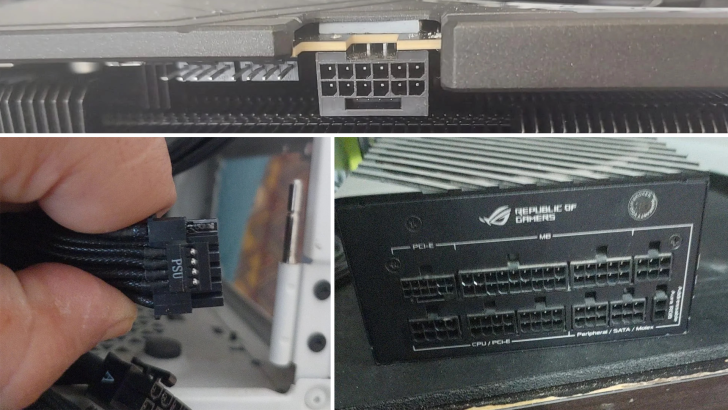
A Reddit user recently shared some startling images that have tech enthusiasts buzzing: a melted 16-pin power connector on his power supply unit (PSU). This incident involved the NVIDIA GeForce RTX 5080, marking one of the first occurrences of such an issue with this particular GPU model. Previously, similar cases were reported with the more power-intensive RTX 5090, but seeing this with the RTX 5080 has raised eyebrows.
The user, known on Reddit as Ambitious_Ladder1320, detailed his experience in the ASUS community, revealing that his setup included the RTX 5080 paired with an ASUS ROG Loki PSU. Alarmingly, his graphics card began flashing a red light, signaling a connection problem. Despite confirming the connectors were seated correctly, he decided to power down and recheck the setup.
While his computer seemed to rectify the error temporarily, he noticed the monitor’s resolution and refresh rate had decreased, and the GPU started behaving unusually, operating in PCI-E x3 mode. Upon another inspection, he discovered the 16-pin connector on the PSU had melted. Fortunately, the GPU remained unaffected in this instance.
This isn’t an isolated case, as the user recounted witnessing three other incidents involving the ROG Loki PSU. However, it’s unclear if those cases also involved the 12VHPWR connector or the same NVIDIA GPUs. The ROG Loki PSU has been noted in previous RTX 5090 cases, but recent analyses, such as those from hardware expert Der8auer, suggest the culprit might be overheating connectors due to an excessive power load exceeding the wires’ capacity.
The design and quality of the 12VHPWR connector are under scrutiny, with many pointing out its insufficient headroom for handling higher power levels. Consequently, this leads to overheating and potential melting of the cables and connectors. There’s ongoing chatter about these design challenges across tech communities, especially as the RTX 5090 and RTX 5080 aren’t yet widely adopted.
Interestingly, the upgraded 12V-2×6 connector, another 16-pin variant intended for these high-performance GPUs, has not reported similar issues. Until a more robust solution is found, users will be keeping a close eye on any developments related to these power connectors. As these incidents continue to surface, it’s clear that ensuring a reliable connection system is crucial for the safety and performance of high-power GPUs.