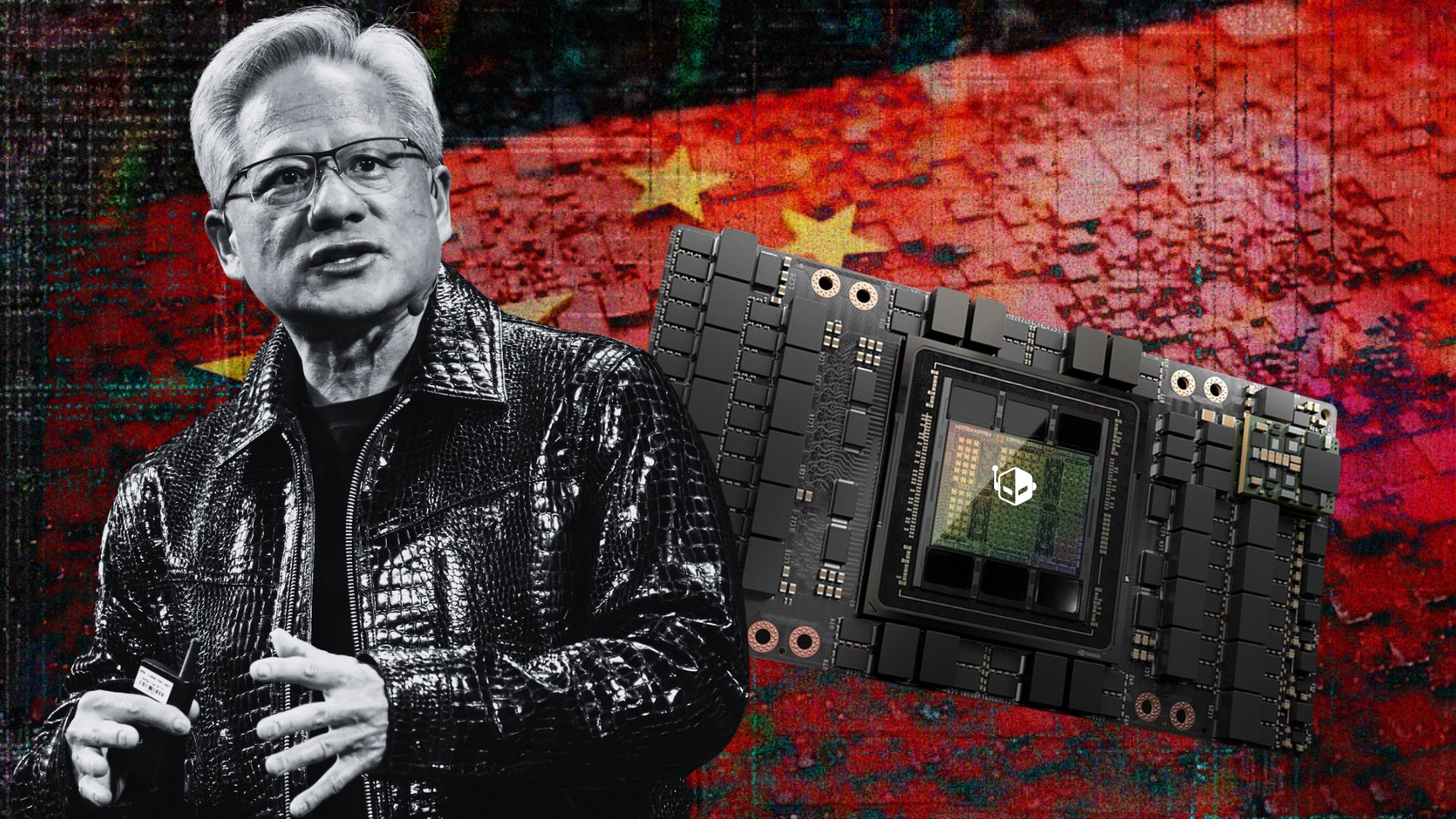
NVIDIA Reportedly Eyes a New China AI Chip Built Around Groq LPU Technology
NVIDIA is looking for a new way to protect its massive business in China as U.S. export restrictions continue to reshape the global AI hardware market. With Chinese companies facing limits on which advanced AI accelerators they can buy, and Beijing reportedly discouraging some firms from relying on certain NVIDIA GPUs, the company appears to be exploring a different strategy: a China-focused AI inference chip that uses Groq’s Language Processing Unit technology.
The goal is straightforward but difficult. NVIDIA wants to offer Chinese customers a competitive AI chip while staying within U.S. export control rules. That means the product must avoid restricted specifications, especially around high-bandwidth memory and advanced packaging, while still delivering enough performance to remain attractive for artificial intelligence workloads.
According to recent reporting, NVIDIA is working on a new chip designed specifically for AI inference in China. The chip is expected to be ready by the end of the year and may incorporate Groq’s LPU architecture, a technology built for extremely fast and predictable language model processing.
Why Groq’s LPU technology matters
Groq’s Language Processing Units are different from traditional GPUs. While GPUs are highly flexible and powerful for training and running AI models, LPUs are designed with a sharper focus on inference, the stage where an already-trained AI model generates responses, predictions, or outputs.
The LPU approach relies on clusters of specialized chips. Each chip contains large Matrix Multiply and Vector units, along with around 230MB of ultra-fast SRAM. One of the key design differences is that model weights can be stored directly in this SRAM, reducing the need for traditional memory caching and helping data move through the system with very low latency.
Another major distinction is how the chip handles scheduling. Groq’s LPU does not depend on typical hardware schedulers or branch predictors. Instead, its compiler maps out operations ahead of time with extreme precision. In simple terms, the system knows exactly what needs to happen and when, allowing data to arrive at the right place at the right time.
This makes the architecture especially useful for AI inference, where speed, consistency, and efficiency are critical. For companies running large language models, chatbots, recommendation engines, and other AI services, inference performance can be just as important as raw training power.
A China-specific chip could help NVIDIA stay relevant
NVIDIA has long dominated the AI accelerator market, but China has become an increasingly complicated region for the company. U.S. export controls have restricted the sale of some of NVIDIA’s most advanced chips to Chinese customers, forcing the company to create modified versions that comply with the rules.
However, compliance alone does not guarantee demand. If a China-approved chip is viewed as too limited, customers may turn to domestic alternatives. At the same time, if the chip is too powerful, it risks falling outside U.S. export guidelines.
That is why an inference-focused design could be important. Instead of trying to replicate the full capabilities of its most advanced data center GPUs, NVIDIA may be aiming to deliver a product that is optimized for real-world AI deployment. Many companies do not need the most powerful training chip for every task. They need efficient hardware that can run AI models quickly and at scale.
By combining NVIDIA’s ecosystem strength with Groq’s LPU technology, the company could create a product that fits into a narrow but valuable market segment: high-performance AI inference that remains compliant with export restrictions.
China’s domestic chip industry is moving fast
NVIDIA’s reported shift comes as China’s semiconductor sector accelerates efforts to reduce reliance on foreign technology. U.S. restrictions have created major obstacles, but they have also pushed Chinese companies to develop new designs, new architectures, and alternative manufacturing strategies.
SMIC, China’s leading domestic foundry capable of producing chips in the 7nm-class range, has become a key player in this environment. The company recently reported strong business momentum, with capacity utilization reaching 93.7 percent. Its latest quarterly revenue reached $3.01 billion, up 36.1 percent year over year, while net profit nearly tripled to $479.2 million.
That growth reflects strong local demand. As access to foreign advanced chips becomes more uncertain, Chinese technology companies are increasingly looking inward for supply. This gives domestic foundries and chip designers a major opportunity, even if they still face challenges in areas such as advanced lithography, high-end packaging, and leading-edge process nodes.
Chinese companies are also developing creative AI chip alternatives
Alibaba has introduced the XuanTie C950, a server-grade 64-bit RISC-V processor aimed at edge AI and other demanding workloads. Unlike conventional AI systems that rely heavily on GPUs, the XuanTie C950 uses 64 compute cores on a single piece of silicon. These cores can scale up to 3.20GHz and are arranged in clusters linked by high-speed AMBA CHI fabric.
To support AI workloads, the chip includes matrix and vector acceleration engines directly inside the processor. This design reduces dependence on external GPUs and gives Alibaba a more self-controlled path for AI computing.
Another Chinese chip effort, DFSX’s DF1000, takes a different approach. Built on a mature 14nm process, it uses a 3D near-memory compute architecture. In this design, memory is stacked directly above the compute layer and connected through 3D wafer-level hybrid bonding. This allows data to move vertically between memory and compute units at extremely high speed, reducing bottlenecks that typically slow down AI workloads.
DFSX is also preparing the DF2000, expected in the fourth quarter of 2026. This chip is said to expand the idea further with a 3.5D Infinity Chiplet layout, placing multiple stacked memory-compute structures side by side on a base layer. It also uses a custom 3D DRAM design to hold more temporary data close to the compute units, potentially improving efficiency for AI processing.
China is also pushing into lithography equipment. Shanghai Aishegna, a relatively secretive company, has reportedly entered the DUV lithography market and plans to produce a small number of machines this year, followed by a larger batch next year. While DUV is not the most advanced lithography technology, domestic progress in this area could still help China strengthen its semiconductor supply chain.
Why this matters for the AI chip market
The global AI hardware race is no longer just about who has the most powerful GPU. It is also about efficiency, compliance, supply chain control, software ecosystems, and the ability to serve specific workloads. AI inference is becoming one of the most important areas of competition because companies need to run models continuously and cost-effectively after they are trained.
For NVIDIA, China remains too large to ignore. But the company must now operate under tight regulatory limits while facing a faster-growing domestic Chinese chip industry. A new China-focused AI inference chip using Groq LPU technology could give NVIDIA a way to stay competitive without crossing export-control boundaries.
For Chinese customers, such a chip could offer a practical middle ground: stronger inference performance than many local alternatives, while still being legally available. For NVIDIA, it could help preserve market share in one of the world’s most important AI regions.
The bigger picture is clear. U.S. restrictions are changing the shape of the semiconductor industry, but they are not slowing demand for AI computing. Instead, they are pushing companies to rethink chip design, memory architecture, packaging, and regional supply strategies.
If NVIDIA’s reported China-specific inference chip arrives by the end of the year, it could become one of the most closely watched AI hardware launches in the region. It may also show how the next phase of the AI chip war will be fought: not only with bigger GPUs, but with specialized architectures built for speed, efficiency, and regulatory survival.


