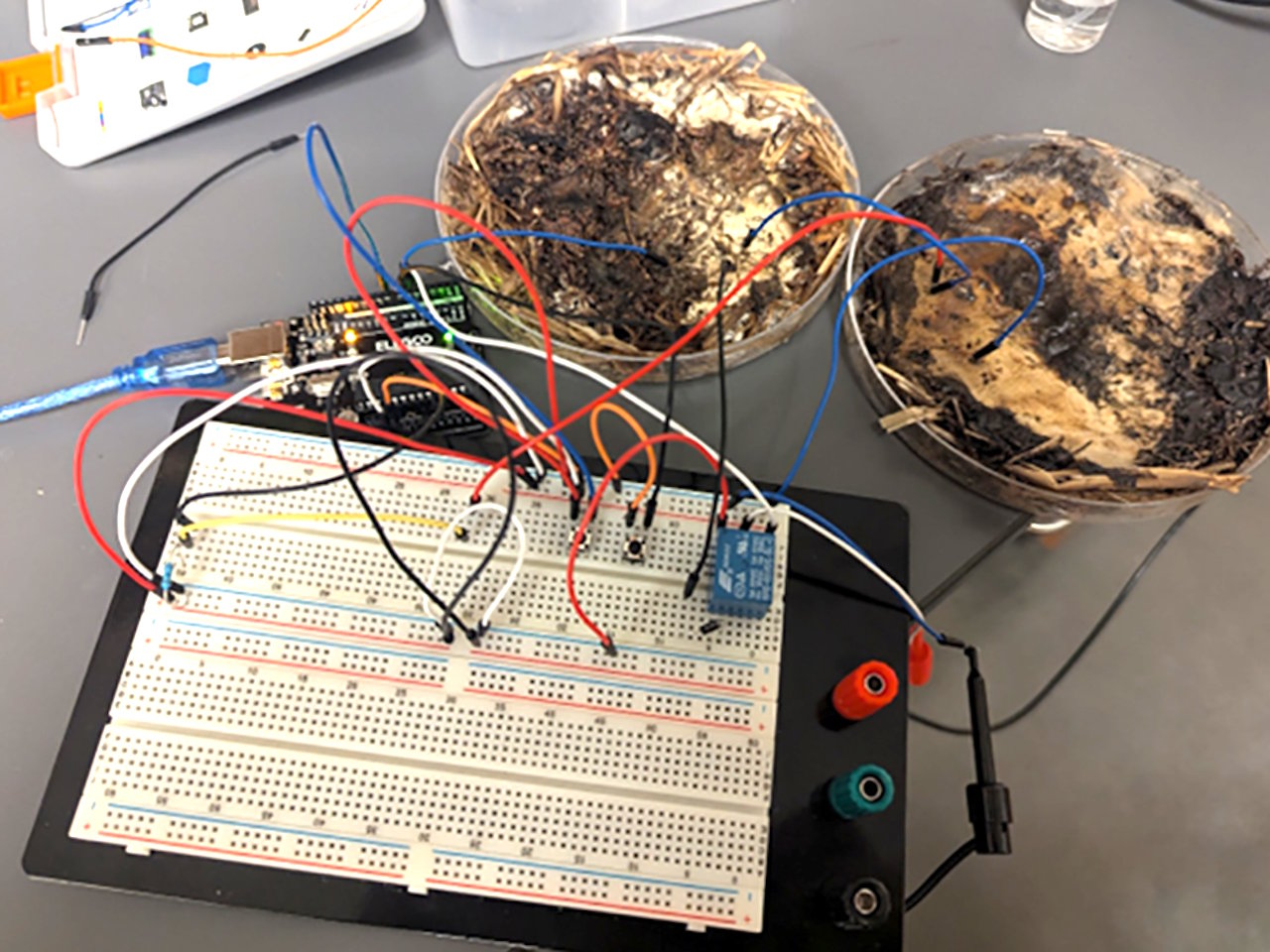
Mushrooms as memory? Researchers at Ohio State University have shown it’s not science fiction. By tapping into the natural conductivity of shiitake mycelium and pairing it with a simple Arduino setup, the team demonstrated mushroom-based memristors—non-volatile memory elements that can store and retain information without power. The project received partial funding from the Honda Research Institute.
Here’s how they did it. The team cultivated four large shiitake mushrooms from spores in a growth-optimized culture, then dehydrated them into round discs after seven days of direct sunlight. The dried mushrooms were later reactivated with a light mist of aerosolized, deionized water to awaken their conductive mycelium networks. Those porous, threadlike structures inside the fungi can conduct and hold electrical charge—exactly what a memristor needs to work.
An Arduino UNO microcontroller, a few resistors, wires, and a basic test circuit provided the read/write interface. The board fed square and sine wave inputs into the rehydrated mushroom discs and read states back at 56k baud. Performance varied with signal type, voltage, and frequency: overall readout accuracy ranged from 46 to 95 percent, with a 10 Hz, 5 V sine wave delivering the best results. In single read/write trials, accuracy landed between 88 and 96 percent—impressive numbers for a living, biodegradable material.
Why this matters goes beyond novelty. Traditional silicon memory contributes to e-waste and often requires toxic materials in manufacturing and disposal. Fungal memristors are organic and potentially compostable, offering a path toward sustainable electronics, low-power sensors, and even future neuromorphic computing concepts. The study ran for less than two months, so long-term data retention and device lifespan remain open questions, but the early results point to a promising, eco-friendly alternative to conventional memory cells.
Curious makers may be tempted to tinker. In principle, a microcontroller such as an Arduino UNO or UNO R4, basic passive components, dried shiitake discs, and deionized water are enough to explore the effect. Anyone experimenting should keep the setup low-voltage, avoid mains electricity, work clean to prevent contamination, and treat the mushrooms as electronic components rather than food once used in a circuit.
From spore to storage, this unusual blend of biology and electronics hints at a future where parts of our computing stack could grow on a shelf and return harmlessly to the earth when their job is done. And for science fiction fans, yes—the idea of information racing through mycelium networks might sound familiar. This time, it’s happening on a workbench.