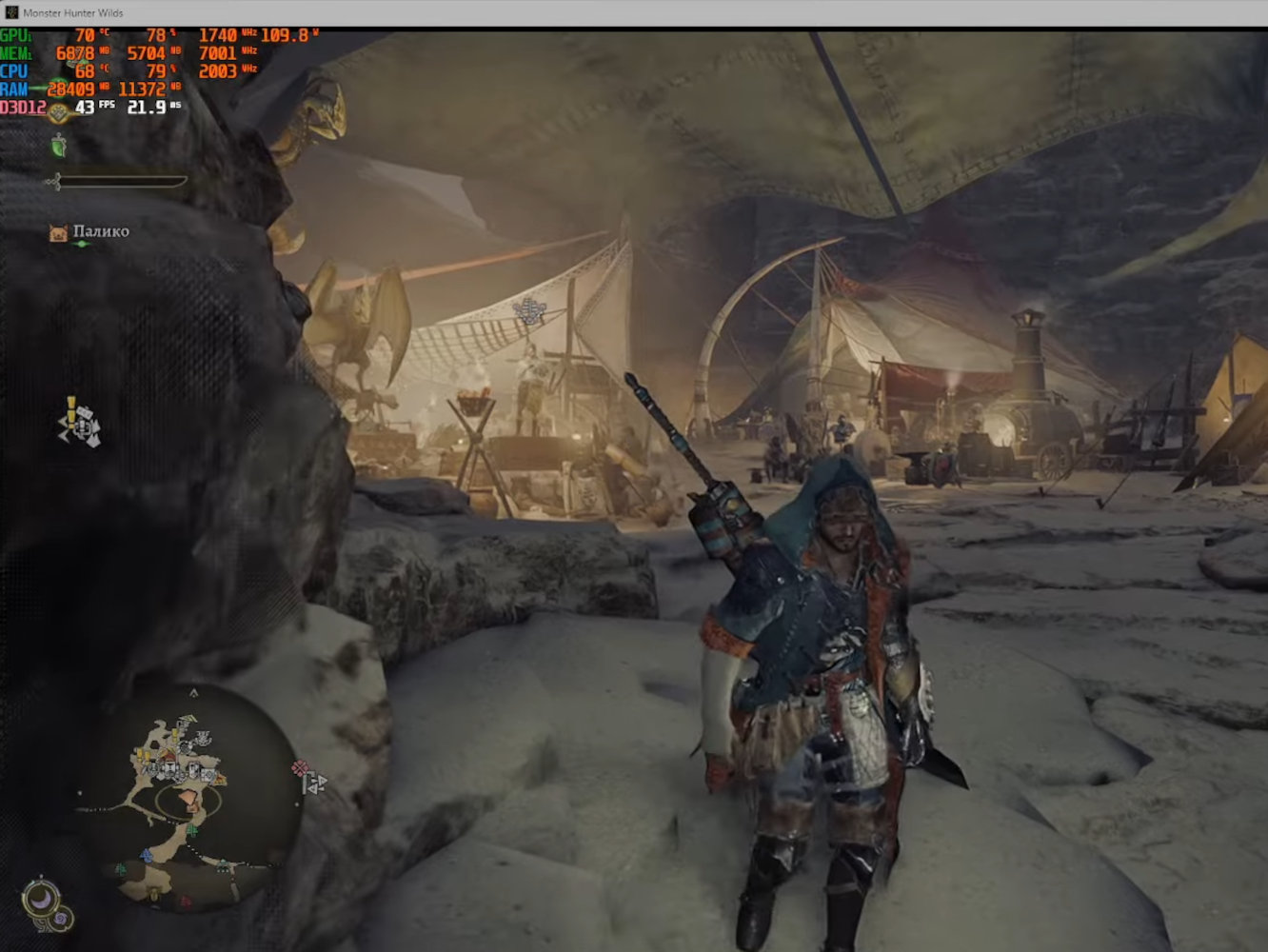
A surprising Monster Hunter Wilds PC performance discovery is making waves in the community: higher frame rates may be tied to the game’s always-on DLC ownership checks. In other words, what looks like a routine background verification system could be quietly dragging down performance for players who don’t own every add-on—while those with all DLC installed may see a major FPS boost at the exact same settings.
Monster Hunter Wilds is a full-price release, but it also includes multiple optional DLC packs and microtransactions. To manage that content, the game uses a DLC verification process to confirm what each player owns. The issue, according to user testing shared by Redditor u/de_Tylmarande, is that this DLC checking appears to run continuously in the background instead of only when needed. The strangest part is that the process reportedly stops only when a player owns all available DLC, which may explain why some players are seeing significantly smoother performance than others on identical hardware.
The discovery came after u/de_Tylmarande compared results with friends running the game on the same laptop. Using the same graphics settings, their copy of Monster Hunter Wilds consistently performed about 20–30 FPS better. After narrowing down what was different, the standout factor wasn’t drivers or settings—it was DLC ownership. His friend had all the DLC, and the higher performance seemed to follow.
To test whether this was real and repeatable, he benchmarked performance in a densely populated village area, both with and without a mod designed to disable DLC presence checks. Without the mod, the game averaged roughly 25 FPS, sometimes hitting the mid-30s. With the fix enabled, the same area on the same settings reportedly jumped to an average above 50 FPS, occasionally touching 60 FPS and rarely dipping below 50. That’s the kind of improvement that can turn Monster Hunter Wilds on PC from choppy and frustrating into genuinely playable.
If accurate, it’s a huge red flag—not necessarily because performance was intentionally “paywalled,” but because a background verification routine may be behaving inefficiently and punishing players who simply don’t own every add-on. The result is an unusual and uncomfortable situation where buying all DLC could indirectly act like an optimization toggle by stopping the repeated checks.
u/de_Tylmarande also claims he previously shared an FPS-related fix with Capcom for Dragon’s Dogma 2 and didn’t receive credit after a later patch, but says he has forwarded the Monster Hunter Wilds findings to the same contact as before. If the developer can reproduce the issue internally, an official patch could potentially deliver the same performance improvements to everyone—without requiring a mod or additional purchases.
For now, players hoping to try the workaround will need to wait. The mod is still in development and described as “not ready for public testing,” though the author says he’ll keep working on it in case an official fix doesn’t arrive. Others discussing the situation have compared it to past performance problems caused by unnecessary repeated file parsing in other major PC games. If this turns into a widely confirmed issue, it could become one of those community fixes that ends up being considered essential for PC players, especially early in a game’s lifecycle.
There is at least one encouraging detail: the demo setup shows the mod being used with a common RE Engine-friendly mod manager, suggesting that if a public release happens, installation may be relatively straightforward for players used to modding Capcom titles.
For Monster Hunter Wilds fans looking for the best PC performance, this developing story is worth watching closely. If the DLC check behavior is truly responsible for massive FPS drops, an official optimization patch could be one of the most impactful updates the game receives.