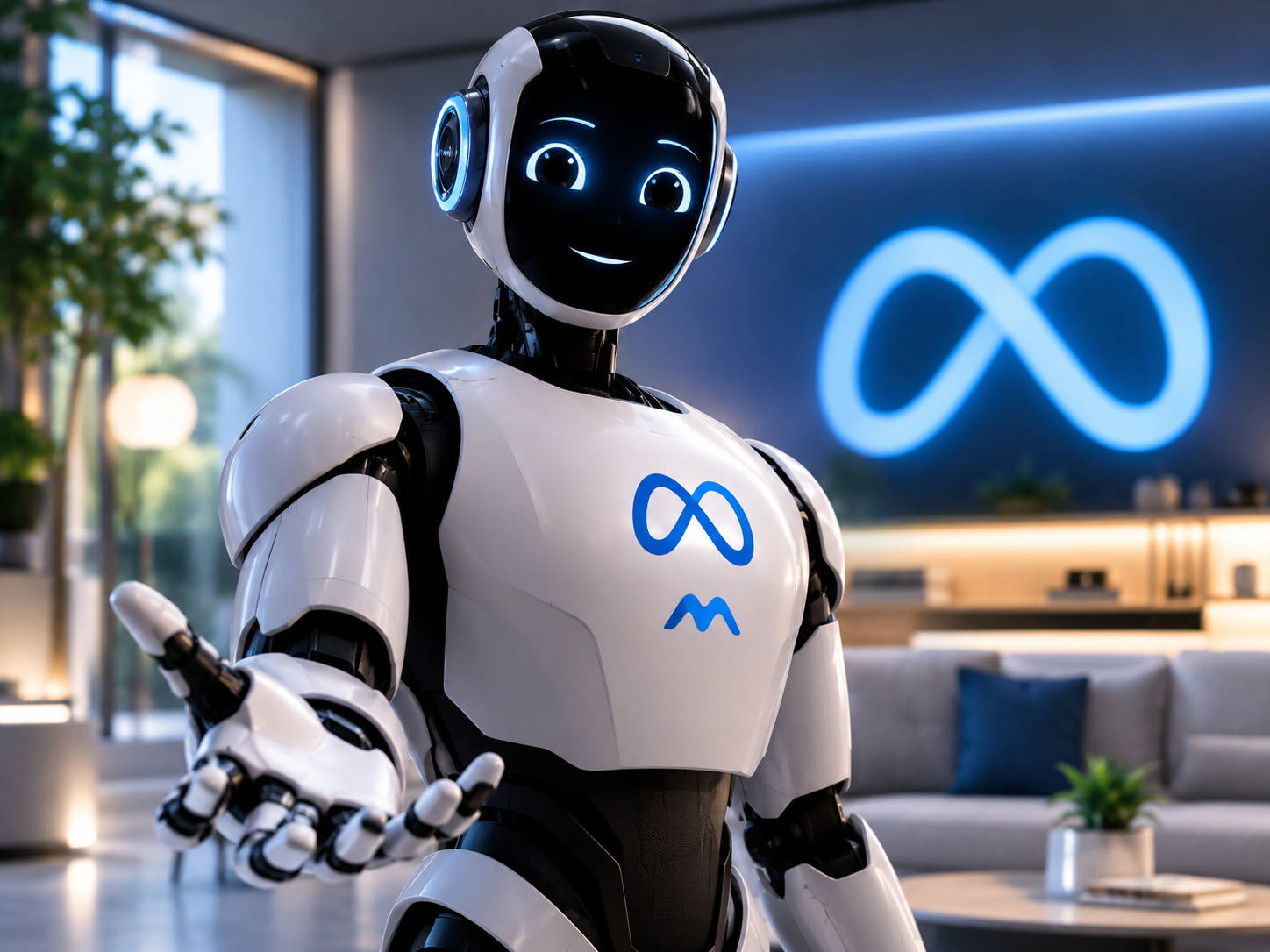
Meta is reportedly moving closer to a future where AI assistants do more than answer questions on a screen. The company has developed a humanoid robot prototype with help from Chinese robotics firm Fourier, signaling a major step toward bringing artificial intelligence into the physical world.
The robot, internally known as Max, is said to weigh around 48 kilograms, or about 106 pounds. It was reportedly built in just three months and uses Fourier’s robotics hardware along with Nvidia’s Jetson Thor chip, a platform designed for advanced AI and robotics tasks.
Max is not just a basic walking machine. The prototype reportedly includes five-fingered hands capable of grabbing smaller objects, along with a face display that can imitate human-like expressions. A second version is already said to be in development, with expected upgrades including better hand movement, improved sensors, and more refined physical interaction.
The bigger story is not the robot itself, but what Meta may want it to become. The company has been investing heavily in AI, and humanoid robotics could give its digital assistant technology a body. Internally, Meta’s leadership has reportedly discussed humanoid robots as a possible physical form for Muse AI, turning a software-based agent into something that could eventually perform real-world tasks.
That vision points toward a future where an AI assistant might not only schedule appointments or summarize messages, but also help around the home. A humanoid robot could potentially pick up objects, move through rooms, respond to people with facial cues, and carry out practical chores. For companies racing to define the next era of artificial intelligence, robotics represents one of the most ambitious frontiers.
Still, the road from prototype to useful household robot is extremely difficult. A machine designed for real homes must understand messy, unpredictable environments. It needs to recognize objects accurately, handle fragile items safely, avoid obstacles, balance reliably, and make decisions without constant human guidance. These are challenges even the most advanced robotics companies are still trying to solve.
Today’s humanoid robots often look impressive in short demonstrations, but real-world usefulness remains limited. Walking smoothly, grasping objects naturally, and operating safely around people are all far more complex than they appear. For Meta, creating a convincing AI-powered robot assistant would require major progress in both hardware and software.
The partnership with Fourier also adds another layer of complexity. By working with an established robotics company, Meta can move faster and avoid building every component from scratch. Fourier already has experience developing humanoid robot platforms, which could help Meta test its AI systems in a physical machine more quickly.
However, relying on outside robotics hardware may raise questions, especially when the partner is based in China. Connected robots can collect sensitive data through cameras, microphones, sensors, and remote software systems. In the United States, concerns around foreign-made connected devices have grown, particularly when security, privacy, and remote access are involved.
For now, Max appears to be an experimental prototype rather than a consumer product. But the project shows that Meta is thinking beyond apps, chatbots, smart glasses, and virtual worlds. The company appears to be exploring how AI could eventually become present in daily life through machines that move, see, respond, and act.
If Meta can combine its AI models with capable robotics hardware, the result could be a new kind of assistant: one that exists not only on a phone or headset, but in the home itself. That future is still far away, but Max may be an early sign of where the AI race is heading next.


