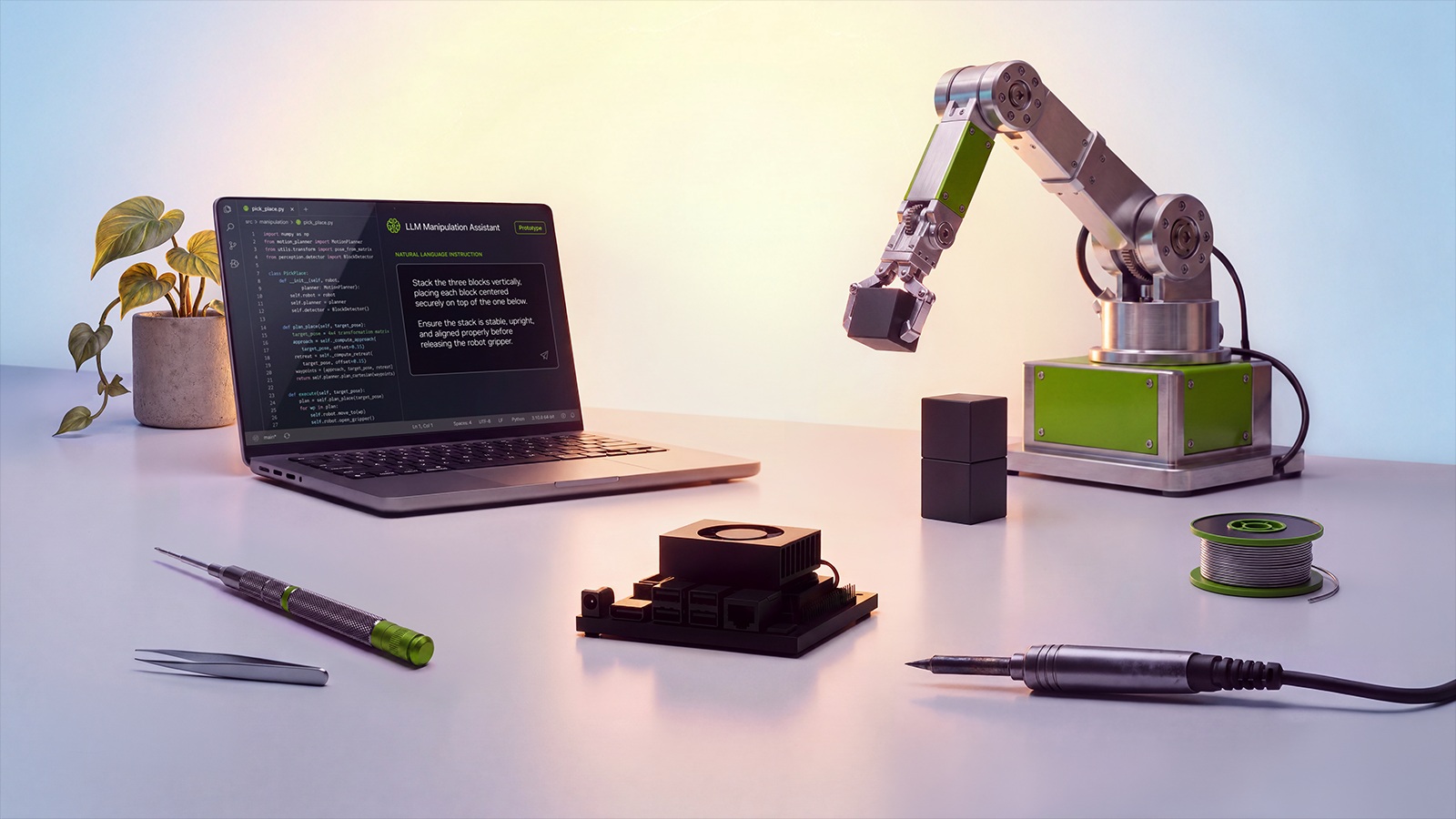
NVIDIA Jetson Orin Nano 2 Brings Faster Edge AI Performance to Robotics Developers
NVIDIA has introduced the Jetson Orin Nano 2, a new entry-level edge AI platform built to bring stronger generative AI and robotics performance to developers working on compact, power-efficient systems.
The Jetson lineup has become an important part of NVIDIA’s push into physical AI, robotics, smart machines, and embedded computing. With the Jetson Orin Nano 2, NVIDIA is targeting developers who need more AI performance at the edge without moving to larger, more expensive hardware.
The new Jetson Orin Nano 2 keeps the same compact form factor while delivering a major performance jump. It is based on NVIDIA’s Ampere architecture and features an 8-core Arm CPU, 8 GB of LPDDR5x memory, and 120 GB/s of memory bandwidth. These specifications make it suitable for robotics, vision AI, autonomous machines, intelligent cameras, and other edge AI applications that require fast local processing.
One of the biggest upgrades is the new 40W power profile, which allows the Jetson Orin Nano 2 to reach up to 78 TOPS of AI performance. That is roughly double the AI compute performance of the previous generation, giving developers more room to run demanding AI workloads, including generative AI models, real-time vision processing, and multimodal robotics applications.
NVIDIA says the performance uplift comes from improved Tensor Core performance and higher memory bandwidth while keeping the same general platform size. This makes the Jetson Orin Nano 2 especially appealing for developers who want to upgrade existing edge AI projects without redesigning around a much larger system.
Power efficiency is another major focus. At 15W, the Jetson Orin Nano 2 can reportedly match the performance level of its predecessor while using around 40% less power. That is important for battery-powered robots, compact AI devices, and embedded systems where heat, size, and energy usage are key design limits.
The Jetson Orin Nano 2 is designed to support real-time interactivity, which is becoming more important as developers bring advanced AI models into robots and edge devices. Instead of relying entirely on cloud servers, devices powered by Jetson Orin Nano 2 can process AI tasks locally, reducing latency and improving responsiveness.
This local AI capability is especially useful for robotics. A robot can use vision AI to understand its environment, speech models to interact with users, and language models to make decisions or respond naturally, all while running on a small onboard computing platform.
NVIDIA is also backing the Jetson Orin Nano 2 with its AI software ecosystem. The platform will support NVIDIA’s open software stack, Jetson Agent Skills, and other AI development tools designed to help developers deploy optimized models more easily. Supported model families include NVIDIA Cosmos, NVIDIA Nemotron, Gemma 4, and Qwen 3.
A demonstration of the Jetson Orin Nano 2 Developer Kit showed it powering the Reachy Mini robot. In the demo, the robot used a language model, a speech model, and real-time vision AI, highlighting how the platform can handle multiple AI tasks at once in a robotics environment.
The Jetson Orin Nano 2 is positioned as an accessible platform for developers building next-generation edge AI devices. Its combination of higher AI compute, better efficiency, compact design, and broad software support could make it a strong option for robotics labs, startups, educators, researchers, and embedded AI developers.
NVIDIA plans to make the Jetson Orin Nano 2 module and developer kit available in the first half of 2027.