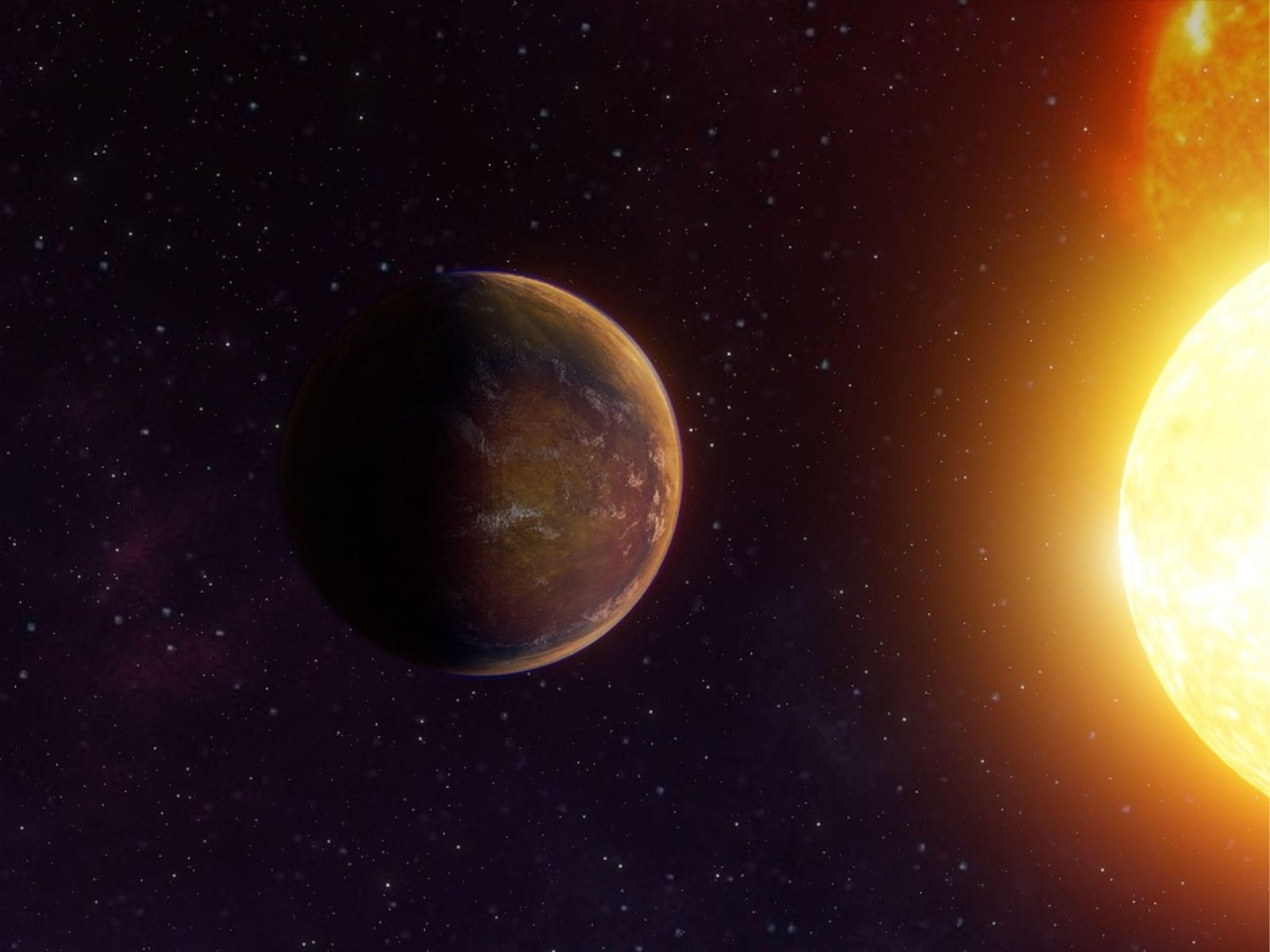
The hunt for exoplanets continues to reveal just how strange and varied worlds beyond our solar system can be. While researchers often focus on finding Earth-like planets that might share familiar conditions, a newly discussed “super-Earth” is capturing attention for a far more extreme reason: scientists say it may host lava tsunamis on its surface.
In a study posted on arXiv, astronomers Mohammad Farhat and Eugene Chiang examined 55 Cancri Ae, a rocky exoplanet located about 40 light-years from Earth. This world circles its host star, a yellow dwarf known as 55 Cancri A, at an incredibly close distance. The result is an ultra-fast orbit that takes only around 18 hours to complete—far shorter than any planet in our solar system.
That tight orbit has dramatic consequences. Because the planet sits so close to its star, the surface is believed to be blisteringly hot, with temperatures that can approach 2,000 degrees Celsius. At that level of heat, rock doesn’t stay solid. Instead, large regions of the surface are expected to melt, forming an ocean-like expanse of molten lava.
Farhat and Chiang’s calculations suggest this lava ocean may not be calm. The researchers propose that massive tidal forces from the nearby star could drive waves through the molten surface—essentially creating lava tides and potentially lava tsunamis. These waves could rise several meters high and travel quickly across the planet’s lava sea.
Unlike tides on Earth, which are primarily driven by the Moon’s gravity, the tidal effects on 55 Cancri Ae would be dominated by its star. The star’s gravitational pull, intensified by the planet’s extremely close orbit, is what could be powering this violent, wave-filled molten environment.
Findings like this underscore why exoplanet science remains one of the most exciting areas in astronomy. Worlds such as 55 Cancri Ae expand our understanding of what planets can be, showing that “rocky planet” doesn’t always mean a stable, Earth-like surface. As telescopes and detection methods improve, astronomers expect many more discoveries—some potentially even more extreme than a planet where oceans of lava may surge in star-driven tsunamis.


