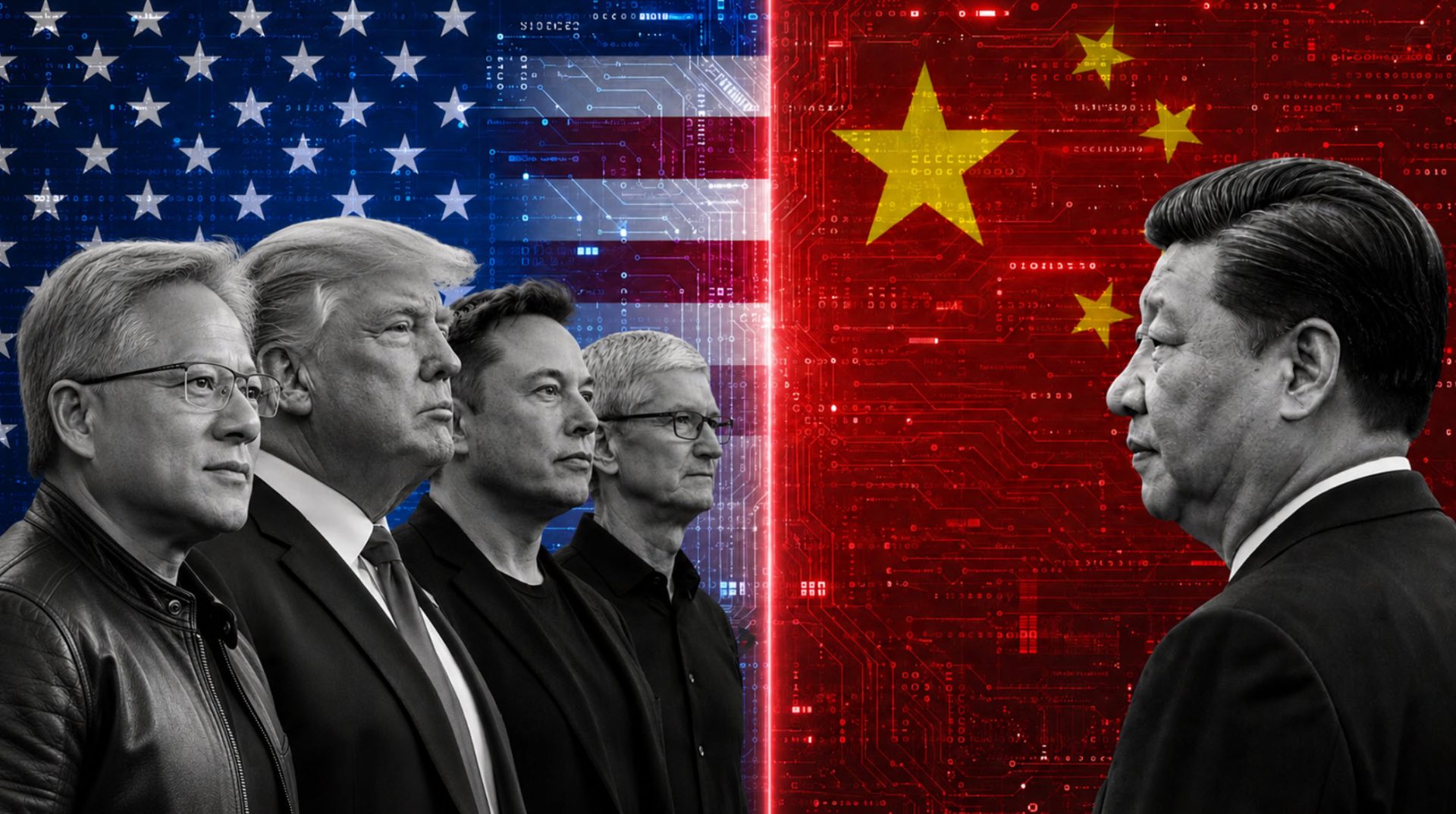
NVIDIA CEO Jensen Huang has been confirmed as part of President Donald Trump’s delegation for a closely watched visit to China, traveling alongside a lineup of America’s most influential technology leaders. The trip runs from May 13 to May 15, with Trump set to meet Chinese President Xi Jinping in what’s being described as a major diplomatic moment—especially because it marks the first time in nearly a decade that a sitting U.S. president will travel to China and hold talks at that level.
For days, there was uncertainty over whether Huang would make the trip. Earlier reports suggested NVIDIA’s chief executive wouldn’t be joining, but that has now changed. According to a White House correspondent who documented the departure, Huang boarded Air Force One during a refueling stop in Alaska, recognizable in his signature leather jacket and carrying a backpack as he joined the rest of the delegation.
Huang won’t be the only heavyweight in the tech world on the plane. The group also includes Elon Musk and Apple CEO Tim Cook, along with senior figures connected to major U.S. companies spanning chips, finance, aerospace, and big tech. Names mentioned as part of the broader roster include executives tied to Qualcomm, Micron, Meta, Boeing, and major financial institutions such as Citigroup, Goldman Sachs, Blackstone, and BlackRock.
While the exact meeting agenda is being kept under wraps, the themes are not hard to predict. Technology trade—especially anything connected to artificial intelligence—along with tariffs and broader supply-chain concerns are expected to dominate the conversation. With so many corporate decision-makers traveling alongside the president, the visit is widely expected to include business-focused discussions and potential agreements involving U.S. and Chinese firms, even if the outcomes are rolled out gradually rather than announced all at once.
NVIDIA’s presence is particularly notable given the company’s recent direction. The chipmaker has leaned into a U.S.-first posture, and it currently has no official foothold in China’s AI market. At the same time, NVIDIA has been pushing hard on domestic production and U.S.-based AI infrastructure, prioritizing its newest GPU platforms—Blackwell and Rubin—for American AI enterprises and data centers. The company is also reportedly positioning next-generation “Feynman” GPUs around U.S. manufacturing ambitions, underscoring how central onshore production has become to the broader strategy.
This trip also comes as the U.S. government appears to be easing off the most aggressive phase of tariff and trade restrictions. After a period marked by heightened trade conflict and sweeping tariffs, the tone has softened. That shift sets the stage for renewed U.S.–China talks in key technology areas, though both sides are still expected to move cautiously. Rather than sweeping announcements, the more likely outcome is a step-by-step reopening of dialogue—especially in sensitive sectors like advanced chips and AI.
With Huang, Musk, Cook, and other top executives sharing the same diplomatic stage, the visit signals how deeply technology and geopolitics are now intertwined. For global markets and the AI industry in particular, what happens during these three days in China could shape trade policy, chip strategy, and cross-border tech relationships well beyond 2026.


