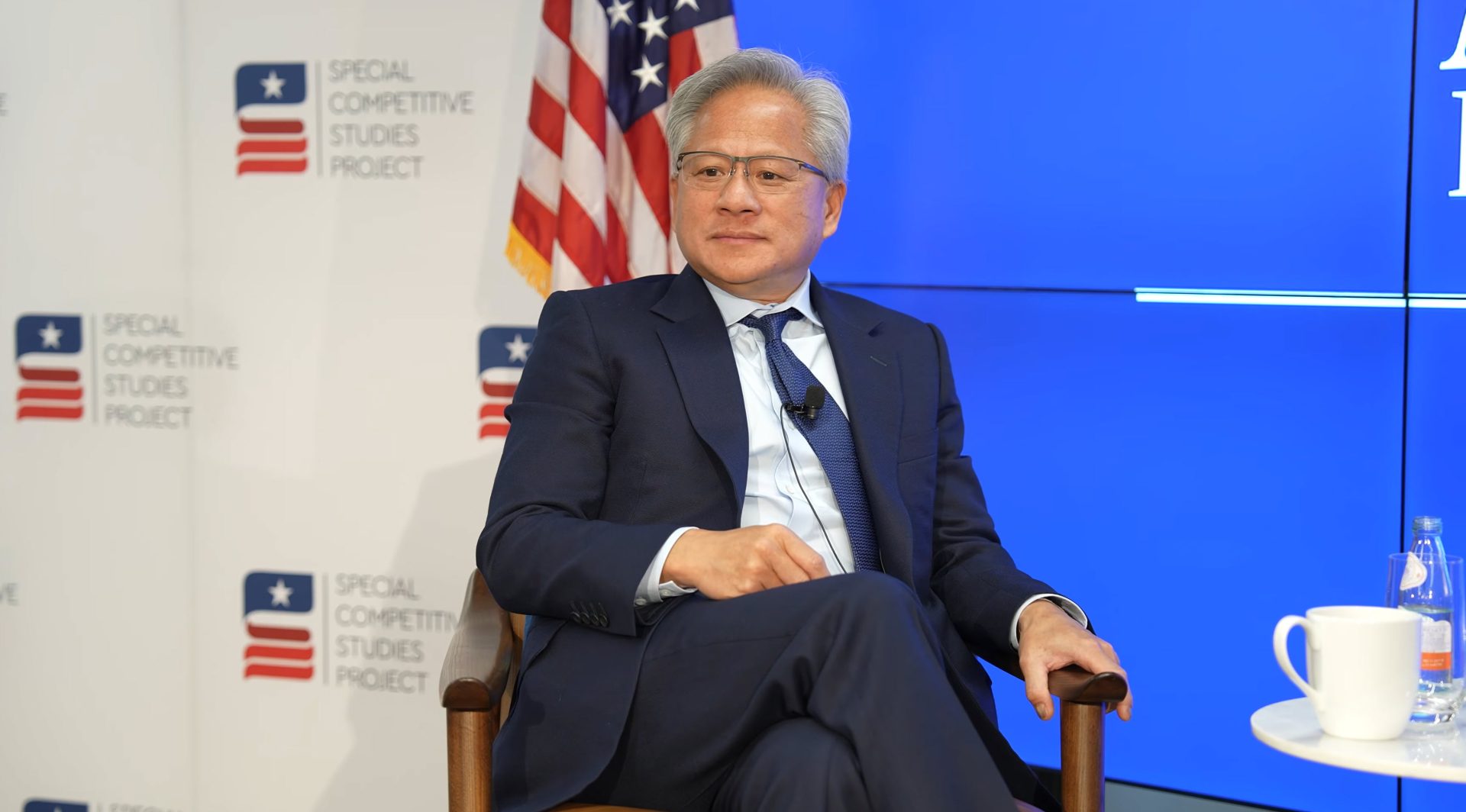
NVIDIA CEO Jensen Huang is doubling down on a message he’s repeated with growing urgency: artificial intelligence isn’t here to wipe out the workforce. In his view, AI is one of the biggest opportunities the United States has had in decades to reindustrialize, attract massive investment, and create hundreds of thousands of new jobs.
Huang made the case that the “AI era” could become a powerful engine for the US economy, bringing trillions of dollars in new activity as companies adopt automation, advanced computing, and AI-driven services. His argument is straightforward: businesses that effectively use AI tend to grow faster, and fast-growing companies hire more people. Instead of shrinking opportunity, he believes AI expands it by unlocking new products, services, and entire categories of work that don’t exist yet.
A big reason people fear AI, Huang suggests, is that they confuse the task of a job with the purpose of a job. He used software development to explain the difference. If you assume a software engineer’s job is simply typing code, then AI-generated code could look like a direct replacement. But Huang argues that writing code is just one task among many. The real purpose of software engineering is to solve problems, design systems, invent new approaches, collaborate across teams, and identify needs that haven’t even been expressed yet. In other words, innovation is the job; coding is only part of the workflow.
He also pushed back on the idea that society only needs a fixed amount of software. Even if AI dramatically reduces the time it takes to produce code, that doesn’t mean demand disappears. Huang’s point is that the world doesn’t need “a billion lines of code.” It can use vastly more—because there are endless challenges to tackle in healthcare, science, manufacturing, retail, infrastructure, and everyday quality of life. If AI removes some of the busywork, people can build more, attempt bigger projects, and move faster.
Notably, Huang emphasized that he still needs a lot of engineers. AI doesn’t operate in a vacuum; it depends on humans to define goals, design algorithms, build systems, evaluate results, ensure safety, and keep improving the underlying tools. As AI becomes more capable, the need for skilled people doesn’t vanish—it shifts toward higher-level problem solving and more ambitious development. He also warned that loud claims about AI “wiping out jobs” can discourage young people from entering fields like software engineering, exactly when demand for that talent may increase.
Huang also addressed geopolitical realities shaping the AI industry, particularly the United States’ shifting policy approach toward China. He said NVIDIA’s share in China has effectively fallen to zero, and that domestic Chinese companies are quickly filling the gap. He pointed to Huawei as a prominent example of a local player expanding its position in the AI market.
In Huang’s view, the situation is complicated because China brings major advantages to the table, including large pools of researchers and AI scientists as well as enormous energy infrastructure—both critical ingredients for building and running large-scale AI systems. He argued that policy needs to remain dynamic and adapt to changing conditions, suggesting that having American chip companies operating in China can make strategic sense depending on the moment and the market realities.
He also described a kind of global balance: China is exceptionally strong in energy production, while the United States leads in cutting-edge chip technology. On AI models, he said the US remains ahead but China is close behind, with rapid progress and a surge of new models coming out of the country. He framed China’s deep bench of AI researchers as a “natural resource” and suggested the US should focus on attracting that talent—bringing more top minds into the American economy to accelerate innovation, expand industry, and strengthen long-term competitiveness.
Overall, Huang’s message ties two big themes together: AI as a job creator at home, and AI as a global race where talent, infrastructure, chips, and policy decisions will determine who leads. His central claim remains optimistic—AI will change how people work, but that change can translate into more opportunity, not less, if the US invests, adapts, and keeps building.NVIDIA CEO Jensen Huang is pushing back on one of the biggest fears surrounding artificial intelligence: the idea that AI will inevitably wipe out jobs. In his view, the AI boom—especially the rise of “agentic AI,” where systems can take on more autonomous, goal-driven work—sets the stage for something very different. He frames it as a once-in-a-generation chance for the United States to rebuild industrial strength, expand advanced manufacturing, and create a wave of high-skilled employment tied to an entirely new technology era.
Huang points to a major competitive reality shaping the future of AI leadership: China’s deep bench of science, math, and engineering talent. He describes China as having an extraordinary number of AI researchers, driven by cultural encouragement, strong academic focus, and a large pipeline of technical expertise. To Huang, that talent base is a strategic asset—so significant he calls it a national “treasure” and even a “natural resource.” His message to U.S. policymakers is straightforward: America needs to stay attractive to global AI researchers and ensure the country remains a place where top talent wants to live and work. He also signals concern that geopolitical or policy barriers could lead to more researchers staying in place—or being unable to move—making the global competition for AI talent even more intense.
At the same time, Huang argues the AI economy won’t just be about software or digital services. He believes it will drive a massive buildout of physical infrastructure: factories, supply chains, and large-scale computing installations. He outlines what he calls a “Five-Layer Cake” approach, centered on bringing key parts of AI production and deployment back onto U.S. soil. According to Huang, NVIDIA has committed half a trillion dollars in spending tied to this vision, with the goal of shifting supply chain dependence from the East back to the West.
He describes multiple “plants” that AI will require. First are chip plants, including not only semiconductor fabrication but also packaging capabilities. Next are computer manufacturing plants that assemble the systems needed for AI workloads. Then comes the deployment layer—turning those systems into full-scale AI factories where advanced computing is produced and consumed at industrial levels. Put together, Huang argues, this represents trillions of dollars in manufacturing activity, alongside a major expansion of high-skilled jobs across engineering, production, operations, and the broader industrial ecosystem that supports advanced hardware.
The takeaway from Huang’s argument is that AI should be viewed less as a job-destroying force and more as a multiplier for human ambition. Rather than obsessing over whether AI can perform specific tasks—like writing code—he emphasizes the deeper purpose of work: innovation, problem-solving, and discovery. In this framing, AI accelerates what people and companies can build, enabling faster growth and expanding opportunity instead of shrinking it.
Huang’s conclusion is optimistic but pragmatic. America can treat the AI era as a historic opening to reindustrialize, create new factories, and generate enormous economic value—while adding hundreds of thousands of high-skill jobs. But it requires clear-eyed policy, sustained investment, and a national posture that welcomes and attracts the world’s best AI researchers. In Huang’s view, the future of work won’t be defined by humans doing less. It will be defined by humans aiming higher—and using AI as the engine to get there.