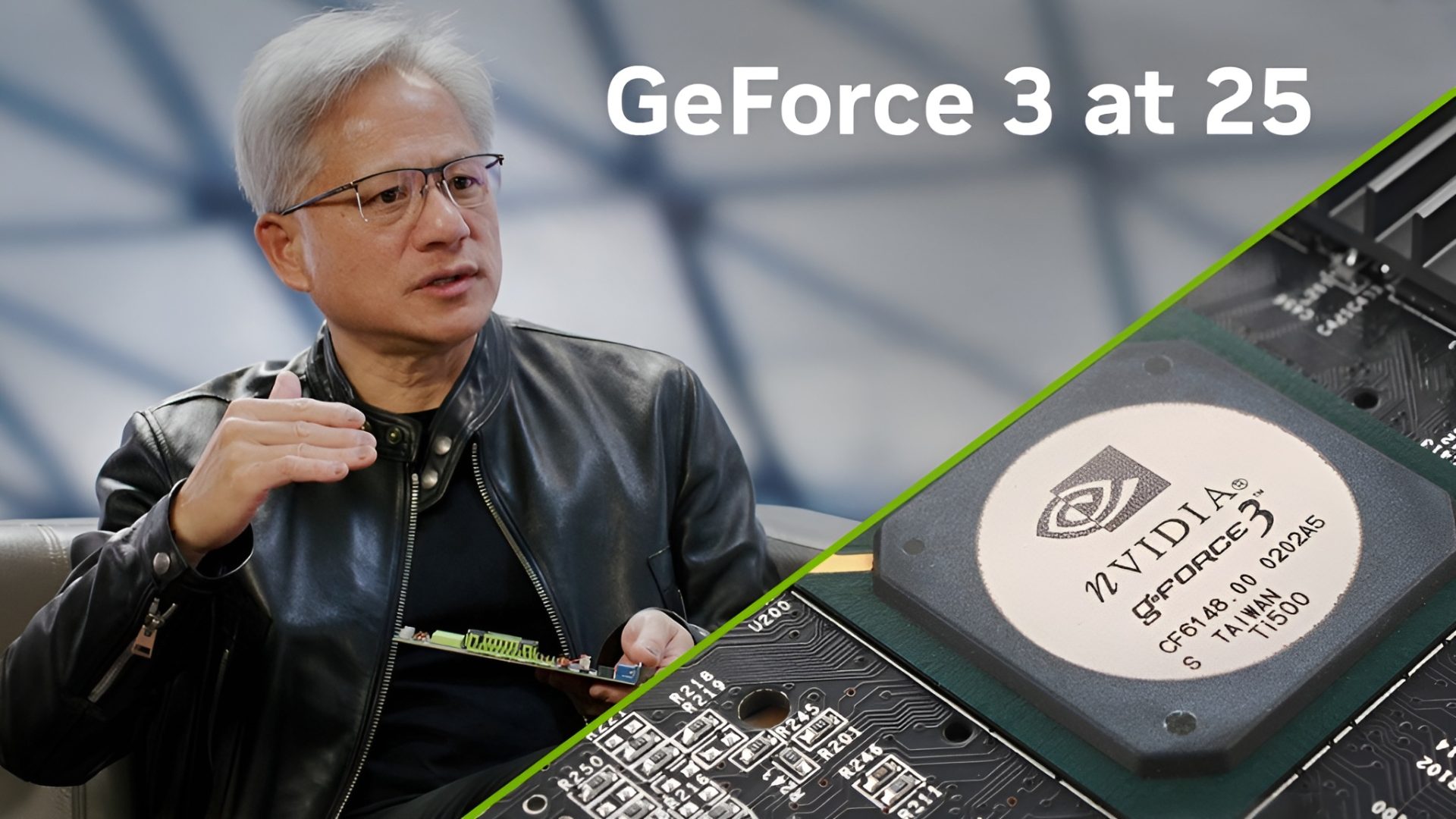
NVIDIA recently marked a major milestone in PC graphics history: 25 years since the launch of the GeForce 3 GPU. To celebrate, CEO Jensen Huang sat down with senior members of the GeForce team and reflected on why that moment mattered far beyond gaming. In his view, GeForce 3 didn’t just push better visuals—it helped kick off the chain of ideas and technologies that ultimately led to today’s AI boom.
Back in the late 1990s, many PC games were starting to feel visually similar. The reason, Huang explained, was the dominance of fixed-function graphics accelerators. GPUs like the Riva 128 and TNT were powerful for their time, but they didn’t give developers much flexibility. The hardware followed a largely pre-defined pipeline, which limited how much a game’s visual identity could stand out.
GeForce 3 changed that by helping drive the industry’s shift from fixed-function accelerators to programmable shaders—specifically programmable vertex and pixel shader architecture. That breakthrough meant developers could “program” more of the visual behavior themselves, bringing a more personal, artistic touch into the final look of a game. Instead of relying on pre-coded rendering paths, creators could shape lighting, materials, and effects with far more freedom, allowing games to look and feel more distinct.
Huang also noted that this move required NVIDIA to evolve in a big way. Making graphics more programmable isn’t just a hardware decision—it forces a company to build serious software and compiler capabilities. As NVIDIA transitioned toward a more programmable pipeline, it pushed the company to become more of a computing platform provider, not only a graphics chip maker.
That mindset helped pave the way for CUDA, NVIDIA’s parallel computing platform that enabled GPUs to be used for much more than rendering. CUDA expanded what developers could do with the GPU by bringing large-scale parallelism to general compute workloads. In Huang’s telling, the path is clear: GeForce made CUDA possible, and CUDA became foundational for modern AI computing.
The conversation also touched on another major bet NVIDIA made: ray tracing. For years, real-time ray tracing was seen as too computationally expensive for practical gaming, and brute force alone wasn’t enough. NVIDIA invested early anyway, and the push behind RTX didn’t just introduce more realistic lighting and reflections—it helped accelerate a broader shift toward AI-assisted graphics techniques.
From there, technologies like DLSS emerged, using neural rendering and AI upscaling to boost performance while maintaining image quality. Huang described this direction as bringing more “generative capability” to computer graphics—an approach that connects directly to the company’s larger AI ambitions. The same steady climb in GPU compute power and rendering innovation helped set the stage for generative AI as we know it today.
Huang summed up the milestone with a message of gratitude to the GeForce team, emphasizing a simple idea: without GeForce, there would be no CUDA; without CUDA, there would be no AI-driven present. And as NVIDIA pushes further into AI and accelerated computing, the company also seems intent on reshaping the future of gaming—particularly through AI-powered rendering advances, including upscaling and frame generation techniques designed to deliver smoother gameplay without requiring massively more hardware.
The bigger takeaway from NVIDIA’s 25-year GeForce reflection is that gaming graphics innovation didn’t just make games look better. It helped redefine what GPUs are for—transforming them from rendering engines into the primary engines of modern AI computation.