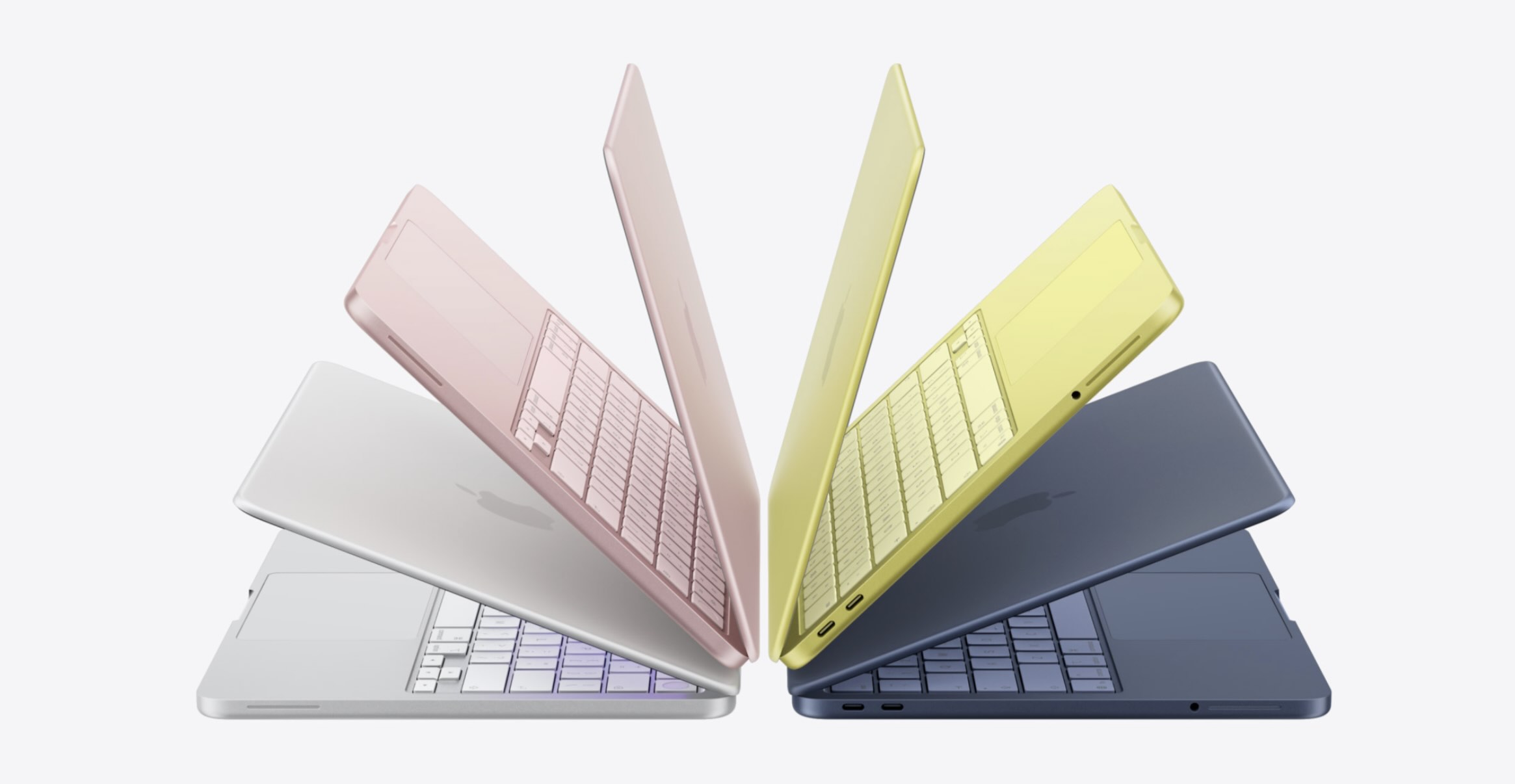
Early benchmark results suggest Apple’s new entry-level laptop could end up being the slowest Mac in the current lineup—and it may even trail Apple’s cheapest iPhone.
According to initial Geekbench 6 scores, the MacBook Neo (listed as model Mac17,5) comes in behind the iPhone 17e (model iPhone 18,5) in both single-core and multi-core performance. Across multiple results, the iPhone 17e leads by roughly 5% to 6%, putting Apple’s most affordable iPhone slightly ahead of its most affordable laptop in raw CPU testing.
The reason is fairly straightforward: the MacBook Neo is powered by a modified version of Apple’s A18 Pro system-on-chip, the same family of silicon used in last year’s iPhone 16 Pro lineup. The iPhone 17e, meanwhile, uses the newer A19 chip, which appears to have a small edge in CPU performance. On the graphics side, early benchmark submissions show the two chips trading blows with no consistent, clear winner, suggesting GPU performance is broadly comparable depending on the specific test and configuration.
Even so, the bigger story isn’t that the MacBook Neo is “slow,” but that Apple’s phone chips have become powerful enough to compete directly with laptop-class devices—especially at the budget end of the market. Early impressions of the MacBook Neo have been largely positive, particularly when it comes to price-to-performance, and the initial numbers indicate it should still be more than capable for everyday workloads like web browsing, school tasks, office apps, streaming, and general multitasking.
This benchmark comparison also highlights something important for buyers: if Apple’s least expensive iPhone can deliver this level of performance, it’s a strong signal that the current iPhone lineup offers more than enough speed for most people’s daily needs.
Of course, the most meaningful performance discussion for the MacBook Neo will come from comparisons against similarly priced Windows laptops, since that’s where most budget laptop shoppers are cross-shopping. As more competing models roll out, a clearer picture will form around how the MacBook Neo stacks up in real-world use beyond synthetic benchmarks.