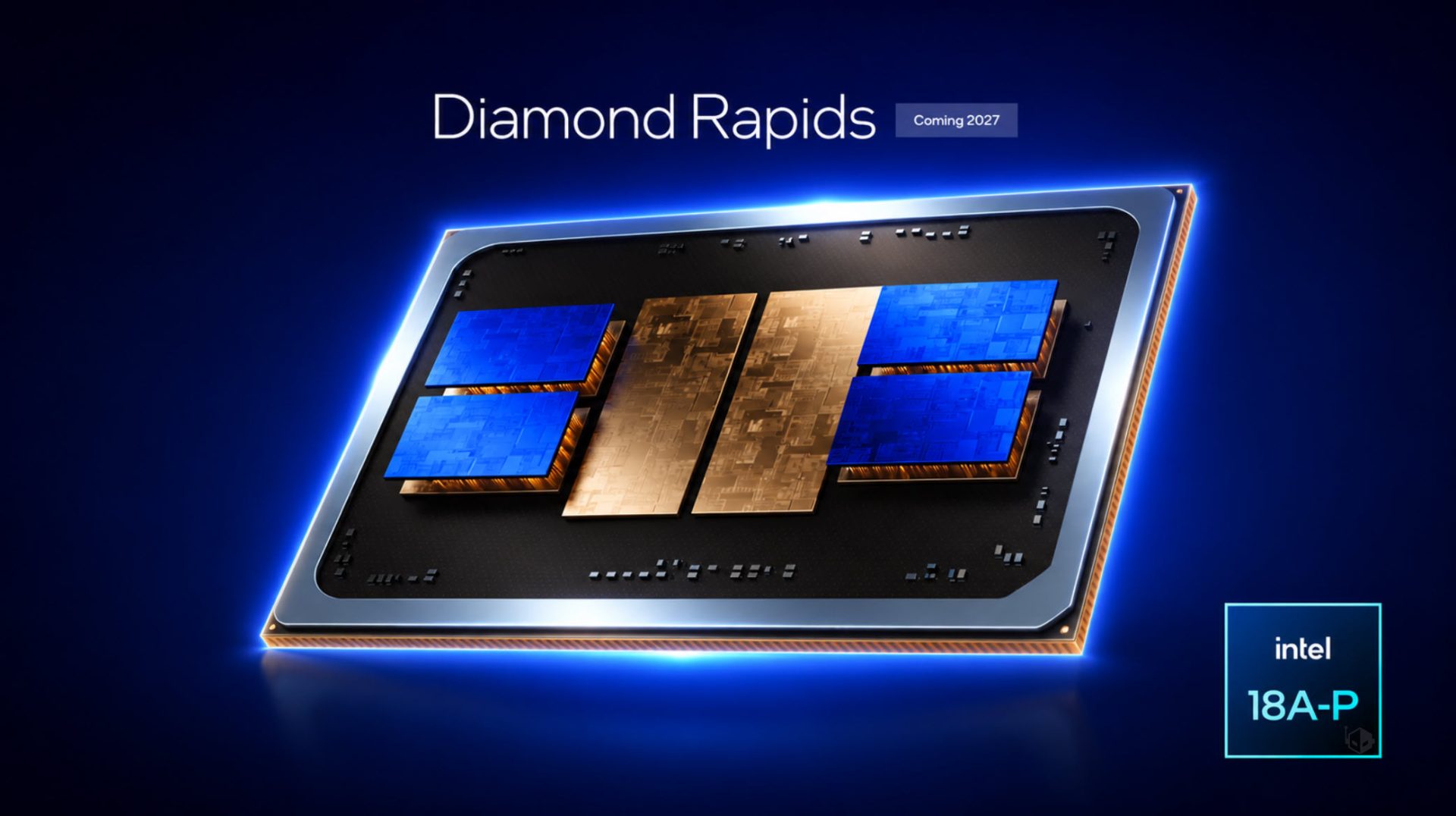
Intel Diamond Rapids Xeon 7 CPUs could bring up to 256 P-cores in 2027, setting up a major server CPU battle with AMD EPYC Venice
Intel’s next-generation Diamond Rapids Xeon 7 processors are shaping up to be one of the company’s most important data center CPU launches in years. According to recent industry chatter, the upcoming platform could include a flagship model with as many as 256 performance cores, putting Intel directly in the same core-count territory as AMD’s EPYC Venice lineup.
If this rumor proves accurate, Diamond Rapids will mark a major jump for Intel’s Xeon family and could become a key weapon in the company’s attempt to regain momentum in high-performance servers, cloud infrastructure, AI workloads, and enterprise data centers.
Earlier expectations around Diamond Rapids were even more ambitious. Previous reports suggested that Intel had explored extremely high-density designs with 384-core and even 512-core configurations. Those versions were believed to be based on efficiency-core designs and aimed at succeeding platforms such as Clearwater Forest.
However, those plans now appear to have changed. The 512-core platform was reportedly canceled during the definition stage, while the broader high-density roadmap was scaled back late last year. As a result, Diamond Rapids is now expected to focus mainly on P-core variants rather than E-core-heavy designs.
That does not mean the platform will be modest. Far from it.
Diamond Rapids P-core chips are rumored to deliver around a 50% improvement in core density compared with current Granite Rapids Xeon 6900P processors, which top out at 128 cores. A simple increase of that scale would suggest up to 192 P-cores, but the latest claim points to an even larger flagship configuration with 256 P-cores.
A 256-core Xeon 7 processor would be a major milestone for Intel. It would allow the company to compete directly against AMD’s upcoming EPYC Venice processors, which are expected to reach up to 256 Zen 6 cores. AMD is also expected to offer a 192-core EPYC Venice model, giving it a strong position in both maximum core-count and high-density server deployments.
For Intel, matching AMD on core count would be only part of the challenge. The bigger question is whether Diamond Rapids can also compete in performance per watt, memory bandwidth, platform features, and real-world workload efficiency.
AMD’s Zen-based EPYC processors have gained significant traction in data centers over the last several generations, largely due to strong core scaling, energy efficiency, and platform consistency. EPYC Venice is expected to continue that trend with Zen 6 cores and advanced manufacturing technology. Intel, meanwhile, is expected to build Diamond Rapids on its 18A-P process node, with a planned launch around 2027.
That timing matters. If AMD reaches volume production earlier with its next-generation server processors, Intel will need Diamond Rapids to arrive with strong performance and competitive availability. Data center customers care about raw specifications, but they also care deeply about power consumption, software compatibility, platform maturity, supply reliability, and total cost of ownership.
Still, Intel has reasons to be optimistic. Demand for server compute continues to rise rapidly, especially as AI, cloud computing, virtualization, and high-performance analytics workloads expand. Even older Intel server CPUs have seen renewed pricing strength due to increased demand, and Intel’s manufacturing business is also seeing greater interest as companies look for more chip supply options.
The broader server CPU market is also becoming more crowded. NVIDIA and other technology companies are developing their own processors for AI enterprise systems and cloud data centers. This means Intel is no longer competing only with AMD in the traditional x86 server market. It must also prove that Xeon can remain relevant as AI-focused infrastructure evolves.
Diamond Rapids could play a major role in that effort. The platform is expected to bring support for modern server technologies, including PCIe 6.0 and high-speed DDR5 memory configurations. Earlier platform information has suggested support for up to 16-channel DDR5-9000+ memory, although final specifications may change before launch.
The expected Diamond Rapids platform, known as Intel Oak Stream, is also believed to use a multi-chip package design, continuing Intel’s move toward more modular server processors. Multi-chip packaging has become essential for scaling core counts, improving yields, and building large enterprise CPUs without relying on a single massive die.
In Intel’s broader server roadmap, Diamond Rapids is expected to follow Clearwater Forest and Granite Rapids, while Coral Rapids is anticipated further down the line. Coral Rapids may strengthen Intel’s position even more in CPU and AI-focused infrastructure, but Diamond Rapids will likely be the platform that determines whether Intel can close the gap with AMD in the 200-plus-core data center segment.
Here is the current expected position of Diamond Rapids in Intel’s Xeon roadmap:
Diamond Rapids is expected to launch around 2027.
It is expected to use Intel’s 18A-P process node.
The platform is expected to feature Panther Cove-X P-core architecture.
It may support PCIe 6.0.
It may support up to 16-channel DDR5-9000+ memory.
Earlier expectations pointed to up to 192 P-cores, but newer rumors suggest a possible 256 P-core flagship.
It is expected to compete directly with AMD EPYC Venice.
For now, the 256-core Diamond Rapids Xeon 7 model remains unofficial. Intel has not formally announced the full lineup, and specifications may change before release. However, if the company does bring a 256-core P-core Xeon to market, it would represent one of the most aggressive server CPU moves Intel has made in years.
The data center CPU race is clearly entering a new phase. Core counts are climbing past 200, memory bandwidth is becoming more important than ever, and AI workloads are reshaping what enterprise processors need to deliver. AMD currently has strong momentum, but Intel’s Diamond Rapids could become a serious contender if it arrives with the right mix of performance, efficiency, platform features, and availability.
In short, 2027 could bring one of the most important Xeon launches in Intel’s modern server history. If Diamond Rapids Xeon 7 truly reaches 256 P-cores, the battle against AMD EPYC Venice will be one of the most closely watched contests in the data center market.