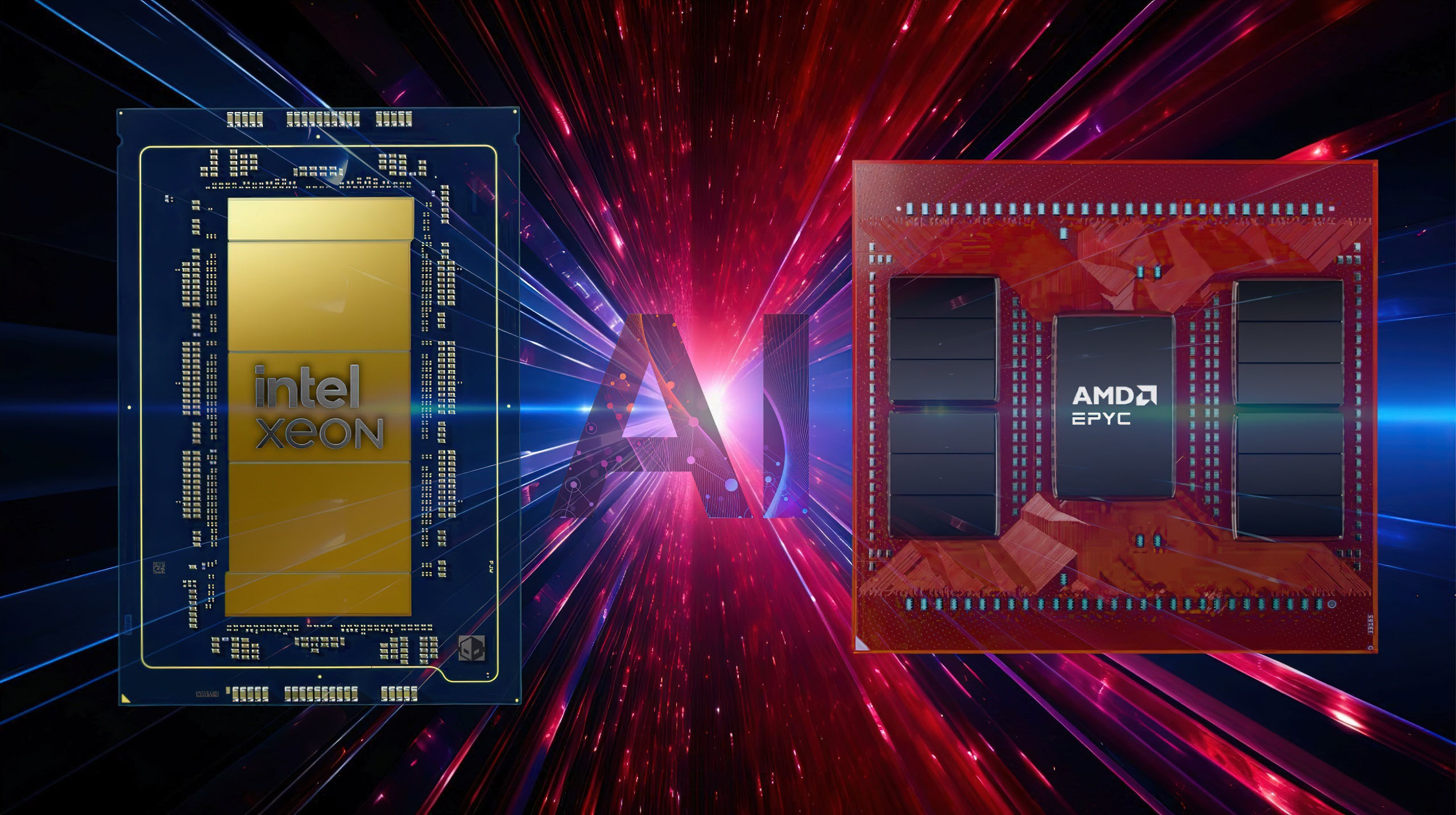
Intel’s grip on the CPU market is getting harder to defend, especially as AMD continues to chip away at both server and client share quarter after quarter. New figures from Mercury Research highlight just how much the competitive landscape has shifted in under a decade—and how quickly AMD has turned what used to be a one-sided market into a true fight.
In the server space, Intel remains the larger player, but its lead has narrowed dramatically. As of Q3 2025, Intel sits at around 72% server CPU unit share, while its server revenue share has dropped to roughly 61%. That revenue number is especially telling: even when Intel still ships more chips overall, it’s capturing a smaller portion of the money, suggesting pricing pressure and a stronger mix of high-value deployments going to AMD.
What makes the trend stand out is how dominant Intel once was. Back in Q1 2019, Intel held about 97% of both server unit share and server revenue share. In less than seven years, that near-total control has steadily slipped away, opening the door for AMD to surge toward the 30% mark—an enormous jump from the roughly 1–2% range AMD hovered around in 2018.
A big driver behind AMD’s momentum has been the steady rise of EPYC. When the first EPYC generation, Naples, launched in mid-2017, adoption didn’t explode overnight—but early customers quickly recognized the performance and efficiency advantages. As more data centers validated those gains, broader enterprise and cloud interest followed. With each new EPYC family, the pattern has repeated: more cores, strong performance-per-watt, and a clear value proposition for operators trying to maximize throughput while controlling power and cooling costs. That combination has helped EPYC become a long-term contender rather than a short-lived disruption.
Intel’s challenges aren’t limited to servers. The client CPU market has also shifted noticeably since AMD’s Zen-based Ryzen processors arrived in 2017. Intel did manage to recapture some momentum with its 12th Gen Alder Lake and 13th Gen Raptor Lake lines, but momentum appears to have weakened again—especially after reliability and degradation concerns surrounding certain 13th and 14th Gen chips pushed parts of the DIY community and some OEM demand toward Ryzen alternatives. The result has been a meaningful lift for AMD in desktop CPU share.
At this point, Intel’s client position looks softer than it once did. Desktop share is now roughly around 60% on a unit basis, while AMD has climbed past 30%. Laptops are a different story: AMD is holding around 20% notebook share and appears relatively flat there, in part because ARM-based processors have become much more competitive in mobile computing. In notebooks, the overall picture suggests that Intel’s decline has benefited multiple rivals, including Apple in mobile systems, while Apple’s presence in desktops has stayed relatively steady as AMD continues to grow.
Taken together, the numbers paint a clear picture: Intel is still the leader in both client and server CPUs, but the gap has narrowed significantly, and the trend lines favor AMD. Intel could still mount a comeback—particularly in mobile with upcoming platforms like Panther Lake, and on desktop where attention is turning to Nova Lake. For now, though, the latest market share data underscores an industry in transition, where AMD’s multiyear climb is no longer a surprise but an established pattern.