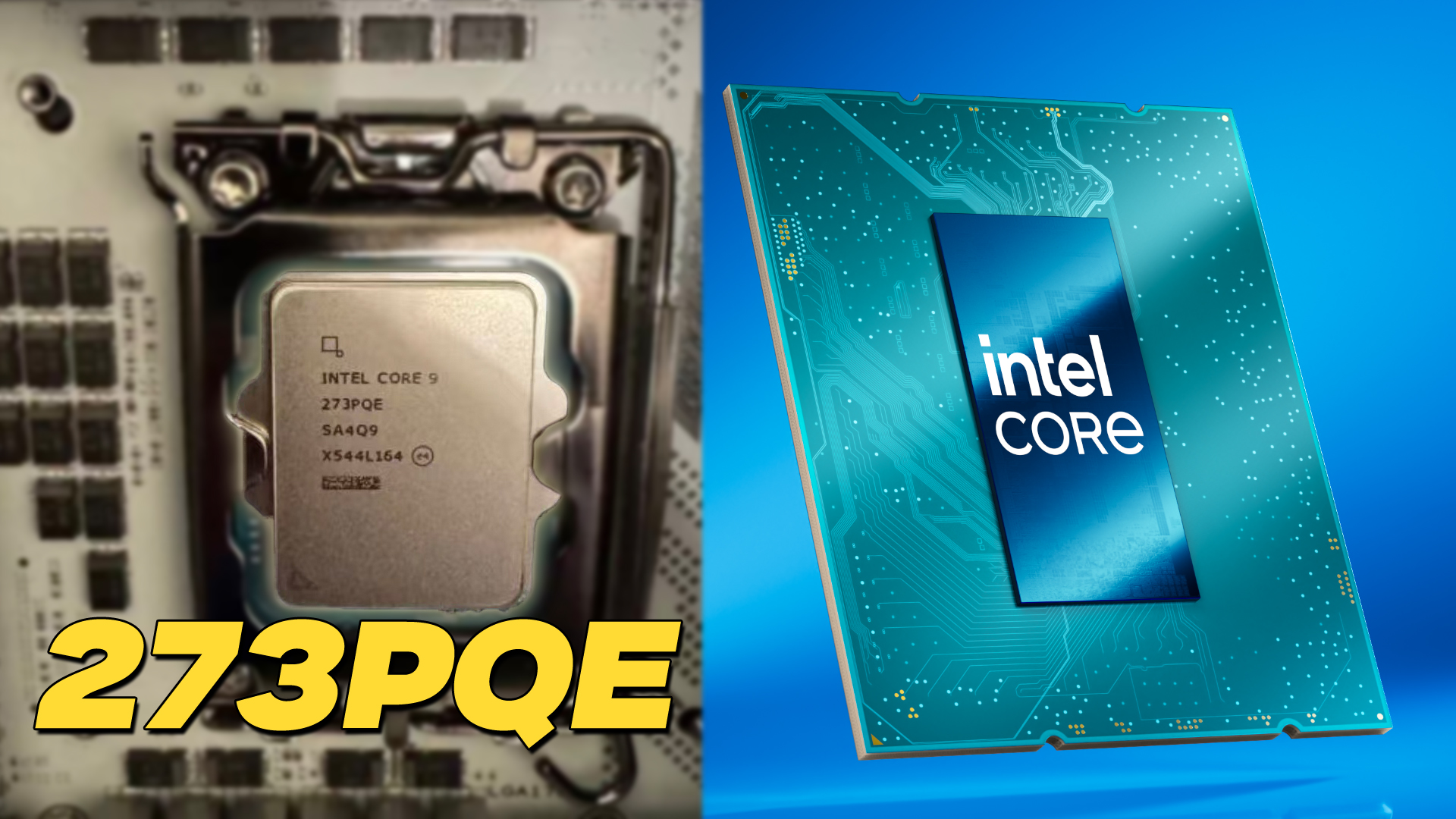
Intel’s Bartlett Lake processors weren’t built with typical PC shoppers in mind, but a new sighting suggests these unusual chips may still interest DIY enthusiasts. The flagship Intel Core 9 273PQE has now been seen sitting in a standard LGA 1700 motherboard, marking one of the first real-world looks at the top P-core-only Bartlett Lake CPU in a mainstream desktop setup.
What makes this processor stand out is its core layout. Unlike recent consumer Intel desktop CPUs such as Raptor Lake and Raptor Lake Refresh, Bartlett Lake’s P-core lineup drops Efficient cores entirely. That means the Core 9 273PQE focuses purely on Performance cores—12 of them—paired with 24 threads. For comparison, even Intel’s consumer flagship Core i9-14900K/KS tops out at 8 Performance cores, relying on Efficient cores to push total core counts higher. Bartlett Lake takes a different approach, aiming for consistent high-performance cores across the board.
A photo shared by user @wxnod shows the Intel Core 9 273PQE installed on an LGA 1700 board. The chip appears to be an early engineering sample. Visible markings include batch code X544L164 and S-Spec SA4Q9 on the heatspreader, lending credibility to the sighting and giving hardware watchers more confidence that these parts are real and circulating.
Based on leaked specifications, the Core 9 273PQE is expected to reach up to 5.9 GHz boost clock and include 36 MB of L3 cache. If those figures hold true in final silicon, this CPU could be especially interesting for workloads that thrive on strong multi-threaded performance and high per-core speeds—particularly because all cores are Performance-class cores rather than a mix of P-cores and E-cores.
The motherboard in the image appears to be a consumer model, though the exact make and model aren’t confirmed. Even so, Bartlett Lake’s compatibility with the LGA 1700 socket is the key takeaway. In theory, these CPUs should run on many mainstream LGA 1700 motherboards as long as the vendor provides BIOS support. Without the right BIOS, compatibility may be limited, especially on boards that were never intended to support workstation or specialized Intel SKUs.
There’s also growing chatter that some vendors may offer these P-core-only Bartlett Lake CPUs to the DIY market through unofficial channels rather than typical retail distribution. If that happens, it could give PC builders access to a different kind of Intel desktop processor—one that prioritizes Performance cores and potentially delivers strong multi-threaded results without relying on hybrid scheduling.
Here’s the leaked Bartlett Lake P-core-only lineup that has been circulating, including the flagship Core 9 273PQE:
Core 5 213PE – up to 5.2 GHz, 24 MB L3
Core 5 213PTE – up to 5.2 GHz, 24 MB L3
Core 5 213PEF – up to 5.2 GHz, 24 MB L3
Core 5 223PE – up to 5.4 GHz, 24 MB L3
Core 5 223PTE – up to 5.4 GHz, 24 MB L3
Core 5 223PQE – up to 5.5 GHz, 24 MB L3
Core 7 253PTE – 10 cores / 20 threads, up to 5.4 GHz, 33 MB L3
Core 7 253PE – 10 cores / 20 threads, up to 5.5 GHz, 33 MB L3
Core 7 253PQE – 10 cores / 20 threads, up to 5.7 GHz, 33 MB L3
Core 9 273PTE – 12 cores / 24 threads, up to 5.5 GHz, 36 MB L3
Core 9 273PE – 12 cores / 24 threads, up to 5.7 GHz, 36 MB L3
Core 9 273PQE – 12 cores / 24 threads, up to 5.9 GHz, 36 MB L3
If previous comparisons are any indication, even the 10-core Bartlett Lake parts are rumored to compete closely with higher-core-count hybrid CPUs in some scenarios. That makes the 12-core flagship especially intriguing for creators and power users who value straightforward, high-end multi-threaded performance on the familiar LGA 1700 platform—assuming these processors become obtainable and motherboards receive the BIOS updates needed to run them properly.