Intel D-Series “Crescent Island” GPUs emerge with dual-chip OAM design, up to 512GB memory potential, and a strong AI focus
Intel’s upcoming D-Series GPUs, previously known by the codename Crescent Island, are starting to look like one of the company’s most ambitious pushes into AI acceleration yet. Fresh details shared around the latest Open Compute Project event reveal new OAM designs, dual-package configurations, large memory options, and a platform strategy aimed directly at high-capacity inference and agentic AI workloads.
The D-Series family is built around Intel’s Xe3P GPU architecture, an enhanced version of Xe3 designed specifically for AI-heavy environments. Rather than focusing only on traditional graphics or general-purpose compute, Xe3P is being positioned for sustained AI performance, large context windows, and efficient handling of massive models.
Intel is targeting several key areas with this architecture: high memory capacity for agentic AI, LPDDR5X memory for better density and efficiency, larger context support for modern AI models, and strong performance per watt in compute-bound “prefill” workloads.
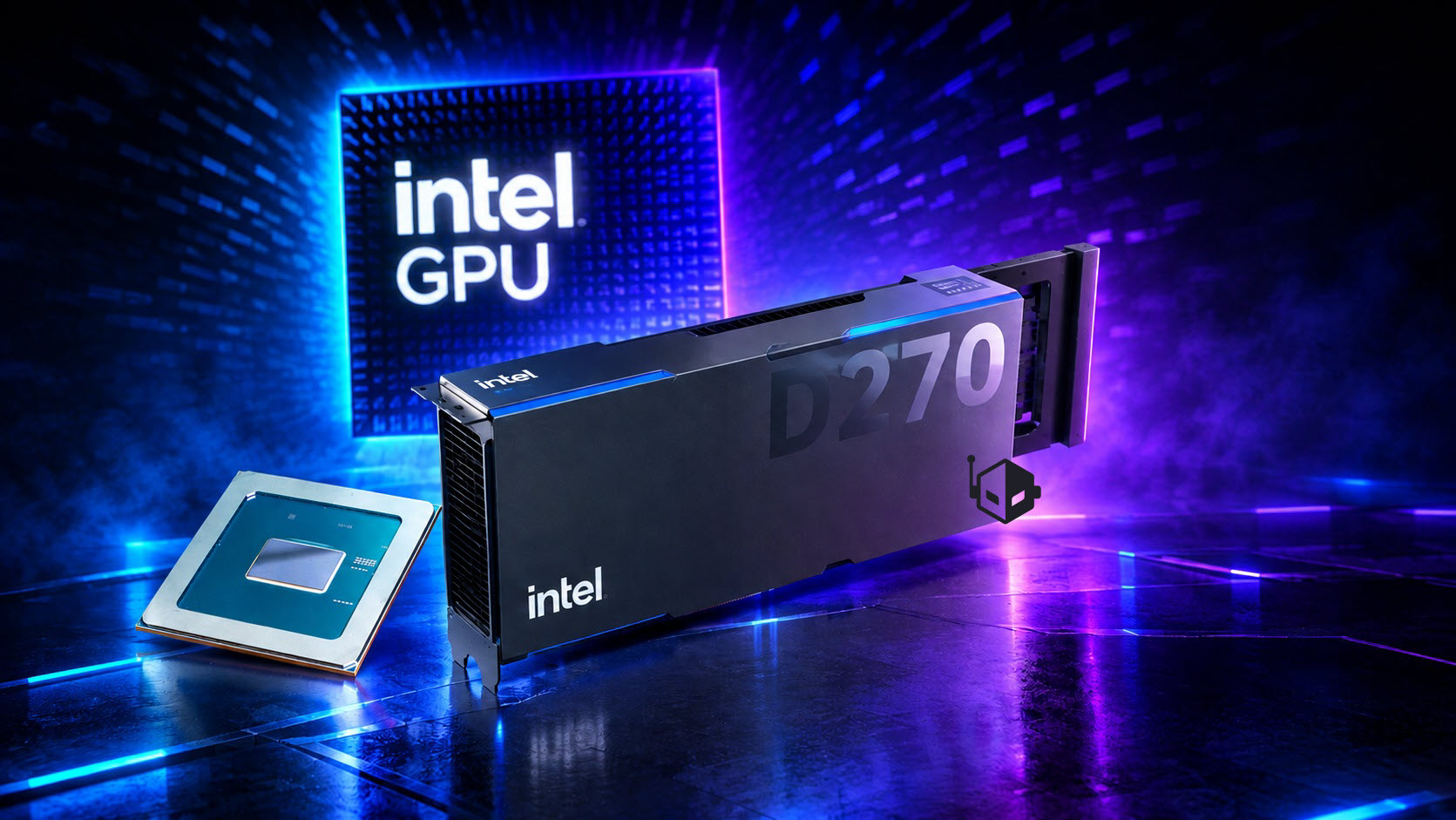
The first highlighted product in this family is the Intel D270, which appears to be the reference design for the Crescent Island platform. Intel’s own reference cards are expected to feature 160GB of LPDDR5X memory, while partner-built versions could push that capacity much higher. Some configurations may reach up to 480GB, and certain add-in-card designs could reportedly climb as high as 512GB of VRAM.
That memory capacity is one of the biggest talking points. Instead of using HBM or GDDR, Intel is leaning on LPDDR5X, aiming to offer a balance of density, power efficiency, and reliability. Bandwidth is expected to reach around 1.5TB/s, making the D-Series one of the first GPU platforms to bring LPDDR5X into a broader AI accelerator role.
The Intel D270 is expected to feature up to 32 Xe3P cores and a 350W thermal design power in air-cooled configurations. In terms of AI compute, Intel is aiming for roughly 1.3 PFLOPs of FP8 performance. That level of throughput is enabled by 256 next-generation XMX AI engines integrated into each chip.
New chip images also show that the D-Series GPU die, reportedly produced on N3P process technology, appears smaller than Intel’s Battlemage BMG-G31 graphics chip. That smaller footprint makes sense because Crescent Island is not designed like a typical gaming GPU. Much of the layout is optimized around AI acceleration rather than conventional graphics hardware.
One of the most interesting reveals is the dual-GPU OAM module. Intel has shown an OAM design featuring two D-Series Crescent Island GPUs on a single liquid-cooled card. Each GPU has its own LPDDR5X memory, while a PLX bridge connector and mezzanine connector help tie the module together. The card uses a large copper block with integrated liquid cooling, making it suitable for dense AI server deployments where thermal efficiency is critical.
Intel is also preparing Day-0 support for Meta Muse Spark Open using four 160GB Intel D-Series GPU cards. That means a compact four-card system would offer a total of 640GB of memory using the reference designs. According to Intel, this amount of memory would allow the system to host extremely large models with up to 816 billion parameters, all while using a conventional air-cooled setup.
That could be a major advantage for AI developers and enterprises that want to run massive models without immediately jumping to exotic cooling or more complex rack-scale installations.
Intel is positioning Crescent Island as a scalable platform rather than a single product. Smaller configurations are expected to support local AI workloads, while eight-card workstation and server builds will target heavier inference tasks. At the high end, Intel is talking about rack-scale systems with more than 80 GPUs, designed for frontier-class AI models such as Grok 3, Kimi K3, and DeepSeek V4 Pro.
Another important part of Intel’s strategy involves combining the D-Series GPUs with the SambaNova RDU stack. In this setup, Crescent Island would handle the prefill stage of token generation, while RDUs would take care of the decode stage. This kind of workload splitting is becoming increasingly important for low-latency AI inference, especially as models become larger and more complex.
Compared with other AI-focused accelerators, Intel’s D-Series appears to be less about chasing only the highest peak compute number and more about delivering a strong balance of memory capacity, efficiency, and scalable deployment options. The 160GB reference card already offers far more memory than many workstation-class GPUs, while possible partner designs with 480GB or even 512GB could make the platform especially attractive for large-context AI and inference workloads.
Intel has not yet confirmed a full commercial launch window, but the number of public demonstrations and platform details suggests that Crescent Island is moving closer to a formal rollout. If Intel can deliver competitive pricing, strong software support, and reliable partner designs, the D-Series could become an important new option in the rapidly expanding AI GPU market.
For now, Crescent Island looks like a serious attempt by Intel to carve out space in agentic AI, large-language-model inference, and high-memory accelerator deployments. With Xe3P architecture, LPDDR5X memory, dual-GPU OAM designs, and rack-scale ambitions, the Intel D-Series platform may become one of the company’s most important AI hardware launches yet.