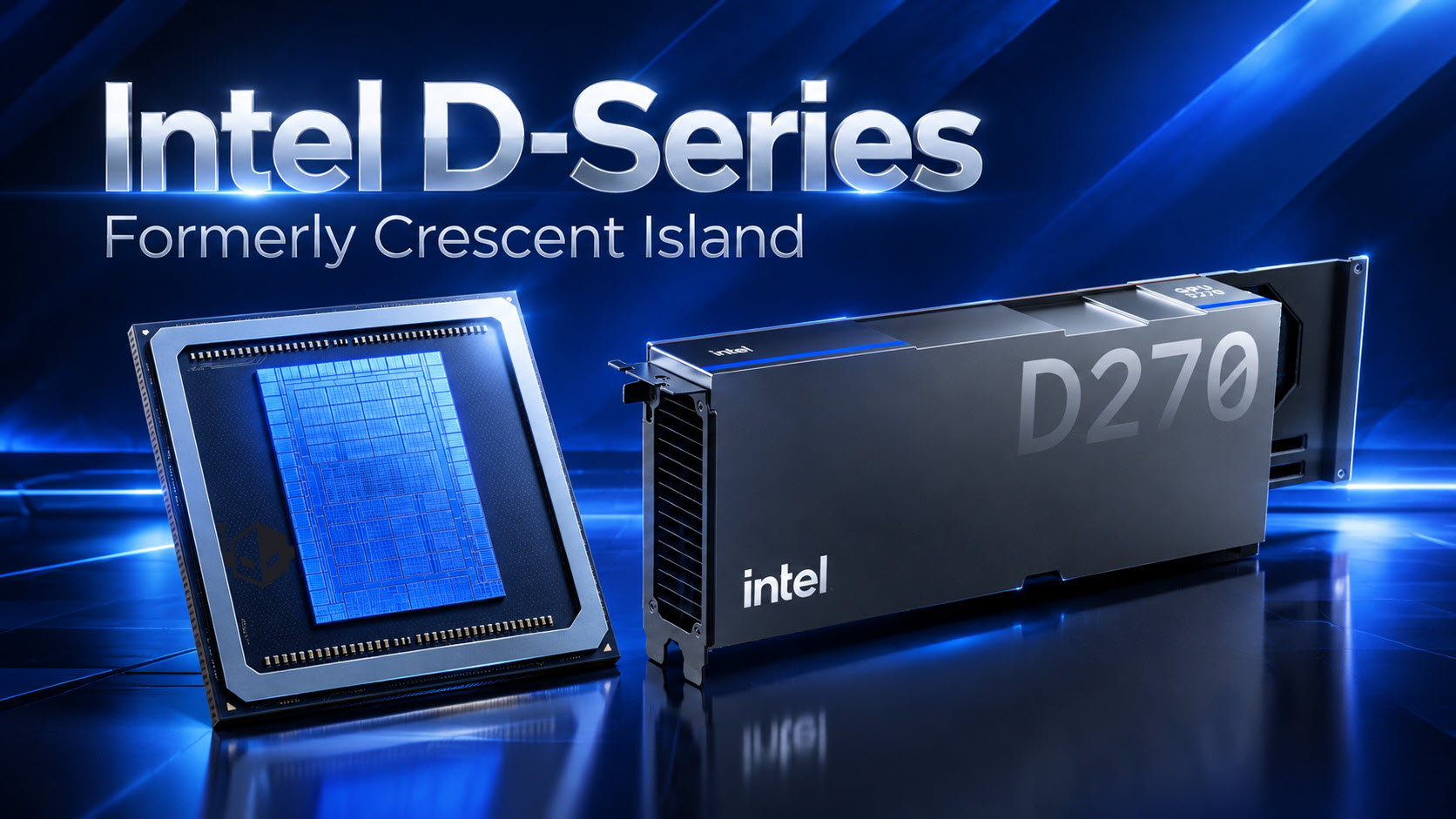
Intel D-Series “Crescent Island” GPUs Unveiled for AI Data Centers With Xe3P Architecture, Up to 1.3 PFLOPs FP8 and 480GB LPDDR5X
Intel is preparing a major push into AI inference with its new D-Series data center GPUs, previously known by the codename Crescent Island. The first announced product in the lineup is the Intel GPU D270, a purpose-built accelerator based on the company’s new Xe3P architecture.
Rather than chasing only the highest possible bandwidth or the biggest thermal envelope, Intel is aiming at a different and increasingly important part of the AI market: efficient, scalable inference. With up to 1.3 PFLOPs of FP8 performance at 350W, support for up to 480GB of LPDDR5X memory, and a design focused on tokens-per-watt, the D-Series could become an important option for companies deploying large language models, agentic AI systems, and high-capacity inference workloads.
Intel D270 targets the future of AI inference
AI training has dominated the spotlight for years, but inference is now becoming the workload that enterprises must run every day at massive scale. Every chatbot response, AI assistant action, document summary, image generation request, or coding suggestion depends on inference performance.
Intel’s Crescent Island platform is designed specifically for that reality. The D-Series GPUs focus on high memory capacity, efficient compute, long-context support, and lower total cost of ownership. This makes them especially relevant for businesses running large models where memory capacity and operating cost can matter as much as raw peak performance.
Intel says the D-Series is “agentic AI ready,” meaning it is designed for AI workloads where models must reason, retrieve information, use tools, and coordinate tasks over longer sessions. These workloads often require larger context windows and more efficient handling of KV cache, which can quickly consume huge amounts of memory during inference.
Xe3P architecture is built for AI acceleration
At the heart of Crescent Island is Intel’s Xe3P architecture. Xe3P is an enhanced version of Intel’s third-generation Xe graphics architecture, tuned for scalability across client GPUs, integrated graphics, workstations, and data center accelerators.
For the D270, Intel has shifted the focus heavily toward AI compute. The GPU does not include traditional graphics and 3D rendering blocks, allowing more silicon area to be used for general-purpose GPU compute and AI acceleration.
Each Xe3P core includes 8 Vector Engines and 8 XMX engines. The Vector Engines support FP8 and FP4 precision, 3-way co-issue, extended math capabilities, and FP64 support. The XMX units use a 16-deep systolic array designed to accelerate matrix operations, which are essential for modern AI workloads.
The Crescent Island GPU contains four compute slices. Each slice includes 8 Xe3P cores, giving the full chip a total of 32 Xe3P cores, 256 Vector Engines, and 256 XMX units. These compute slices are connected through a large L2 cache, while each Xe core includes its own load/store units, instruction cache, and L1/SLM cache.
The memory hierarchy includes 512KB of L1/SLM per Xe core, adding up to 16MB total, plus 32MB of unified L2 cache.
Up to 480GB LPDDR5X memory gives Intel a different advantage
One of the most interesting choices Intel has made with Crescent Island is the use of LPDDR5X memory instead of HBM. While competing high-end AI accelerators from NVIDIA and AMD often rely on HBM3E or next-generation HBM4, Intel is taking a more cost- and power-conscious path.
The Intel reference D270 card will feature 160GB of LPDDR5X memory. However, partner-built cards will be able to scale up to 480GB.
That is a very large amount of memory for a PCIe AI accelerator, and it could be a major advantage for inference workloads that need to store large models, long context windows, and large KV caches. In many real-world AI deployments, being able to keep more data on one card can reduce complexity and improve efficiency.
For comparison, AMD’s Instinct MI450X is expected to offer up to 432GB of HBM4, while NVIDIA’s Vera Rubin platform is expected to offer up to 288GB of HBM4. Intel’s maximum capacity of 480GB stands out, even though LPDDR5X does not provide the same peak bandwidth as HBM.
Intel’s strategy is clear: reduce power consumption, reduce memory cost, avoid some of the supply pressure affecting HBM, and offer massive capacity for inference-focused customers.
1.3 PFLOPs FP8 at 350W positions D270 as an efficient AI accelerator
Intel says the D-Series can deliver up to 1.3 PFLOPs of FP8 compute at a 350W power target. That places the D270 in a competitive position among PCIe AI accelerators, especially for customers looking for air-cooled cards that can fit into existing data center infrastructure.
Some current professional and AI-focused GPUs offer strong peak performance, but often with higher power draw, lower memory capacity, or a different focus. For example, AMD’s Radeon AI PRO R9700 reaches up to 766 TFLOPs of FP8 at 300W with 32GB of GDDR6. NVIDIA’s RTX PRO 5500 Blackwell reaches around 846 TFLOPs of FP8 at a much higher 600W power rating, while the RTX PRO 5000 Blackwell lands lower in peak compute but targets a more balanced workstation profile.
AMD’s Instinct MI350P offers significantly higher peak FP8-class performance, reaching up to 2.3 PFLOPs, but it also operates in a higher-power, higher-bandwidth class with HBM3E memory.
Intel is not trying to win every raw performance comparison. Instead, D270 appears designed to offer a strong mix of AI compute, memory capacity, PCIe deployment flexibility, and power efficiency.
Why LPDDR5X matters for AI inference
LPDDR5X may seem like an unusual choice for a data center GPU, but it fits Intel’s goal for Crescent Island. The memory type offers high density and lower power consumption, which can be valuable in inference environments where operating costs scale quickly.
LPDDR5X also allows Intel and its partners to build cards with very large memory capacities without relying on expensive and supply-constrained HBM. Intel estimates memory bandwidth around 1.5TB/s with LPDDR5X-9600 configurations, which is lower than top HBM-based accelerators but still substantial for many inference workloads.
This tradeoff makes sense for workloads where memory capacity and energy efficiency are more important than maximum memory bandwidth. Compute-bound prefill operations, long-context processing, and KV cache-heavy deployments could benefit from Intel’s design approach.
Built for open AI software ecosystems
Hardware is only one part of the AI accelerator story. Intel is also emphasizing software support for the D-Series.
Crescent Island is designed to support a broad range of model types, including language models, reasoning models, multimodal models, and diffusion models. Intel is also focusing on KV-cache-aware routing and offloading, which can help scale inference more efficiently across systems.
The platform is being built to work with open AI frameworks such as vLLM, SGLang, llm-d, and NVIDIA Dynamo. Intel is also targeting heterogeneous agent orchestration, meaning AI agents could run across mixed infrastructure without developers needing to rewrite agent code for each hardware platform.
That could be important for enterprises that already use a mix of CPUs, GPUs, and accelerators in their data centers. Intel wants the D-Series to fit into a broader AI deployment strategy rather than operate as a closed, isolated platform.
Support from FP4 to FP64
The Intel GPU D270 is expected to support a wide range of data formats, from FP4 and FP8 for efficient AI inference to FP64 for higher-precision workloads. This gives the architecture flexibility across different types of compute tasks, although the main design focus remains AI inference.
Lower precision formats such as FP4 and FP8 are increasingly important for large model deployment because they can reduce memory usage and improve throughput. For companies offering “tokens as a service,” those gains can translate into lower cost per generated token.
Air-cooled PCIe design for easier deployment
Another key part of Intel’s D-Series strategy is practical deployment. Crescent Island is targeted at air-cooled data center systems and workstations, using a PCIe Gen5 x16 form factor.
That matters because not every customer wants or can support complex liquid-cooled infrastructure. A 350W air-cooled PCIe card is easier to integrate into existing servers, especially for enterprises expanding AI inference capacity without completely redesigning their data centers.
Intel is positioning the D-Series as a power- and cost-optimized solution for scalable AI inference, not just a halo product for the most extreme supercomputing environments.
Sampling expected in the second half of 2026
Intel is targeting customer sampling for Crescent Island GPUs in the second half of 2026. More details about partner cards, exact bandwidth figures, software readiness, pricing, and final performance will likely arrive closer to launch.
If Intel delivers on its claims, the D270 could become a compelling alternative in the AI accelerator market. Its combination of 1.3 PFLOPs FP8 performance, 350W power consumption, and up to 480GB of LPDDR5X memory gives it a distinct identity.
The AI hardware race is no longer just about the biggest chip or the fastest memory. For many businesses, the winning solution will be the one that delivers enough performance, enough memory, strong software support, and better cost efficiency at scale. That is exactly where Intel’s D-Series Crescent Island GPUs are aiming.