Intel Arc Pro B70 Arrives With Big Battlemage Power, 32 GB VRAM, and a Strong Push Into AI Workstations
Intel’s Arc Pro graphics lineup is moving into a more ambitious phase. After starting with the first-generation Alchemist-based A-series cards, Intel expanded its professional GPU roadmap with the Battlemage B-Series. The early Arc Pro models focused heavily on budget-friendly performance, but the newer Arc Pro B60, B65, and B70 cards show Intel aiming higher, especially in workstation, AI, and professional content creation workloads.
That timing matters. Local AI tools, private AI agents, and workstation-based inferencing are becoming more important for developers, creators, and businesses that want performance without relying entirely on cloud services. With Intel also pushing its Xeon 600 series workstation platform, the company now has the pieces for a fully Intel-based professional PC built around modern CPUs, GPUs, and AI acceleration.
One of the most interesting cards in this lineup is the Maxsun Intel Arc Pro B70 32G, a custom version of Intel’s flagship Arc Pro B-Series GPU. Priced from $949, the Arc Pro B70 is built around Intel’s larger Battlemage graphics chip and is aimed at users who need serious memory capacity, modern media support, and strong AI compute features in a workstation-ready graphics card.
The Big Battlemage GPU finally enters the workstation market
The Intel Arc Pro B70 is based on the BMG-G31 GPU, also known as “Big Battlemage.” While many PC gamers were hoping to see this larger Battlemage chip appear first in a gaming graphics card, Intel has chosen to launch it for professional and AI-focused users instead.
That decision makes sense. The workstation market increasingly demands large VRAM pools, reliable drivers, multi-GPU scalability, AI acceleration, and strong media engines. These are areas where the Arc Pro B70 is designed to compete.
Previous Arc Pro B-Series cards, such as the Arc Pro B60 and Arc Pro B50, used the smaller BMG-G21 GPU. With the Arc Pro B70 and Arc Pro B65, Intel moves to the larger BMG-G31 design, manufactured on TSMC’s N5 process. This gives the B70 more cores, more AI hardware, and a wider memory configuration.
Intel Arc Pro B70 specifications
The Intel Arc Pro B70 is the flagship model in the Arc Pro B-Series. It uses the full BMG-G31 GPU and comes equipped with 32 Xe2-HPG cores, 256 XMX AI engines, and 32 ray tracing units.
For AI workloads, the card is rated at up to 367 INT8 TOPS, making it suitable for local inferencing, AI-assisted creative tools, development work, and other accelerated professional applications.
The card includes 32 GB of GDDR6 memory on a 256-bit bus. Memory runs at 19 Gbps, delivering up to 608 GB/s of bandwidth. The GPU clock is listed at up to 2800 MHz.
Power consumption depends on the model. Intel’s own version is rated at 230W, while partner cards can range from 160W to 290W depending on cooling, clocks, and board design. The Intel-branded model uses a single 16-pin power connector, while custom partner designs may use different connector layouts.
Why 32 GB of VRAM matters
The biggest selling point of the Arc Pro B70 is its 32 GB memory capacity. For professional users, VRAM is often just as important as raw GPU speed.
Large AI models, complex 3D scenes, high-resolution video timelines, simulation datasets, and advanced rendering projects can all consume huge amounts of memory. With 32 GB of GDDR6, the Arc Pro B70 gives workstation users more breathing room than mainstream graphics cards with smaller memory pools.
This makes the card especially relevant for local AI workloads, high-resolution content creation, professional visualization, media production, and software development.
Intel also highlights scalable multi-GPU support for Linux-based large language model workflows, which could make the Arc Pro B70 useful in compact AI workstations or development systems where multiple GPUs are installed together.
Features for creators, developers, and professional users
The Arc Pro B70 is designed around Intel’s Xe2 architecture and includes a broad set of modern workstation features.
It supports XMX AI acceleration for workloads that can take advantage of Intel Xe Matrix Extensions. It also includes hardware ray tracing for faster photorealistic rendering and visualization tasks.
Media support is another major strength. The card supports AV1, HEVC, H.264, and VP9 encode and decode, making it suitable for modern video production and streaming workflows. AV1 support is particularly useful for creators working with efficient next-generation video formats.
Software support includes DirectX 12 Ultimate, OpenCL 3.0, OpenGL 4.6, Vulkan 1.3, oneAPI, OpenVINO, and professional driver support with ISV certifications. Both Windows and Linux are supported, which is important for creative studios, AI developers, engineering teams, and workstation users.
Maxsun Intel Arc Pro B70 32G design and packaging
Maxsun’s Intel Arc Pro B70 32G arrives in a simple cardboard package with a large B70 logo on the front. The rear of the box includes a three-year limited warranty label and standard trademark information.
Inside the box, the card is protected by anti-static wrapping and foam inserts. Maxsun also includes a thank-you note and support information. The only major accessory is a 16-pin power adapter rated for 450W, with three 8-pin connectors on the other end.
The card itself uses a compact dual-slot layout measuring 267 x 111 x 38 mm. That makes it easier to fit into workstation cases and professional systems where space and airflow management matter.
The front shroud is plastic and carries the phrase “Touch The AI Future,” making the card’s purpose very clear. Maxsun is positioning this GPU for AI and professional workloads rather than gaming-first use.
Cooling system and build quality
The Maxsun Arc Pro B70 uses a blower-style cooling system. This design is common in workstation graphics cards because it pushes hot air through the heatsink and exhausts it out of the rear of the case, rather than dumping heat inside the system.
That can be especially useful in multi-GPU workstations, compact professional cases, and server-style environments where internal airflow needs to be controlled carefully.
The card includes a large blower fan, a nickel-plated copper baseplate, vapor chamber cooling, thermal pads for the VRAM and VRM components, and a heatsink with multiple aluminum fin arrays. The fan connects through a 4-pin PWM header.
The rear of the card is covered by a full-length metal backplate, which adds rigidity and helps protect the PCB. The card also includes mounting holes for server-style installations.
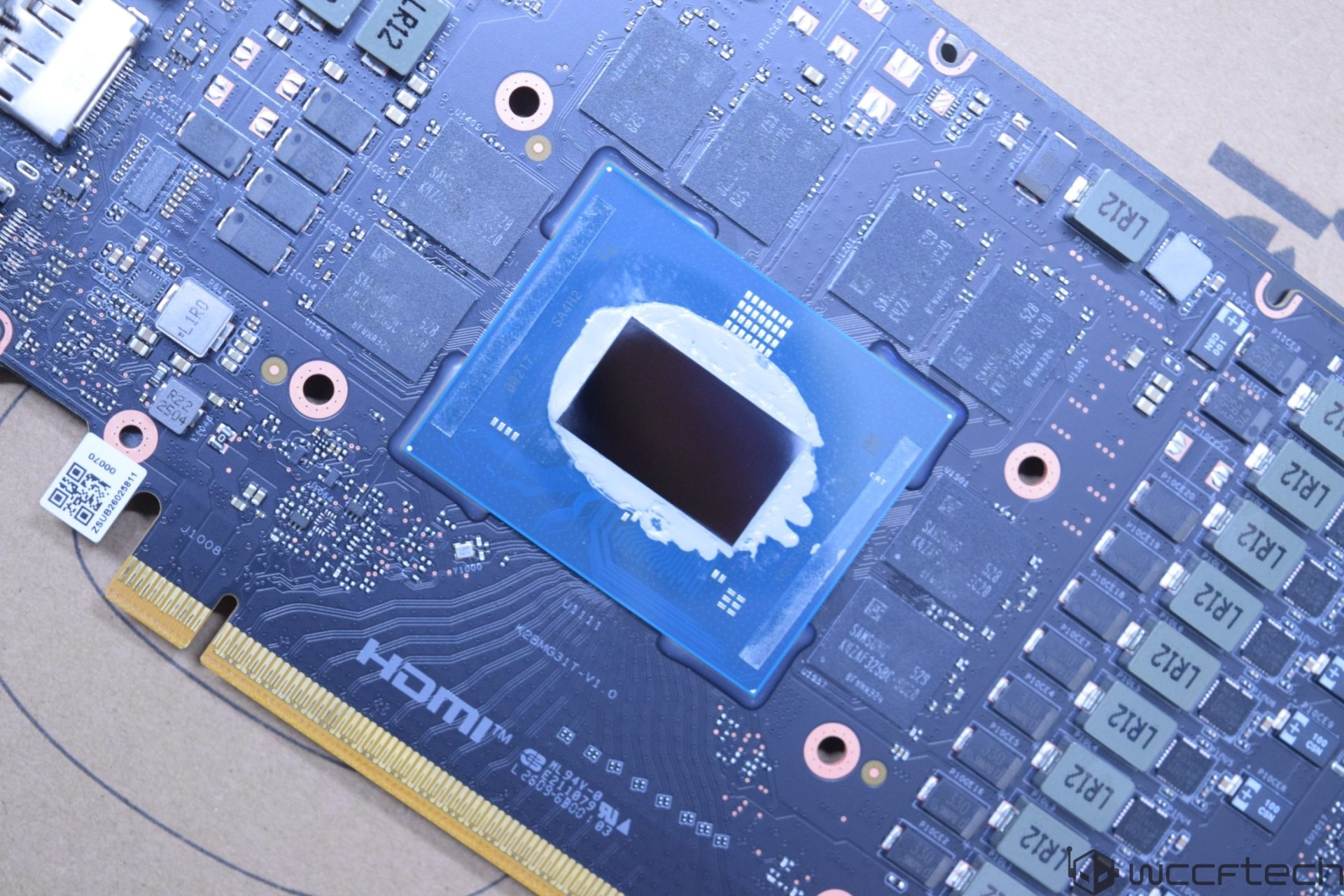
Under the cooler, the BMG-G31 GPU is paired with 32 GB of GDDR6 memory. The memory is arranged across 16 Samsung modules, with eight on the front side of the PCB and eight on the back. The PCB uses a 13-phase VRM design, suggesting Maxsun has built the card with stable workstation operation in mind.
Display connectivity
Intel’s reference Arc Pro B70 configuration supports DisplayPort 2.1 outputs, while the Maxsun version offers a different layout. The Maxsun card includes three DisplayPort 2.1 connectors and two HDMI 2.1a ports.
That gives users strong flexibility for multi-monitor workstations, high-resolution displays, creative setups, and professional visualization environments.
Arc Pro B-Series lineup comparison
Intel’s current Arc Pro B-Series covers several tiers.
The Arc Pro B70 sits at the top with the BMG-G31 GPU, 32 Xe cores, 256 XMX engines, 367 INT8 TOPS, 32 GB of GDDR6 memory, a 256-bit memory bus, 608 GB/s bandwidth, and a power range of 160W to 290W depending on the model.
The Arc Pro B65 also uses BMG-G31 but steps down to 20 Xe cores and 160 XMX engines. It offers 197 INT8 TOPS, 32 GB of memory, a 192-bit memory bus, 608 GB/s bandwidth, and a 200W power rating.
The Arc Pro B60 uses the smaller BMG-G21 GPU with 20 Xe cores, 160 XMX engines, 197 INT8 TOPS, 24 GB of memory, a 192-bit bus, 456 GB/s bandwidth, and a 120W to 200W power range.
There is also a dual-GPU Arc Pro B60 configuration with 48 GB of memory, 40 Xe cores, 320 XMX engines, 394 INT8 TOPS, and a 400W power rating.
At the entry level, the Arc Pro B50 uses BMG-G21 with 16 Xe cores, 128 XMX engines, 170 INT8 TOPS, 16 GB of memory, a 128-bit bus, 224 GB/s bandwidth, and a 70W power rating.
Price and availability
The Intel Arc Pro B70 has been available since March 2026 through Intel and board partners including ARKN, ASRock, Gunnir, Maxsun, and Sparkle.
Pricing starts at $949, though custom partner models may vary depending on cooling design, power limits, display outputs, and regional availability.
A serious step forward for Intel workstation graphics
The Intel Arc Pro B70 is one of Intel’s most important professional GPUs so far. With the larger BMG-G31 “Big Battlemage” chip, 32 GB of GDDR6 memory, 367 AI TOPS, ray tracing hardware, modern media support, and workstation-focused driver features, it is clearly built for more than basic graphics acceleration.
For AI developers, creators, engineers, and workstation users who need large VRAM capacity and strong local acceleration, the Arc Pro B70 gives Intel a much stronger position in the professional GPU market.
Maxsun’s version adds a practical dual-slot blower design, a solid cooling setup, and flexible display connectivity, making it a compelling option for compact workstations and AI-focused systems.
At $949, the Intel Arc Pro B70 is not a budget graphics card, but it brings a feature set that targets a fast-growing part of the market: local AI, professional visualization, high-resolution media work, and scalable workstation computing.Intel Arc Pro B70 Review: A 32GB Workstation GPU That Delivers Big AI, Rendering, and Gaming Performance
The Intel Arc Pro B70 is one of Intel’s most compelling professional graphics cards yet, especially for users who need high VRAM capacity, strong AI performance, solid rendering power, and surprisingly capable gaming support. Built around Intel’s newer Battlemage architecture, the Arc Pro B70 brings a major performance uplift over previous Arc Pro models while offering 32GB of graphics memory at a price point that makes it stand out in the workstation and prosumer GPU market.
Across synthetic graphics tests, professional workloads, AI benchmarks, rendering applications, and real-world gaming, the Arc Pro B70 proves that Intel’s discrete GPU efforts are moving in the right direction. It is not just a workstation card with extra memory; it is a strong all-around GPU that can handle demanding creative, AI, and even gaming tasks with impressive consistency.
Intel Arc Pro B70 graphics performance
In the standard 3DMark benchmark suite, the Intel Arc Pro B70 shows a clear advantage over the Arc Pro B60 Dual. The difference starts out noticeable in lighter tests and becomes much larger as workloads become more demanding.
In 3DMark Night Raid, the Arc Pro B70 is around 31% faster than the Arc Pro B60 Dual. Once the benchmarks shift toward heavier graphics workloads, the lead grows significantly. In Fire Strike, the Arc Pro B70 pulls ahead by roughly 53%, while Port Royal shows the biggest advantage, with the B70 leading by around 67%.
Across the full 3DMark test range, the Arc Pro B70 averages about 52% higher performance than the Arc Pro B60. That is a major generational and tier-to-tier improvement, especially for users considering the B70 for professional visualization, GPU compute, rendering, or AI acceleration.
Geekbench 6 GPU performance
Geekbench 6 was used to evaluate Vulkan and OpenCL performance, both of which are important for modern GPU workloads. The Intel Arc Pro B70 performs strongly in these tests, showing that Intel’s updated architecture and driver stack are helping the card deliver better compute and graphics performance across different APIs.
For creators, developers, and workstation users, strong Vulkan and OpenCL results matter because many professional applications rely on these APIs for acceleration. The Arc Pro B70’s performance here reinforces its position as a capable workstation GPU rather than just a high-memory graphics card.
Blender rendering performance
Rendering is one of the biggest strengths of the Intel Arc Pro B70. In the Blender benchmark, which tests GPU rendering across three different scenes, the B70 delivers a huge improvement over the Arc Pro B60 Dual.
The Arc Pro B70 leads by up to 72.3% in one Blender scene and averages around 70% faster across all three rendering tests. This is a very strong result for anyone working in 3D modeling, animation, product visualization, or creative rendering.
The combination of improved GPU horsepower and 32GB of VRAM gives the Arc Pro B70 a real advantage in heavier scenes, especially when compared with cards that may have decent compute performance but less available memory.
SPECviewperf professional workload performance
Professional workloads were also tested using SPECviewperf 15.1, a benchmark suite designed to measure GPU performance in workstation-class applications. These workloads typically represent industries such as CAD, engineering, medical visualization, 3D design, and digital content creation.
The Arc Pro B70 performs well across these professional scenarios, helped by Intel’s Arc Pro driver optimizations. For workstation users, stable drivers and application compatibility are just as important as raw performance, and Intel appears to have made meaningful progress in this area.
The card is clearly positioned for users who need reliable performance in professional software while also benefiting from a large 32GB VRAM pool.
AI benchmark performance
AI is one of the biggest selling points of the Intel Arc Pro B70. With 32GB of VRAM, the card has enough memory to run larger local AI models that may not fit comfortably on many lower-memory consumer GPUs.
In Geekbench AI, the Arc Pro B70 performs very well, helped by Intel’s OpenVINO optimizations. Its performance places it in a competitive position against modern higher-end GPUs, especially in workloads that can take advantage of Intel’s software stack.
UL Procyon AI testing also showed strong results across several AI workloads, including text generation and image generation. Tested workloads included models such as Llama 2, Mistral 7B, Llama 3.1, Phi 3.5, Stable Diffusion XL, and Stable Diffusion 1.5.
For users interested in local AI, generative AI, model testing, and development, the Arc Pro B70 is especially attractive because of its large memory capacity and strong price-to-VRAM ratio.
Intel AI Playground experience
Intel’s AI Playground software was also tested with the Arc Pro B70. This suite brings together several AI tools in one place, including local AI assistant features, generative AI tools, and other AI-powered utilities.
On the Arc Pro B70, the experience was fast and responsive. Text generation and generative AI responses were produced quickly, making the software feel practical rather than experimental. Intel has done a good job creating an accessible AI environment for users who want to explore local AI without needing to manually configure every tool from scratch.
For beginners and enthusiasts, AI Playground makes the Arc Pro B70 easier to use. For professionals, it shows that Intel is serious about building a complete AI ecosystem around its GPUs.
LM Studio and large language model performance
LM Studio testing further highlights why 32GB of VRAM is such a major advantage. The Intel Arc Pro B70 Dual 32GB is well-suited for large language models because it provides a single-GPU memory pool large enough for models that would be difficult or impossible to run on many lower-VRAM cards.
Large models such as Qwen3.5 40B, NVIDIA Nemotron Nano, and Gemma 31B were handled smoothly. Responses were generated quickly, and the GPU still had plenty of VRAM available.
Optimized 120B-class AI language models can be supported, but a more practical recommendation is to use the Arc Pro B70 for models up to around 80B. That makes it a very interesting option for AI developers, researchers, hobbyists, and prosumers who want to run large models locally without spending several thousand dollars on a professional AI GPU.
Gaming performance: the surprise factor
Although the Intel Arc Pro B70 is designed as a professional GPU, its gaming performance is surprisingly strong. With the latest Arc Pro drivers adding full game support for the Battlemage-based card, the B70 was able to run modern games smoothly and reliably.
The most surprising part is not simply that the games ran. It is that they ran very well.
This raises an obvious question: why did Intel not release a gaming-focused version of this GPU?
Cyberpunk 2077 performance
Cyberpunk 2077 was tested at High settings with XeSS enabled in Balanced mode at both 1080p and 2160p. Testing was also done with XeSS Frame Generation both disabled and enabled.
The Arc Pro B70 delivers around 40% better performance than the Arc B580, despite both being based on the same general architecture family. Compared with the older Arc A770, based on Intel’s previous Alchemist architecture, the B70 is more than 50% faster.
That is a major improvement and shows how much progress Intel has made with its newer GPU architecture and driver stack.
Forza performance
In Forza, the Arc Pro B70 shows an even larger lead over older Intel GPUs. Compared with the Arc A770, the B70 can be up to 75% faster.
Against the Arc B580, the B70 maintains a strong advantage as well, leading by around 50% at 1080p and about 42% at 2160p. These are impressive margins and suggest that a gaming version of this GPU could have been very competitive in the mid-range to upper-mid-range graphics card market.
Silent Hill 2 Remake performance
Silent Hill 2 Remake also shows strong results for the Arc Pro B70. In rasterized performance, the B70 is around 45% to 50% faster than the Arc B580.
When ray tracing is enabled, the lead narrows but remains meaningful, with the B70 showing around a 28% to 30% improvement. This demonstrates that Intel’s newer GPU architecture is becoming more capable in ray tracing workloads, though there is still room for further optimization.
Pragmata performance
In Pragmata, the Arc Pro B70 performs exceptionally well compared with the older Alchemist-based Arc A770. The performance gap can approach nearly 2x in some cases.
Against the Arc B580, the B70 is roughly 35% faster, which is still a strong improvement. The weaker showing from the older Alchemist GPU appears to be related to driver behavior, highlighting once again how important software support is for Intel’s graphics cards.
Doom: The Dark Ages performance
Doom: The Dark Ages is another strong showing for the Arc Pro B70. Raster performance is excellent, but the biggest improvement appears in path tracing, where the B70 can nearly double the performance of the older Alchemist-based card.
This is thanks to the newer ray tracing engines in Intel’s Xe2 architecture, with further improvements expected as Intel continues advancing its graphics technology. The results make a strong case for Intel to keep developing discrete GPUs for both professional and gaming users.
Thermals, cooling, and power behavior
The tested Arc Pro B70 design features a strong cooling solution that keeps the card operating at around 70°C to 75°C under full load. Power consumption typically sits around 250W, though some workloads can push the GPU closer to its full 290W power envelope.
For workstation users, this is a reasonable power and thermal profile considering the performance and 32GB memory configuration. The card remains practical for demanding professional setups, AI workstations, and high-end desktop systems.
Value and competition
One of the strongest arguments for the Intel Arc Pro B70 is value. The card offers 32GB of VRAM with an official price far below many competing professional GPUs with similar memory capacity.
While real-world pricing may vary, the Arc Pro B70’s listed price makes it highly attractive for workstation users, AI developers, content creators, and prosumers who need a large VRAM buffer without paying several thousand dollars.
The 32GB memory capacity is especially important for AI workloads. Many competing GPUs may offer faster raw performance in some cases, but if they do not have enough VRAM for larger models or complex workloads, they can quickly become limiting. The Arc Pro B70 avoids that issue by offering a large single-GPU memory pool.
Driver improvements make a big difference
Intel’s Arc Pro drivers deserve credit here. Setup was smooth, professional workloads ran well, and gaming performance was surprisingly stable. There were no major frame pacing issues or noticeable stuttering problems in the tested games.
That is important because Intel’s early discrete GPU efforts were often criticized for driver maturity. With the Arc Pro B70, the experience feels much more polished. Intel’s graphics software team has clearly made major progress, and the results are visible across professional, AI, rendering, and gaming workloads.
The gaming GPU Intel could have made
The Arc Pro B70 also highlights a missed opportunity. Based on its gaming performance, Intel could potentially have released a gaming-focused version of this GPU with higher clocks, tuned power limits, optimized cooling, and a more aggressive consumer price.
A gaming variant with 16GB of VRAM priced in the $449 to $549 range could have been very competitive against modern mid-range graphics cards. Given the B70’s performance uplift over the Arc B580, such a card could have offered a meaningful jump for gamers looking for strong 1440p performance and enough VRAM for modern titles.
Unfortunately, current market conditions may have prevented Intel from launching such a product. Still, the performance is clearly there, and it gives hope that Intel may continue expanding its discrete graphics lineup for both professionals and gamers.
Final thoughts
The Intel Arc Pro B70 is one of Intel’s most impressive discrete GPUs so far. It delivers strong graphics performance, excellent Blender rendering gains, useful professional workload acceleration, and very capable AI performance thanks to its 32GB of VRAM.
It is especially compelling for users working with local AI models, content creation, rendering, and workstation applications. The card handles 40B-class language models comfortably, can work with even larger optimized models, and offers a memory capacity that is difficult to find at this price level.
Gaming performance is the unexpected bonus. The Arc Pro B70 runs modern games smoothly and delivers major gains over both the Arc A770 and Arc B580. It proves that Intel’s Battlemage architecture has serious potential beyond the workstation market.
For AI developers, creators, workstation users, and prosumers looking for a powerful 32GB GPU under the $1000 price class, the Intel Arc Pro B70 stands out as one of the most interesting options available. It is not perfect, but its mix of VRAM, performance, software improvements, and value makes it a highly competitive professional graphics card.


