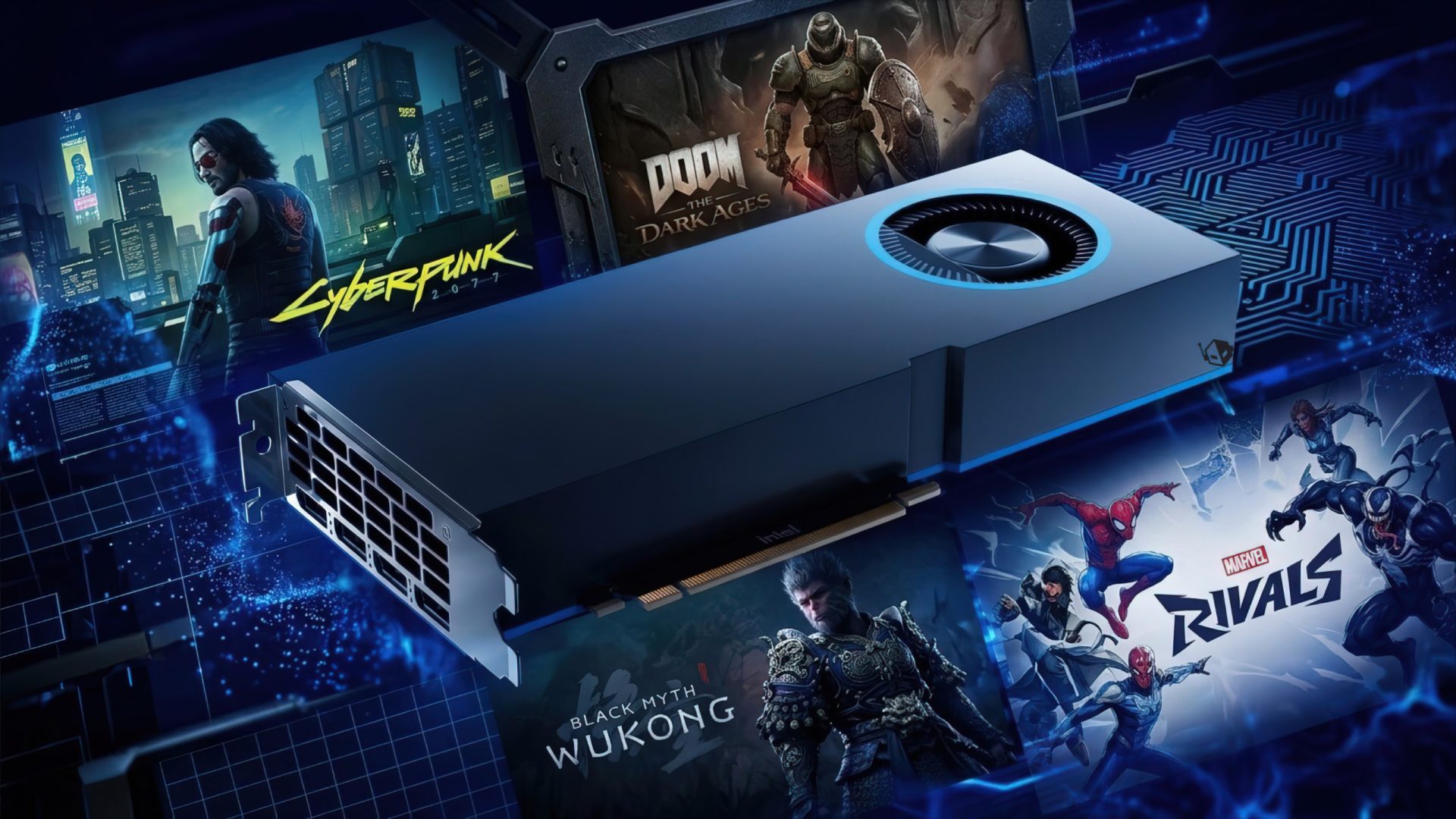
Intel’s Arc Pro B70 32GB has finally been put through real gaming tests, and the results are turning heads. Even though this GPU was positioned as a professional and AI-focused product, new gaming-ready drivers have made it possible to see how Intel’s “Big Battlemage” silicon performs in modern PC games. And based on early benchmark data, it offers a strong glimpse of what a consumer-friendly Arc B770 could have looked like—if it ever made it to market.
Intel released the Arc Pro B70 in March as the top model in its Arc Pro lineup, built on the larger Battlemage BMG-G31 GPU. For gamers, this is the chip many hoped would power a higher-end Arc desktop graphics card. Instead, Intel leaned into AI and workstation workloads, pairing the GPU with a massive 32GB of GDDR6 memory. That large VRAM capacity is a big part of why the Pro B70 sits in a higher price tier, but it also makes it an interesting alternative for creators and AI users who need memory headroom.
A recent driver update added proper gaming support for the Arc Pro B70 (and Pro B65), opening the door for broader game performance testing. With these drivers in place, the Arc Pro B70 has now been benchmarked across a range of titles at 1440p, with comparisons against Intel’s Arc B580 and NVIDIA’s GeForce RTX 5060 Ti 16GB.
Intel Arc Pro B70 specs at a glance
The Arc Pro B70 uses the full BMG-G31 “Big Battlemage” GPU and comes loaded with hardware aimed at both graphics and AI tasks. Key specifications include:
– 32 Xe2-HPG cores
– 256 XMX engines
– 32 ray tracing units
– Up to 367 INT8 TOPS for AI workloads
– 32GB GDDR6 on a 256-bit bus
– 19 Gbps memory speed for 608 GB/s bandwidth
– Around 2800 MHz GPU clock
On paper, it’s a hefty step up from the Arc B580, and the game results back that up.
1440p rasterization performance: big gains vs Arc B580
In Cyberpunk 2077 at 1440p (raster settings), the Arc Pro B70 posted 90.27 FPS. That puts it ahead of the RTX 5060 Ti 16GB at 79.06 FPS, and well above the Arc B580 at 66.02 FPS. In other words, it’s about 36.7% faster than the B580 in this title, while beating the 5060 Ti by roughly 14%.
Across additional 1440p raster benchmarks that include Black Myth: Wukong, Marvel Rivals, Monster Hunter Wilds, and Assassin’s Creed Shadows, the Arc Pro B70 continued to show major uplifts over the Arc B580—reportedly up to 41% faster. In those broader tests, the RTX 5060 Ti 16GB still held the overall lead, but the gap was often close enough to show that the bigger Battlemage chip could compete in this class.
Ray tracing benchmarks: competitive, sometimes ahead
Ray tracing is where things get especially interesting. In tests covering F1 25, Doom: The Dark Ages, Cyberpunk 2077, Monster Hunter Wilds, and Assassin’s Creed Shadows, the Arc Pro B70 managed to outperform the RTX 5060 Ti 16GB by an average of around 9% in the first three titles, with its biggest advantage in F1 25 at up to 14%.
In the remaining ray tracing titles, the RTX 5060 Ti regained a small advantage, but Intel’s gains over the Arc B580 were still substantial. Depending on the game, the Arc Pro B70 was measured up to 65.7% faster than the Arc B580 in ray tracing workloads, landing around 40% faster on average.
AI benchmarks: strong results for token throughput and latency
Beyond gaming, the Arc Pro B70’s AI positioning shows up clearly in ML-focused testing. In MLPerf Client benchmarks, it delivered the highest token throughput and the best Time-To-First-Token (TTFT), indicating strong responsiveness for local AI workloads. It also showed an advantage over the RTX 5060 Ti when using Windows ML. Intel’s OpenVINO ecosystem is expected to improve compute performance further in supported workloads.
What this suggests about a potential Arc B770 (and why it matters)
These results make one thing clear: a gaming-tuned Big Battlemage card based on the same silicon—something like an Arc B770—could have been a serious contender in the upper-midrange GPU market.
Based on the performance deltas shown here, a consumer variant could plausibly land 40–50% ahead of the Arc B580 and potentially match or even beat the RTX 5060 Ti 16GB in many scenarios. At today’s approximate pricing—around $500 for the 5060 Ti 16GB—that kind of performance at a similar or lower cost would have been extremely compelling for 1440p gamers, especially those looking for an alternative in a crowded GPU market.
The challenge is pricing and positioning. The Arc Pro B70 is listed at $949, which is largely driven by its professional branding and the 32GB VRAM configuration. A hypothetical gamer-focused model with 16GB and a $400–$500 price target could have been a standout value. However, current memory supply constraints impacting consumer PC hardware appear to be one of the reasons such a gaming version may not arrive at all.
For now, the Arc Pro B70 serves as a fascinating “what if” for PC gaming: proof that Intel’s larger Battlemage GPU can deliver strong 1440p performance, meaningful ray tracing improvements over the Arc B580, and genuinely competitive results against NVIDIA’s RTX 5060 Ti 16GB—especially now that gaming drivers are in place.