Intel is making a big push to bring local AI inference within reach for more creators, developers, and workstation users with its new Arc Pro B70. The headline pitch is simple: more memory, stronger AI-focused efficiency, and a far lower entry price than the GPU it’s being compared against.
Intel is positioning the Arc Pro B70 as a flagship option in its Arc Pro lineup for professional and AI workloads, and it’s framing the value around three core claims: up to 2.2x larger context windows versus the competition, up to 6.2x faster responses in multi-agent or multi-user workloads, and up to 2x tokens-per-dollar performance.
Arc Pro B70 vs RTX PRO 4000 Blackwell: the big differentiators
The most immediate advantage is pricing and VRAM capacity. Intel lists the Arc Pro B70 starting at $949, while the NVIDIA RTX PRO 4000 Blackwell typically sits around $1800. That’s close to double the cost on the NVIDIA side. At the same time, Intel equips the B70 with 32 GB of memory compared to 24 GB on the RTX PRO 4000, giving Intel a 50% VRAM advantage on paper.
That extra memory matters a lot for local AI work because it can directly translate into larger context windows, fewer out-of-memory errors, and less need to aggressively shrink prompts or reduce model settings.
Bigger context windows: why 32 GB can be a major AI advantage
In Intel’s testing focused on token throughput versus context length, the Arc Pro B70 is shown running Llama 3.1 8B using BF16. In that scenario, the RTX PRO 4000 reaches an out-of-memory limit at a 42K context length, while the Arc Pro B70 pushes to 93K before exhausting memory. Intel describes this as up to a 2.2x larger context window.
For AI users, that can mean handling longer documents, larger codebases, extended chat histories, or more complex agent workflows without constant truncation.
Multi-user and multi-agent workloads: higher throughput and faster “time to first token”
Intel also highlights performance in parallel “multi-agent flows,” using Ministral Instruct 2410 8B (BF16). In these multi-user or multiple-request scenarios on Linux, Intel reports up to an 85% higher token throughput versus the RTX PRO 4000.
On responsiveness, Intel points to faster time to first token in multi-user usage, with a lead that can extend up to 6.2x in its showcased results. Intel emphasizes that these results aren’t only about raw hardware, but also its oneAPI and AI software stack helping deliver better throughput and responsiveness.
Scaling up with multiple GPUs: larger models, larger contexts
Beyond single-card workstations, Intel leans into multi-GPU scalability and shows results from a 4-GPU setup on both platforms. In these comparisons, Intel lists higher maximum context windows across multiple models and precisions, including:
DS-R1-Distill-Qwen 3 32B (Int4): up to 183K context on Arc Pro B70 vs 80K on RTX PRO 4000
Qwen3 32B (FP8): up to 304K context on Arc Pro B70 vs 199K on RTX PRO 4000
Mistral-Small 24B (BF16): up to 408K context on Arc Pro B70 vs 243K on RTX PRO 4000
The broader message is that Intel wants the Arc Pro B70 to look equally compelling in an entry workstation and in a more serious multi-GPU AI box, especially for users who care about context length and cost efficiency.
Tokens per dollar: the value argument Intel wants to win
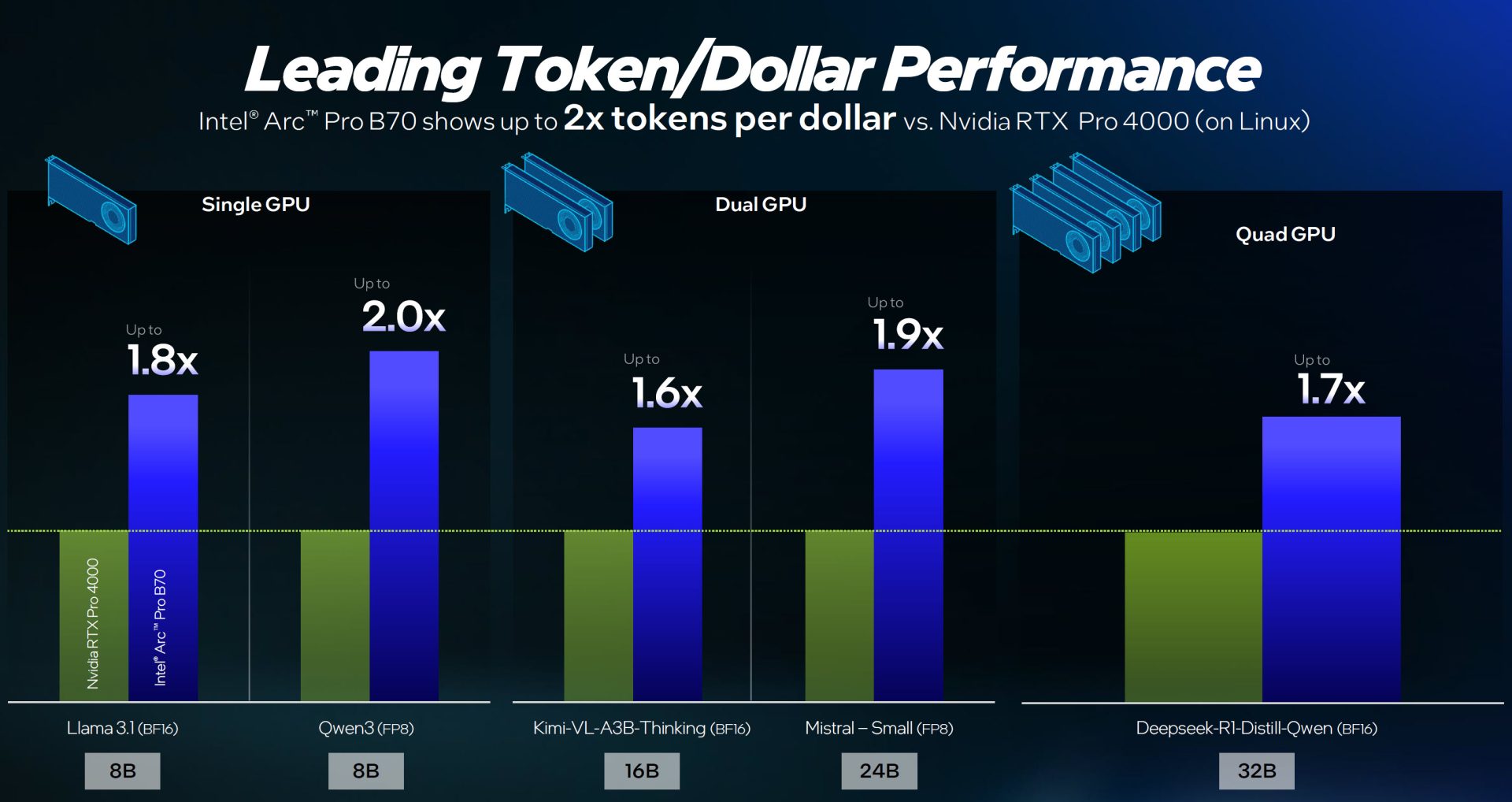
Cost-per-performance is a recurring theme in the Arc Pro B70 positioning. Intel claims up to 2x tokens per dollar across single, dual, and quad-GPU configurations, suggesting the performance scales well as you add cards, while the pricing stays comparatively accessible for professionals building AI systems on a budget.
What this means for AI creators and workstation buyers
If Intel’s showcased numbers translate cleanly into real-world workflows, the Arc Pro B70 could become a highly attractive option for local LLM inference, multi-user AI services, and professional workloads that are limited by VRAM capacity. The combination of 32 GB VRAM and a sub-$1,000 starting price is the centerpiece, with Intel’s software stack positioned as a key enabler for throughput and responsiveness.
Looking ahead, Intel’s rollout doesn’t stop with the B70. The next few months should be notable as the Arc Pro B70 and the more cost-effective B65 begin appearing on retail shelves. It also raises an interesting question for enthusiasts: could a gaming-oriented variant of this “big” Arc design ever show up, similar to past cases where pro-focused GPUs inspired niche gaming releases?