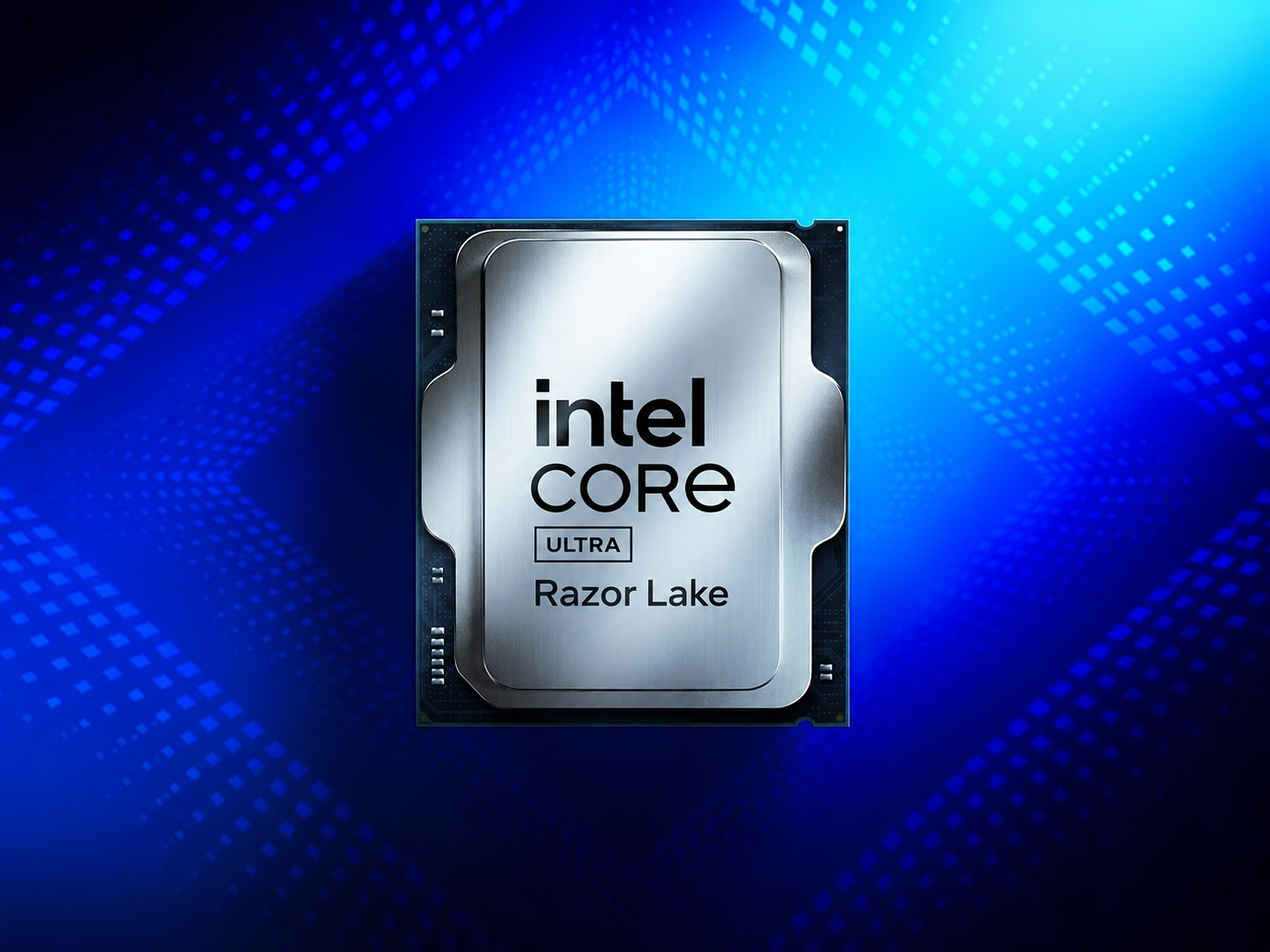
Intel Confirms Razor Lake-AX for 2028 With Up to 700 TOPS of AI Performance
Intel has officially confirmed Razor Lake-AX, a next-generation processor platform aimed at high-performance AI computing and robotics. After months of leaks and speculation, the chip has now appeared on Intel’s future roadmap, with a planned launch window in 2028.
The confirmation came during the Semiconductors Powering Humanoids conference held on October 16, where Intel executive Cho Min-sung discussed the company’s long-term robotics strategy. According to the roadmap presented, Razor Lake-AX is expected to deliver around 700 TOPS of AI processing performance, marking a major leap over Intel’s current robotics-focused platforms.
To put that number into perspective, Intel’s Panther Lake-based robotics platform currently offers up to 180 TOPS of combined AI performance. Intel plans to follow Panther Lake with Nova Lake for robotics applications in early 2027, before introducing Razor Lake-AX in 2028. If the 700 TOPS target holds, Razor Lake-AX could offer nearly four times the theoretical AI compute of Panther Lake.
However, Intel has not yet explained how that 700 TOPS figure is calculated. The company has not confirmed the precision format used for the measurement, nor has it broken down how much performance comes from the CPU, GPU, or NPU. Even so, the number suggests Intel is preparing a very powerful APU designed for demanding AI workloads.
Razor Lake-AX has been discussed in leaks for some time, with earlier rumors referring to it as Nova Lake-AX. It was described as a high-performance APU intended to compete in the same category as AMD’s Ryzen AI Max and Strix Halo-style chips. Reports have suggested that Razor Lake-AX may feature either 16 or 32 Xe3P GPU cores, which could make it one of Intel’s strongest integrated graphics solutions to date.
Another major rumored feature is on-package memory, similar to what Intel introduced with Lunar Lake. This design could help provide the high memory bandwidth needed by a large integrated GPU and advanced AI engines. For robotics, AI PCs, compact workstations, and possibly premium laptops, that kind of memory configuration could be a key advantage.
There have also been interesting claims about the processor’s CPU architecture. Some leaks suggest Razor Lake-AX may use Nova Lake’s Coyote Cove performance cores and Arctic Wolf efficiency cores, rather than the newer Griffin Cove and Golden Eagle cores expected in other Razor Lake chips. The AX version is also rumored to skip the large last-level cache expected in some other Razor Lake processors.
What makes Intel’s latest confirmation especially notable is the intended market. Razor Lake-AX is not being positioned only as a powerful chip for consumer devices. Intel appears to be aiming it directly at humanoid robots, autonomous mobile robots, and other machines that require real-time AI processing on the device itself.
Humanoid robotics is one of the most demanding emerging computing markets. Robots need to process camera data, sensor inputs, movement instructions, environmental information, and decision-making tasks instantly. Relying heavily on cloud computing can introduce latency and reliability concerns, so powerful on-device AI hardware is becoming increasingly important.
Intel expects customers to begin mass-producing autonomous mobile robots in 2027, with humanoid robot production expected to follow in 2028. That timeline lines up closely with the arrival of Razor Lake-AX, suggesting the chip could play an important role in Intel’s robotics ambitions.
The company already offers a Panther Lake-based robotics development platform known as Robinson Bay, along with software tools such as OpenVINO, Physical AI Studio, and Robotics AI Suite. These tools are designed to help developers build, train, optimize, and deploy AI models for robotics applications. Razor Lake-AX could significantly expand what developers can do without needing a separate discrete GPU.
Still, several important questions remain unanswered. Intel has not confirmed the chip’s power consumption, memory capacity, integrated GPU performance, or whether it will appear in standard laptops, mini PCs, or desktop-style systems. Given the scale of the rumored hardware, it would not be surprising if Intel also brings Razor Lake-AX to high-end mobile computing devices, compact AI workstations, and creator-focused systems.
For now, the official confirmation gives Intel watchers something concrete: Razor Lake-AX is real, it is planned for 2028, and it is targeting up to 700 TOPS of AI performance. If Intel delivers on that goal, the processor could become one of the company’s most important AI-focused chips, with potential impact across robotics, edge computing, AI PCs, and high-performance integrated graphics platforms.