Intel Razor Lake-AX SoCs Gain Early HWiNFO Support, Hinting at a Powerful Future for High-End AI PCs
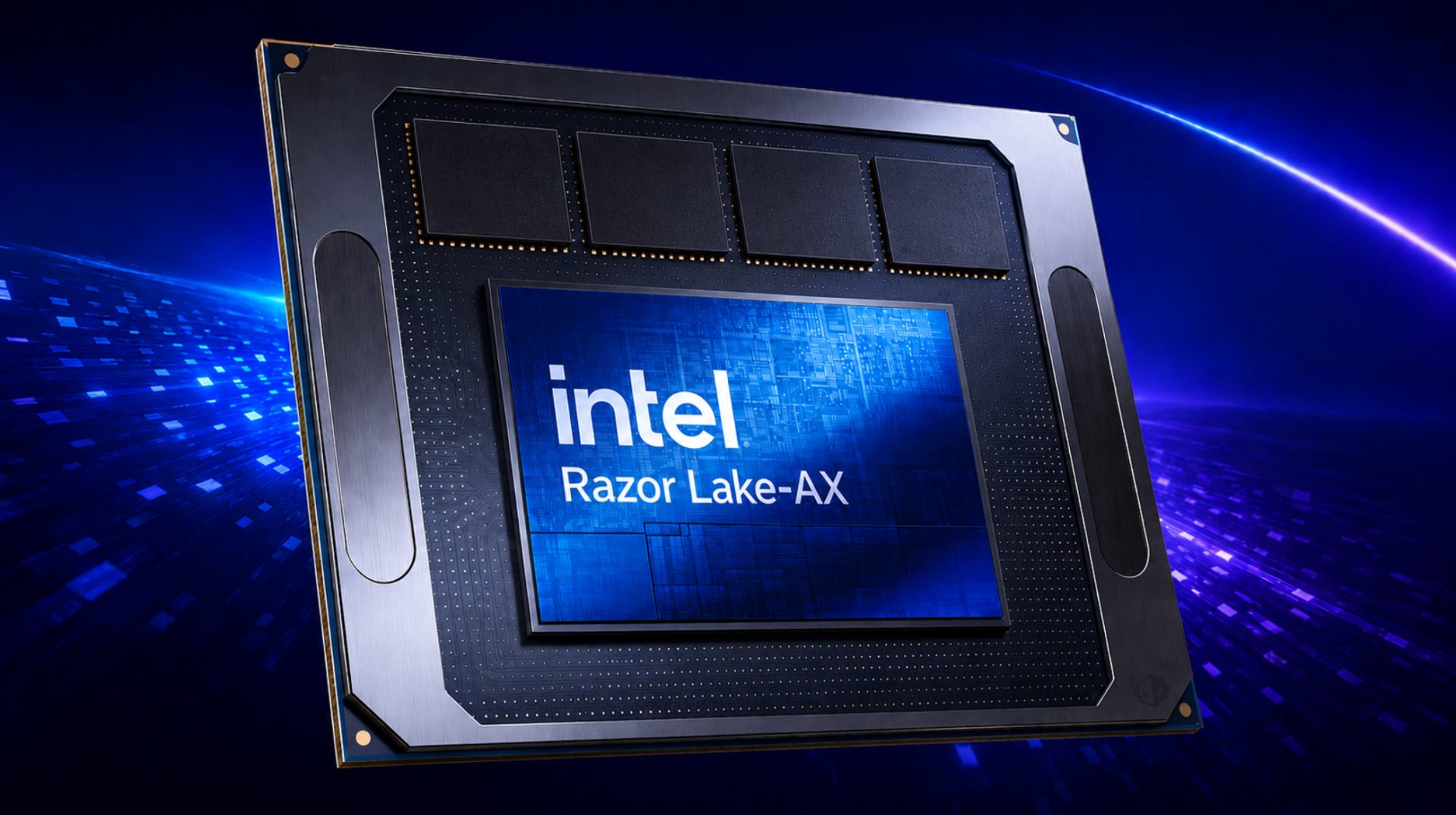
Intel’s next major move in high-performance mobile processors may already be taking shape. Early support for Intel Razor Lake-AX has appeared in HWiNFO, suggesting that development work on the company’s future “Halo-class” system-on-chip lineup is underway.
While these chips are still years away from launch, the appearance of preliminary support is an important signal. It indicates that Intel is preparing the foundation for a new class of processors aimed at premium laptops, mobile workstations, and AI-focused PCs that need far more CPU and GPU power than standard mobile chips can provide.
Razor Lake-AX could become Intel’s answer to AMD’s Halo-class APUs
The Razor Lake-AX series is expected to be part of Intel’s broader Razor Lake family, but it will not be a typical mobile CPU lineup. Unlike standard S, H, or HX-series processors, the AX chips are expected to target a more advanced category with bigger silicon, stronger integrated graphics, high CPU core counts, dedicated AI acceleration, and a more unified platform design.
Intel has not yet released an “AX” processor family to the market. Earlier expectations pointed toward Nova Lake-AX, but that lineup is no longer expected to arrive. As a result, Razor Lake-AX is now seen as Intel’s likely entry into the growing market for ultra-powerful mobile SoCs designed to compete with AMD’s top-tier Halo APUs.
AMD currently has a strong position in this segment with chips built for high-performance AI PCs and compact workstation-class systems. Intel appears to be preparing Razor Lake-AX as a direct challenger, combining next-generation CPU, GPU, and NPU technologies into one advanced package.
Why HWiNFO support matters
HWiNFO is widely used for real-time hardware monitoring, diagnostics, and system reporting. When early support for an unreleased platform appears in such software, it often suggests that hardware enablement work has already started behind the scenes.
The newly listed preliminary support for Intel Razor Lake-AX does not mean a launch is imminent. However, it does suggest that Intel’s platform planning is moving forward. Since Razor Lake is expected to arrive after Nova Lake, which is currently projected for the 2027 timeframe, Razor Lake-AX may not appear until around 2028 or 2029.
That long timeline makes this early software support notable. It points to Intel laying the groundwork well in advance for a major new mobile processor class.
Expected Razor Lake-AX specifications and architecture
Razor Lake is expected to build on the foundation of Nova Lake, with improvements across CPU, GPU, and AI processing. Current expectations suggest that Razor Lake may use Griffin Cove performance cores and Golden Eagle efficiency cores, giving Intel a more advanced hybrid architecture for future laptops and desktops.
On the graphics side, Nova Lake is expected to use Xe3 and Xe3P integrated graphics technology. Razor Lake could move forward with a refined version of Xe3P, also known as Celestial, or potentially adopt Intel’s next-generation Xe4 Druid graphics architecture.
For Razor Lake-AX, the integrated GPU will likely be a major focus. Halo-class chips are designed to deliver far stronger graphics performance than typical laptop processors, reducing the need for a separate discrete GPU in some systems. This could make Razor Lake-AX especially attractive for AI workloads, content creation, gaming laptops, and compact performance machines.
On-package memory could return with Razor Lake-AX
One of the most interesting expected features of Razor Lake-AX is on-package memory. Intel previously used this approach with Lunar Lake, but it is not expected to appear on Arrow Lake or standard Nova Lake chips.
Bringing on-package memory back for Razor Lake-AX would make sense for a high-performance SoC. By placing memory closer to the processor, Intel could improve bandwidth, reduce latency, and increase efficiency. Future standards such as LPDDR6 may be used by the time these chips are ready.
This approach would also support a unified memory architecture, where CPU, GPU, and AI engines can access shared high-speed memory more efficiently. That design is becoming increasingly important for AI PCs, where large models and real-time workloads benefit from faster memory access and tighter integration between compute units.
How Razor Lake-AX differs from standard Razor Lake chips
Standard Razor Lake processors are expected to launch across desktop and mobile platforms, with compatibility planned around the broader Nova Lake ecosystem. That could make the transition smoother for mainstream S, H, and HX-series systems.
Razor Lake-AX, however, is expected to be different. Instead of using a conventional CPU design, it is likely to be a full system-on-chip built for high-end mobile platforms. This means it may require unique motherboard layouts, cooling designs, power delivery systems, and memory configurations.
The AX lineup is expected to combine a high CPU core count, a large integrated GPU, advanced cache structures, AI acceleration, and multiple onboard controllers. In other words, Razor Lake-AX is not just another laptop CPU. It is likely being designed as a complete premium computing platform.
A future battle in premium AI PCs
The high-end AI PC market is becoming one of the most important battlegrounds in computing. Users increasingly want laptops and compact systems that can handle AI acceleration, local model processing, heavy multitasking, gaming, and creative workloads without relying entirely on cloud services or bulky discrete hardware.
AMD has already pushed aggressively into this space with Halo-class APUs, and more refreshes are expected in the coming years. Intel’s Razor Lake-AX could arrive as the company’s strongest response, potentially combining powerful x86 cores with advanced integrated graphics and dedicated AI hardware.
There are also expectations that Intel may work on custom SoCs that combine its CPU technology with external GPU architectures from major graphics partners. If those projects arrive near the same timeframe, Intel could have multiple approaches to the premium AI PC market.
When could Intel Razor Lake-AX launch?
Based on current expectations, Razor Lake is likely to follow Nova Lake, placing the broader family around the late 2020s roadmap. Since Nova Lake is expected in 2027, Razor Lake-AX may arrive sometime between 2028 and 2029.
That means consumers should not expect Razor Lake-AX laptops anytime soon. Still, early software support suggests Intel is already preparing for a major push into this space.
If the final design delivers strong CPU performance, powerful integrated graphics, fast unified memory, and efficient AI acceleration, Razor Lake-AX could become one of Intel’s most important mobile platforms of the next decade.
For now, the early HWiNFO support is a small but meaningful clue: Intel’s future Halo-class SoC strategy appears to be alive, and Razor Lake-AX may be the chip family that brings it to market.