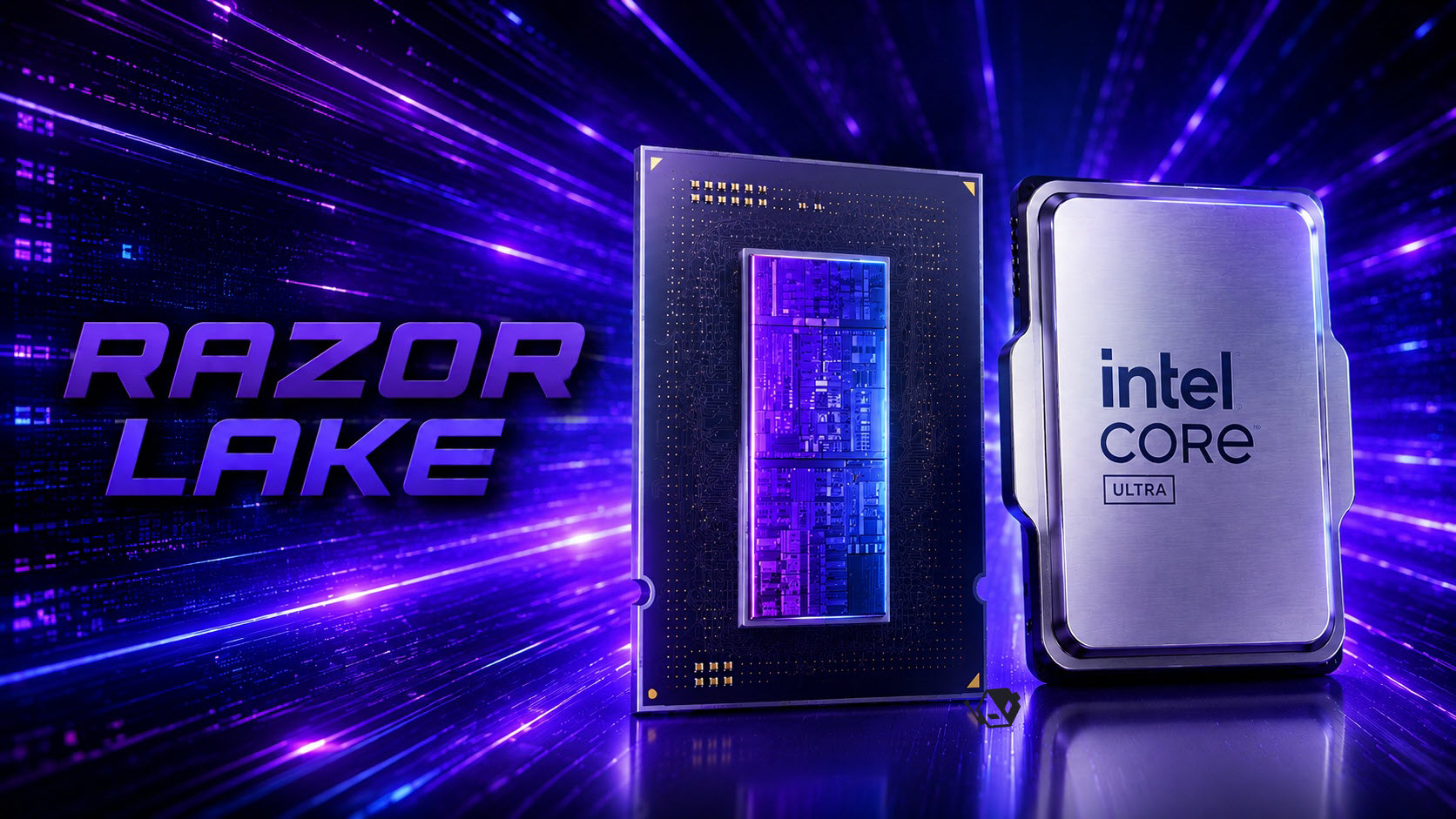
Intel Razor Lake CPUs Reportedly Move to TSMC N2X With Big Cache Upgrades for Laptops
Intel’s next wave of client processors is already starting to take shape, and the latest rumors suggest Razor Lake could be one of the company’s most performance-focused CPU families yet. Expected to arrive after Nova Lake, Intel Razor Lake CPUs are reportedly being designed around TSMC’s advanced N2X process technology, while also bringing a major cache upgrade to high-end laptops.
According to recent hardware leaks, Nova Lake is expected to use a combination of TSMC N2P and Intel 18A technologies. Razor Lake, however, may push things further by adopting TSMC’s N2X node, a more performance-oriented version of the 2nm-class process.
The use of TSMC N2X would be an important move for Intel. This node is designed to deliver higher frequencies and stronger current handling compared to N2P. The trade-off is higher leakage and reduced power efficiency, but that makes sense for a CPU family focused on maximum performance. If the rumors are accurate, Razor Lake could be built to chase very high clock speeds, potentially scaling beyond 6 GHz.
Details about Intel Razor Lake are still limited, but early information points to a split between standard S/H variants and more powerful AX variants. The standard compute tiles are expected to combine Griffin Cove performance cores with Arctic Wolf efficiency cores. Meanwhile, the AX models, which appear to be aimed at competing with AMD’s high-end mobile chips, are rumored to feature Coyote Cove performance cores alongside Arctic Wolf efficiency cores.
One of the more interesting architectural details is the role of Griffin Cove. It is described as a “Tock,” meaning it would represent a new architecture rather than a simple refinement of the Coyote Cove performance core. If true, this could make Razor Lake a more substantial generational leap rather than a minor refresh.
Another major upgrade reportedly planned for Razor Lake is the arrival of bLLC, also known as Big LLC cache, in laptop processors. This would be especially important for gaming laptops and mobile workstations, where larger cache pools can improve performance in games, content creation, and other latency-sensitive workloads.
Intel is expected to introduce Big LLC first on Nova Lake-S desktop processors. However, the technology is not expected to appear on Nova Lake-H or Nova Lake-HX laptop chips. That means Intel’s enthusiast mobile lineup may have to wait until Razor Lake-HX before receiving a cache upgrade similar in concept to AMD’s 3D V-Cache approach.
Nova Lake desktop chips are rumored to offer up to 144 MB of L3 cache with a single compute tile and up to 288 MB with a dual compute tile layout. If Intel brings similar cache-focused thinking to Razor Lake laptops, it could significantly improve the company’s competitiveness in premium gaming notebooks.
This matters because AMD has already been pushing cache-heavy mobile processors through its Ryzen HX3D lineup. AMD’s Ryzen 7000HX and 8000HX series introduced 3D V-Cache to high-end laptops, while the newer Ryzen 9000HX “Zen 5” chips continue that strategy. These laptop processors can offer up to 128 MB of L3 cache, while AMD’s desktop chips can reach up to 192 MB with dual 3D V-Cache designs.
Intel Razor Lake-S and Razor Lake-HX processors are also expected to include integrated graphics with 2 Xe3 GPU cores, similar to what is rumored for Nova Lake-S and Nova Lake-HX. These integrated graphics are unlikely to replace discrete GPUs in enthusiast systems, but they can still be useful for display output, media acceleration, and efficiency-focused tasks.
Looking further ahead, Intel’s future Titan Lake platform is also beginning to surface in early rumors. Titan Lake is said to be the first major step toward unifying Intel’s performance and efficiency core strategy. The platform may feature Copper Shark performance cores paired with Golden Eagle efficiency cores, or it could use Copper Shark designs for both performance and efficiency cores, depending on validation progress.
For now, Nova Lake remains the next major Intel client CPU family to watch, but Razor Lake is already shaping up to be a potentially important follow-up. With TSMC N2X process technology, new CPU core architectures, higher clock speed potential, and Big LLC cache for laptops, Intel appears to be preparing a more aggressive push into the high-performance desktop and mobile processor markets.
If these leaks prove accurate, Razor Lake could become a key product family in Intel’s battle against AMD’s Ryzen HX3D and future cache-enhanced processors, especially in gaming laptops and enthusiast PCs.