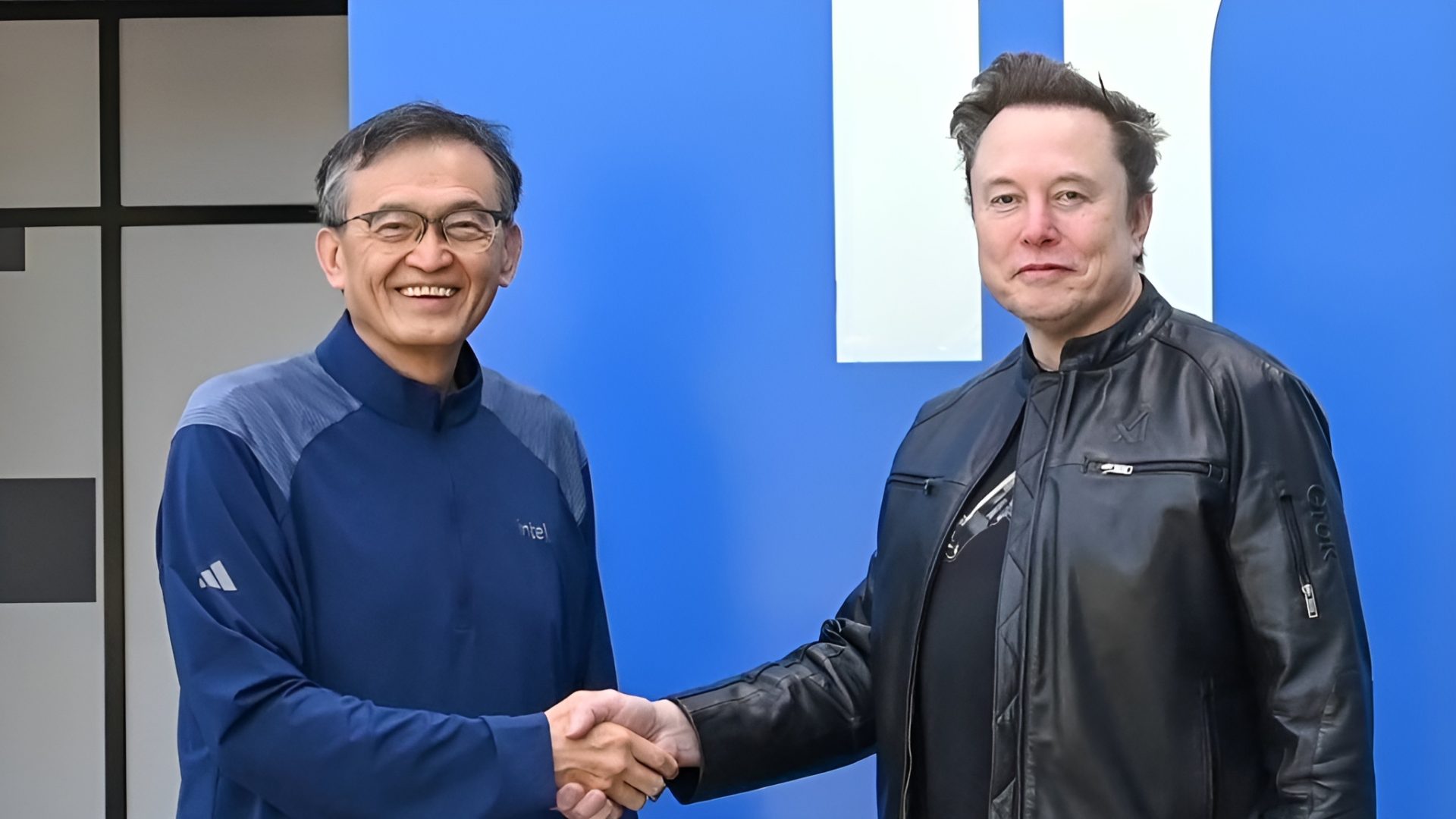
Intel Foundry may have just landed one of its most high-profile partnerships yet. Intel has announced plans to join Tesla’s ambitious TeraFab project, a large-scale manufacturing push designed to deliver 1 terawatt (TW) of compute capacity per year.
The move is turning heads because it brings together two big goals that have been building momentum for years: Tesla’s drive to scale AI compute dramatically, and Intel’s push to expand advanced chipmaking in the United States. Intel confirmed the collaboration publicly on its official X account, noting it will work alongside Tesla, xAI, and SpaceX to modernize how silicon fabs are built and operated at massive scale. The message is clear: this isn’t just about producing chips, it’s about reinventing the factory model itself.
Why Tesla needed a partner for TeraFab
TeraFab has been positioned as an answer to one of the most pressing realities in modern tech: the world’s most advanced chips are still heavily dependent on a small number of overseas manufacturing hubs. Tesla’s plan aims to reduce reliance on external supply chains and create a domestic semiconductor production capability big enough to support the next generation of AI systems.
But there’s a catch. Building a chip fab is already extremely difficult. Building one that can manufacture leading-edge nodes—like 2nm-class chips—is a different level entirely. That kind of production requires deep process technology, manufacturing know-how, and a mature ecosystem for everything from tools and materials to advanced packaging. Tesla has the capital and the urgency, but it doesn’t have established semiconductor process IP. That’s why an alliance with an experienced foundry partner always seemed likely.
Intel now appears to be that partner.
Intel CEO Lip-Bu Tan framed the partnership as a strategic step forward for the industry, pointing to Elon Musk’s history of reshaping complex sectors and positioning TeraFab as a “step change” in how logic, memory, and packaging could be produced in the future.
How Intel’s 18A process could fit into Tesla’s plans
One of the most intriguing parts of this collaboration is what it could mean for Intel’s advanced 18A process technology. Intel’s 18A has reportedly been in production at Fab 52 in Arizona since late last year, signaling that the domestic groundwork for cutting-edge manufacturing is already in place.
The likely next step is that Intel helps Tesla stand up and optimize the Austin-based facility around Intel’s foundry model, accelerating the ramp to high-volume manufacturing. Under this scenario, Intel’s 18A technology could be licensed for production at the TeraFab lines—either under the same name or under a Tesla-specific implementation, depending on how Tesla wants to shape its next-generation AI chip lineup, including the AI6 direction mentioned in discussion around TeraFab ambitions.
In practical terms, this would give Tesla a faster path to domestically built, leading-edge chips, while giving Intel Foundry a major flagship customer associated with AI scale and aggressive compute targets.
More than wafers: advanced packaging could be part of the deal
Beyond the core process node, there’s also the question of packaging—an increasingly critical part of modern high-performance computing. The discussion around this partnership suggests Texas could also become a site for advanced packaging technologies such as EMIB (and related approaches). If that happens, TeraFab could evolve into something larger than a traditional fab project: a more complete, end-to-end domestic stack covering fabrication and packaging at scale.
What comes next for Intel, Tesla, and US chip manufacturing
Key details—like how revenues would be split for chips produced through the project—haven’t been disclosed yet. But even without those specifics, the announcement signals something bigger than a typical supplier agreement. This partnership strengthens two major pillars at once: the push for a truly “total” domestic semiconductor manufacturing ecosystem, and the foundational structure required to make the TeraFab concept realistic.
If Intel’s process leadership and production experience combine effectively with Tesla’s appetite for scale and infrastructure investment, TeraFab could become one of the most closely watched manufacturing efforts in the semiconductor industry. For now, the direction is set: more domestic chip production, more AI compute capacity, and a race to build fabs that look nothing like the ones the industry is used to.