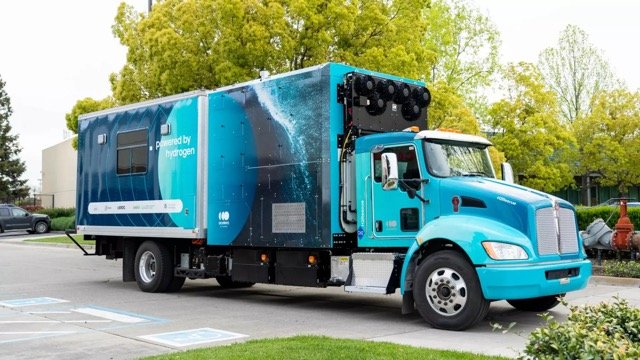
Accelera, a branch of Cummins based in the United States, has shattered a Guinness World Record by achieving the longest distance with a hydrogen fuel cell electric heavy-duty truck without needing to refuel. This remarkable journey was accomplished with the H2Rescue truck, a Kenworth T370 prototype meticulously crafted for emergency response missions.
The truck achieved an astounding 1,806 miles (or approximately 2,900 kilometers), which is about the same distance as driving from Berlin to Porto. Throughout this impressive journey, it consumed 168 kilograms of hydrogen from an initial 175-kilogram supply, emitting zero carbon dioxide. To put this achievement in perspective, an equivalent diesel truck would have released roughly 664 pounds (or 300 kilograms) of CO2 over the same distance.
Equipped with a fuel cell engine and a robust 250-kilowatt traction motor, the H2Rescue truck was put to the test in real-world scenarios, including navigating rush-hour traffic. It kept a speed range of 80 to 88 kilometers per hour, while handling various temperatures between 15°C and 26°C.
This groundbreaking truck is a product of collaboration among Accelera, the U.S. Department of Homeland Security’s Science and Technology Directorate, the U.S. Department of Energy, and the U.S. Department of Defense. Their teamwork underscores the increasing viability of hydrogen fuel cells in heavy-duty and emergency response transportation.
However, despite this phenomenal achievement, hydrogen fuel as an alternative faces some hurdles, primarily regarding cost. Currently, the price of hydrogen fuel for FCEVs varies between EUR 7 to EUR 8 per kilogram, depending on production factors and usage, according to 2023 data from Independent Commodity Intelligence Services (ICIS). Nevertheless, experts anticipate a drop in prices to about EUR 4 per kilogram in the future, potentially making hydrogen a more competitive option compared to traditional diesel fuels.