Ryzen 9 9950X reportedly burns out in two separate tests, despite cool temps and stock settings
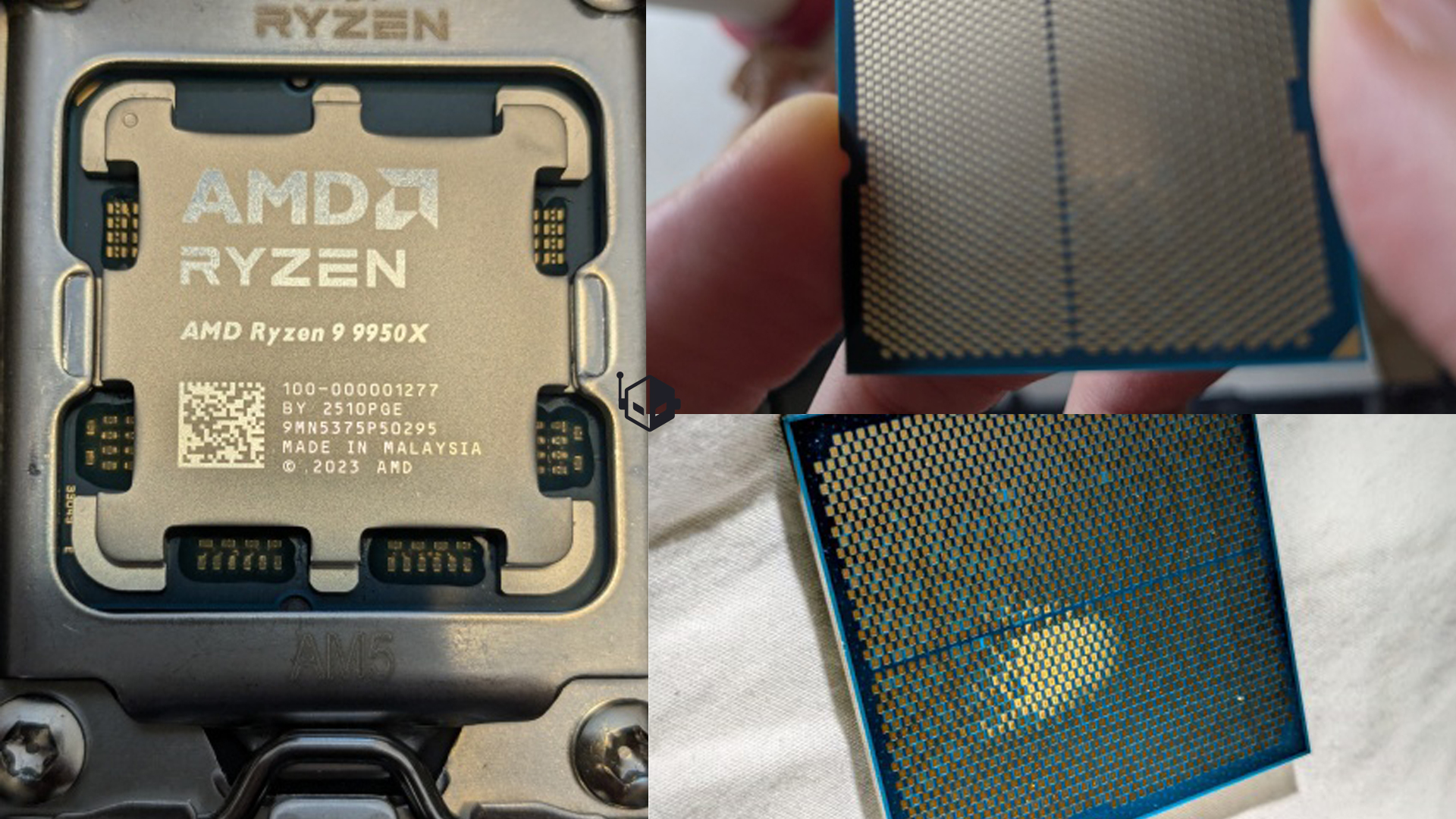
A new report from GMP Project describes two nearly identical failures of the flagship Ryzen 9 9950X. In both cases, the CPU died during testing and showed a large discolored yellow patch on the pin side. Neither system was overclocked or overvolted, and both ran with extra case fans and low ambient temperatures.
According to the group, the first incident occurred in February and the second just days ago. Both test beds used budget-friendly ASUS B650 motherboards: one with a Prime B650M-K on BIOS 3057, the other with a Prime B650M-A WiFi on BIOS 3278. The CPUs were cooled by the same Noctua NH-U9S cooler. While the NH-U9S is a well-regarded single-tower design, it can be challenged by a 170W-class processor under sustained heavy load. Even so, GMP says airflow and case ventilation were more than adequate in both setups, with ambient temps under or just above 20°C.
Aside from different RAM and PSUs, the two systems were configured similarly. Importantly, GMP states no overclocking or manual voltage adjustments were used. Yet both CPUs failed while running the team’s testing suite, leaving visible burn marks on the underside.
Image Credit: gmplib.org
Why did it happen? GMP floats a few possibilities. One is that the Ryzen 9 9950X may have drawn more power than expected under this specific workload, though that remains speculation. Another theory involves cooler mounting. In the second system, the team used an offset mounting approach recommended to better cover the hotter area of the heatspreader. They suspect the way the thermal paste spread could have created small voids between the IHS and the heatsink, potentially triggering a localized hotspot. That said, the first CPU was mounted in a centered configuration and still failed, which complicates the offset theory.
This behavior contrasts with the previous-generation Ryzen 9 7950X in their lab, which reportedly ran hotter for longer without showing similar issues.
Image Credit: gmplib.org
What PC builders can do right now
– Keep everything stock until more is known. Avoid manual voltage tweaks and aggressive power limits for the time being.
– Update your BIOS and chipset drivers to the latest stable releases, then retest.
– Reseat the cooler carefully. Whether centered or offset, ensure even pressure, full contact, and an even paste spread. Consider a higher-capacity cooler if you run long, all-core workloads.
– Monitor temps, PPT, and clock behavior during stress tests. If power draw or temperatures spike unexpectedly, stop the test and inspect the hardware.
– Inspect the CPU and socket after any thermal event. Discoloration on the pin side or socket pads is a red flag.
– If you run heavy math or AVX-heavy workloads, ramp up gradually and watch telemetry closely.
GMP Project reports it is continuing to investigate. For anyone experiencing similar failures, document your configuration, BIOS version, and mounting method, photograph any visible damage, and contact your hardware vendors for support.