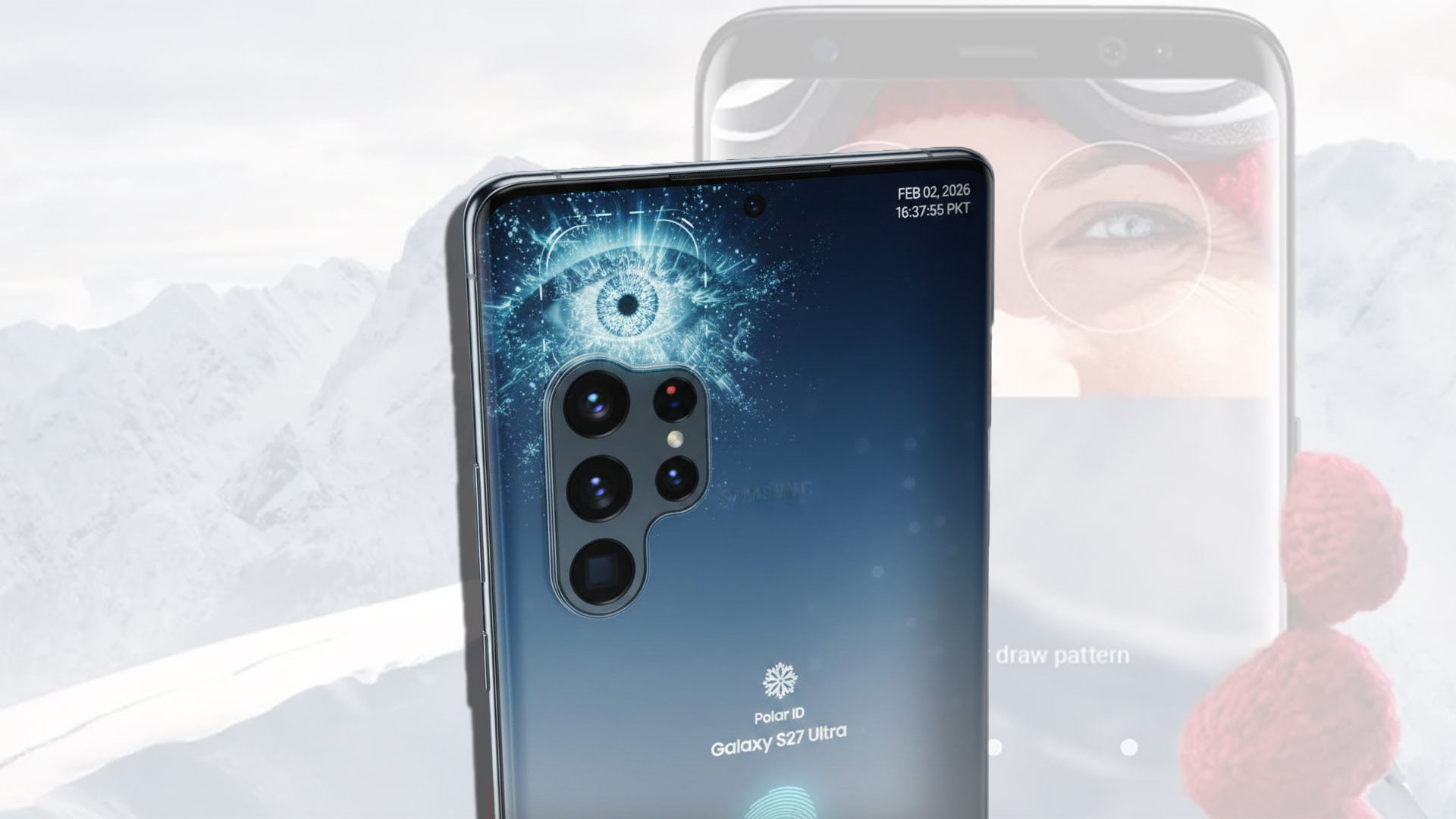
Samsung hasn’t truly matched Apple’s Face ID experience on Galaxy phones since the iris scanner era that started with the Galaxy S8 series. Since then, the company has leaned on fast, dependable fingerprint scanners across its lineup. But a new report suggests Samsung may be preparing something far more advanced for a future flagship: the Galaxy S27 Ultra could debut Polar ID, a next-generation facial recognition system that may be more secure, faster to use, and easier to integrate into a modern display design.
The big idea behind Polar ID is that it doesn’t rely on the same approach as traditional 3D facial scanning. Instead of depending primarily on depth mapping, Polar ID uses polarized light. That shift could offer an important real-world benefit: it may eliminate the need for a large front cutout to fit bulky facial recognition hardware.
How Polar ID could work on the Galaxy S27 Ultra
According to details shared by @phonefuturist, Polar ID would still be a hardware-and-software combo like other secure face unlock systems, but with a different method of verifying who you are.
First, the phone emits infrared (IR) light toward your face. Next, meta-optics filter the polarization state of the reflected light. A specialized sensor then captures a single image containing both the visual information and polarization data at the same time. Finally, the device’s secure enclave processes this “polarization map” and compares it against a stored reference. If everything matches, the Galaxy S27 Ultra unlocks.
In other words, it’s not just checking a picture of your face. It’s analyzing how your skin interacts with light in a way that’s extremely difficult to replicate.
Why Polar ID could be harder to spoof than typical face unlock
One of Polar ID’s most promising advantages is security against spoofing attempts. The report claims inorganic materials reflect light with polarization characteristics that differ greatly from human skin. That difference makes it very difficult for fake faces, masks, or other non-organic tricks to fool the system, because the polarization signature won’t match what the sensor expects from real skin.
Smaller hardware, cleaner design
A major drawback of Face ID-style setups is the space they require. Systems that depend on multiple components—such as an IR camera, dot projector, and flood illuminator—typically need a noticeable cutout or a wider “notch-like” area to fit everything.
Polar ID reportedly shrinks that entire stack significantly, with the hardware estimated to be about 50% smaller than Apple’s Face ID module. That matters for phone design, because it could allow Samsung to keep a sleeker front look—potentially sticking with the familiar punch-hole camera style on the Galaxy S27 Ultra rather than expanding the cutout for additional sensors.
Speed, reliability, and everyday convenience
If the reporting is accurate, Polar ID could deliver an unlock time of around 180 milliseconds, which is in the same speed class as Face ID. It’s also said to be less affected by harsh lighting conditions, and to keep working well even when you’re wearing glasses or a face mask—two situations that can cause inconsistent results for some facial recognition systems.
Cheaper than Face ID, and possibly coming to more phones
Another interesting angle is cost. Polar ID is expected to be cheaper than Face ID. If Samsung can scale production and optimize the components over time, that could open the door for this kind of advanced facial recognition to appear not only on ultra-premium models, but also on more affordable smartphones in the future.
For now, it’s still early and there’s no official confirmation from Samsung. But if Polar ID does arrive with the Galaxy S27 Ultra, it could mark one of the biggest upgrades to Galaxy biometric security and front-screen design in years.