Beelink has been building compact desktops since 2011 and has become a go-to name for powerful Mini PCs that don’t take over your desk. The latest addition, the EQi13 Pro, brings 13th Gen Intel performance, generous memory and storage options, and a clean, cable-light setup thanks to its integrated power supply. Even better, it hits a very friendly price point around $450, making it an appealing choice for home offices, students, and small businesses that want serious multitasking muscle without a bulky tower.
At its core, the EQi13 Pro can be configured with either an Intel Core i5-13500H or Core i7-13620H. Depending on the chip you choose, you’re looking at up to 12 cores and 16 threads on the i5 or 10 cores and 16 threads on the i7, with boost clocks up to 4.9 GHz and 24 MB of Smart Cache. The tested unit features the Core i7-13620H, 32 GB of dual-channel DDR4-3200 memory (2 x 16 GB), and a fast 1 TB PCIe 4.0 NVMe SSD. Storage is a highlight: there are two M.2 2280 PCIe 4.0 x4 slots supporting up to 4 TB each, so you can scale to 8 TB total if you need space for large media libraries or project files.
Graphics are handled by Intel UHD with 64 execution units up to 1.5 GHz. While it isn’t designed for modern AAA gaming, it easily covers everyday visuals, media playback, and light creative tasks. If you need acceleration beyond that, you’ll want to lean on CPU horsepower or attach dedicated peripherals.
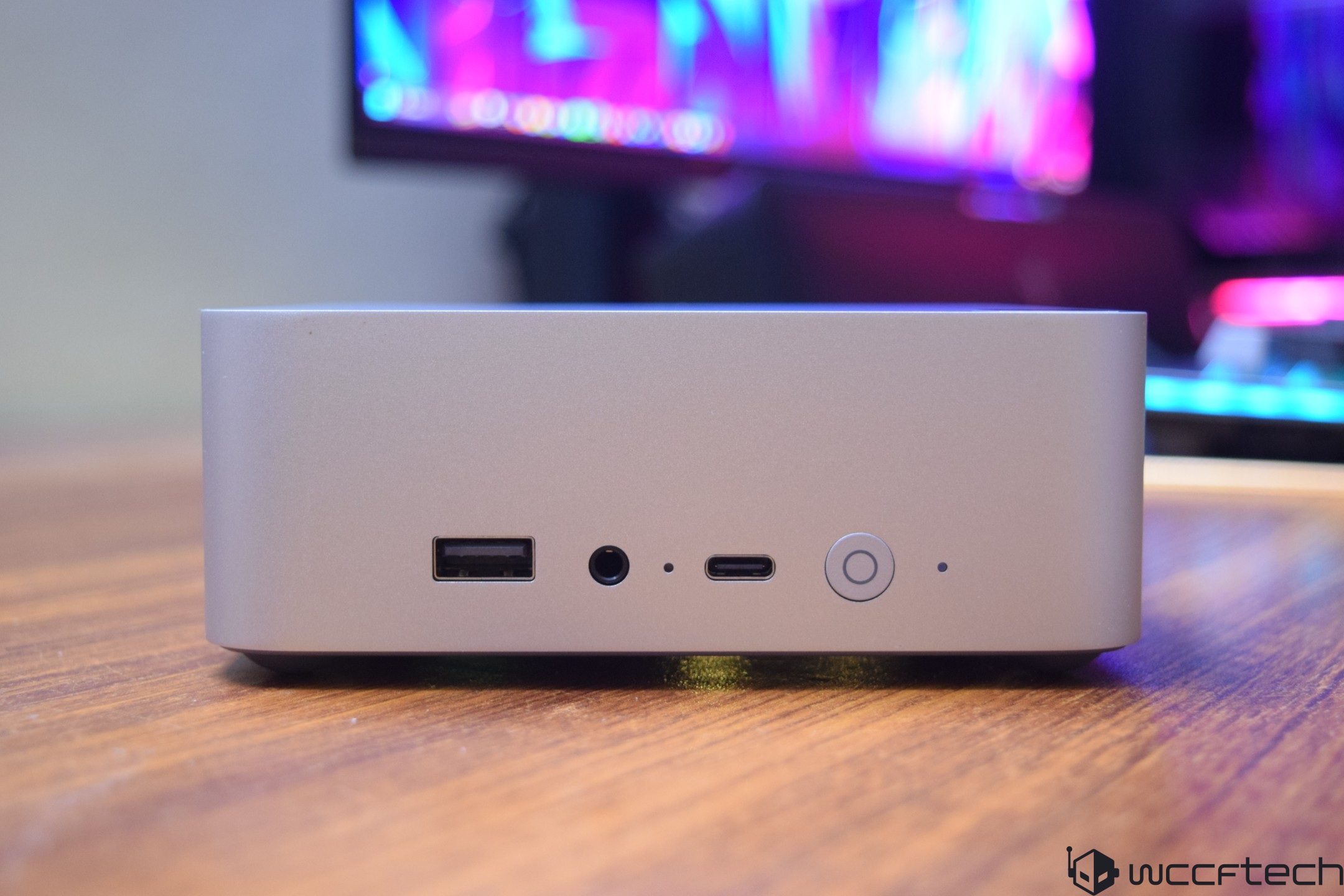
Connectivity is excellent for such a small box. Up front, you get a 10 Gbps USB-A, a 10 Gbps USB-C, a 3.5 mm audio jack, a Clear CMOS button, a power LED, and the power button. Around back, there are two 10 Gbps USB-A ports, one USB 2.0 Type-A, two HDMI outputs for dual displays, dual Gigabit Ethernet ports, and the power-in. Wireless is handled by Wi-Fi 6 (Intel AX200) with speeds up to 2.4 Gbps and Bluetooth 5.2 for stable connections to keyboards, mice, headsets, and other peripherals.
One of the smartest touches is the built-in 85W power supply. Instead of a bulky external brick, the PSU is integrated into the chassis, so you only need a single power cable. It’s a clean-desk dream that makes the EQi13 Pro easy to place anywhere, whether tucked behind a monitor or on a bookshelf.
Cooling is handled by Beelink’s quiet design with bottom air intake, large rear exhaust vents, dual heatpipes, a finned heatsink, and a smartly tuned fan. The result is near-silent operation during typical workloads while keeping the CPU, RAM, and SSD temperatures under control. The compact case measures 135 x 135 x 44.7 mm, and the aluminum finish with curved edges feels premium. You can choose between Space Gray and Frost Silver finishes, both of which look sharp in professional or home setups.
Upgrades are straightforward. Remove four screws hidden under the rubber feet to access the internals. Inside, you’ll find a metal dust filter, the integrated PSU, and a heatsink covering the M.2 slots. Memory comes standard at 32 GB in dual-channel mode; you can swap in higher-capacity SO-DIMMs if your workflow demands more. Storage expansion is as simple as adding or replacing M.2 drives. There are no built-in speakers or microphones, which is common in this price bracket and easy to work around with USB or Bluetooth peripherals.
In everyday use, the EQi13 Pro’s 45W power profile on the Core i7-13620H delivers responsive multitasking across office apps, dozens of browser tabs, code editors, light photo and video edits, and AI assistants like Copilot. It’s a strong fit for productivity-first workloads where quick app launches, snappy file access, and reliable connectivity matter most. Dual LAN is a bonus for anyone who wants link aggregation, soft routing, intranet/extranet isolation, or virtualization-friendly networking in a tiny footprint.
Key highlights that make the EQi13 Pro stand out:
– 13th Gen Intel Core performance with i5-13500H or i7-13620H options
– 32 GB dual-channel DDR4-3200 memory included, upgradeable by the user
– Dual M.2 2280 PCIe 4.0 x4 slots supporting up to 8 TB total
– Dual HDMI for two displays and dual Gigabit Ethernet for flexible networking
– Wi-Fi 6 and Bluetooth 5.2 for fast, stable wireless connections
– Integrated 85W PSU for a clean, single-cable setup
– Quiet, efficient cooling in a compact 135 x 135 x 44.7 mm chassis
If you’re shopping for a Mini PC that balances price, performance, and expandability, the Beelink EQi13 Pro hits a sweet spot. It’s small, powerful enough for serious daily work, easy to upgrade, and tidy on the desk thanks to the built-in power supply. For anyone who values a compact, clutter-free workspace without compromising on connectivity or storage, this little desktop is an easy recommendation.Beelink EQi13 Pro Mini PC: how its Intel Iris Xe iGPU stacks up at 1080p
If you want a compact desktop that can double as a light gaming rig, the Beelink EQi13 Pro is an appealing option. It pairs a 45W Intel Core i7-13620H with Intel Iris Xe graphics and aims squarely at smooth 1080p esports play with careful settings. We put its integrated GPU performance into context against today’s most popular mini PCs and mobile-class chips, including AMD’s Radeon 890M/780M/680M, Intel’s latest Arc 8 Xe inside Core Ultra processors, and older Vega and Iris Xe-LP solutions.
What we tested and compared
– 1080p gaming across popular esports titles and a mix of recent AAA releases
– Integrated GPUs: AMD Radeon 890M, 780M, 680M; AMD Vega 8/7/6; Intel Iris Xe (12th/13th Gen); Intel Iris Xe-LP; Intel Arc 8 Xe in Core Ultra
– Representative systems and power limits: 35–65W configurations to show how TDP impacts performance
– Upscaling and frame tech where supported: FSR, XeSS, and frame generation on capable iGPUs
The quick take
– Top tier integrated graphics today belong to AMD’s Radeon 890M, especially when paired with very fast memory (LPDDR5X-8000) and with frame generation enabled. It sits at the top of our 1080p charts and even brushes against older entry discrete GPUs in some esports titles.
– Just behind, Radeon 780M RDNA 3 remains a gaming sweet spot. At 65W it delivers very playable 1080p in esports and surprisingly solid results in many AAA games with medium-to-low settings and FSR.
– Intel’s Arc 8 Xe inside 65W Core Ultra 9/7 chips is competitive with 780M in several titles, especially when XeSS is available, though performance can swing between games.
– AMD’s Radeon 680M (RDNA 2) forms the next tier—reliably faster than older Vega and Intel’s 12th/13th Gen Iris Xe solutions, but behind 780M.
– Legacy baselines like the GeForce GTX 1060 6 GB still offer strong 1080p performance; today’s best iGPUs can approach it in optimized esports, but AAA workloads still favor that discrete headroom.
– The Iris Xe in the EQi13 Pro is perfectly serviceable for 1080p esports with tuned settings, but it trails the RDNA-based 680M/780M and the latest 890M. It also lands behind Core Ultra’s Arc 8 Xe at 65W.
Where the EQi13 Pro fits
The EQi13 Pro’s Intel Core i7-13620H runs at 45W, and its 13th Gen Iris Xe graphics place it among mid-pack integrated solutions. In our 1080p tests:
– Esports titles are very playable at low-to-medium settings, often landing near or above 60 FPS with smart presets and resolution scaling if needed.
– Demanding AAA games typically require 1080p low presets, FSR/XeSS where supported, or a drop to 900p/720p for a comfortable experience.
– Against AMD’s 680M and 780M, the EQi13 Pro trails by a noticeable margin, especially in titles that favor fast memory and modern GPU architectures.
– Compared with 12th Gen Iris Xe-based mini PCs, the EQi13 Pro generally edges them out slightly thanks to newer CPU-side efficiencies and higher sustained clocks, but the gap to RDNA iGPUs remains.
How memory speed and power limits change the game
Integrated GPUs feed on memory bandwidth and sustained power:
– LPDDR5X-8000 can transform the Radeon 890M’s output, and overclocked configurations widen the lead even more. We saw clear gains with a Beelink SER9 configured this way, especially when frame generation was enabled.
– Power budgets matter. The same 780M at 65W outpaces its 54W variant, and both surpass lower-power versions with ease. If gaming is a priority, choose higher TDP configurations.
– Intel’s Arc 8 Xe inside Core Ultra 9/7 systems at 65W shows its best side when XeSS is available, letting it trade blows with 780M in several esports and some modern games.
Representative systems in the stack
– Top iGPU performers: systems with Radeon 890M, often with LPDDR5X-8000 and optional frame generation
– Strong upper-middle tier: Core Ultra 9/7 with Arc 8 Xe at 65W; Ryzen 9 7940HS/8945HS and Ryzen 7 7840HS with Radeon 780M at 54–65W
– Solid mid tier: Ryzen 9 6900HX / Ryzen 7 6800H and other 680M RDNA 2 designs
– Value and legacy options: Intel 13th/12th Gen Iris Xe mini PCs such as the EQi13 Pro and comparable 12650H/12900H/13900H systems; older AMD Vega 8/7/6; Iris Xe-LP at the bottom
Practical buying advice
– Best 1080p iGPU today: Look for Radeon 890M with fast memory. If you can enable FSR with frame generation in your games, you’ll see another step up.
– Balanced performance with great efficiency: Radeon 780M at 54–65W remains excellent for 1080p esports and very capable for modern titles with upscaling.
– Intel-focused builds: Core Ultra 9/7 units at 65W with Arc 8 Xe impress when XeSS is supported. For productivity-first setups with occasional gaming, 13th Gen Iris Xe machines like the EQi13 Pro are cost-effective and compact.
– Older platforms for budget rigs: 680M still delivers enjoyable 1080p in many games with tuned settings. Vega-based and Iris Xe-LP systems are fine for casual or indie titles but require aggressive settings in newer AAA releases.
Key takeaways for the EQi13 Pro
– Great for 1080p esports and lighter games, especially with sensible presets and upscaling.
– Not the first choice for demanding AAA at 1080p native; plan on low settings or a resolution drop.
– If gaming is your top priority in a mini PC, a 780M/890M system or a Core Ultra with Arc 8 Xe at 65W will provide a bigger uplift.
– If you value a strong CPU, compact form factor, and dependable everyday performance with occasional gaming, the EQi13 Pro remains a smart, affordable pick.
The bottom line
The mini PC landscape has evolved fast. AMD’s latest RDNA iGPUs and Intel’s Arc 8 Xe in Core Ultra chips have redefined what’s possible without a discrete GPU. The Beelink EQi13 Pro slots into a practical middle ground: it handles 1080p esports well, runs modern games with the right compromises, and keeps power and size in check. For buyers who want the absolute best integrated graphics, look to Radeon 780M/890M or Arc 8 Xe at higher power targets. For everyone else, the EQi13 Pro delivers exactly what a compact PC should—quiet competence, surprising versatility, and enough graphics muscle to keep your casual gaming habit happy.Beelink’s EQi13 Pro refreshes its compact desktop lineup with 13th Gen Intel power, delivering a noticeable step up from the previous 12th Gen models while keeping the same premium aluminum chassis and clean, understated design. With CPU options that include the Core i5-13500H and Core i7-13620H, this Mini PC serves up to 10 cores, higher clocks, and a strong balance of performance and efficiency for a wide range of everyday tasks.
In daily use, the EQi13 Pro feels quick and responsive for office work, multitasking, web apps, and content creation. The integrated Intel Iris Xe graphics add welcome versatility, offering smooth video playback, accelerated media work, and the ability to handle light, low-end gaming at sensible settings.
Thermals and acoustics are handled impressively well. Running in its default 45W performance profile, the EQi13 Pro leverages the MSC 2.0 cooling solution to keep the CPU hovering around 70°C under sustained load, all while maintaining very low noise. Beelink also integrates dedicated cooling for the M.2 slots, helping SSDs stay fast and consistent during heavy transfers.
Connectivity is a strong point. Dual LAN and dual HDMI ports make multi-monitor setups simple and reliable, ideal for productivity, dashboards, or creative workflows. There’s also a USB Type-C port and multiple 10 Gbps USB ports for fast peripherals and storage, giving you the flexibility you’d expect from a full-sized desktop in a much smaller footprint.
Upgradability is another highlight. Memory and storage are easily accessible, letting you tailor the system to your needs. While most users won’t need more than 32 GB of RAM for productivity and creative work, the two M.2 slots support up to 4 TB per slot, making this Mini PC a great choice if you need large, fast local storage for media, projects, or virtual machines.
All of this comes together at a very competitive price point. Starting around $420–$450, the EQi13 Pro offers strong value for anyone wanting a small form factor PC that doesn’t compromise on build quality, cooling, or connectivity. It’s a smart pick for home offices, students, creators, light gamers, and anyone who wants a quiet, efficient, multi-monitor-ready Mini PC with room to grow.