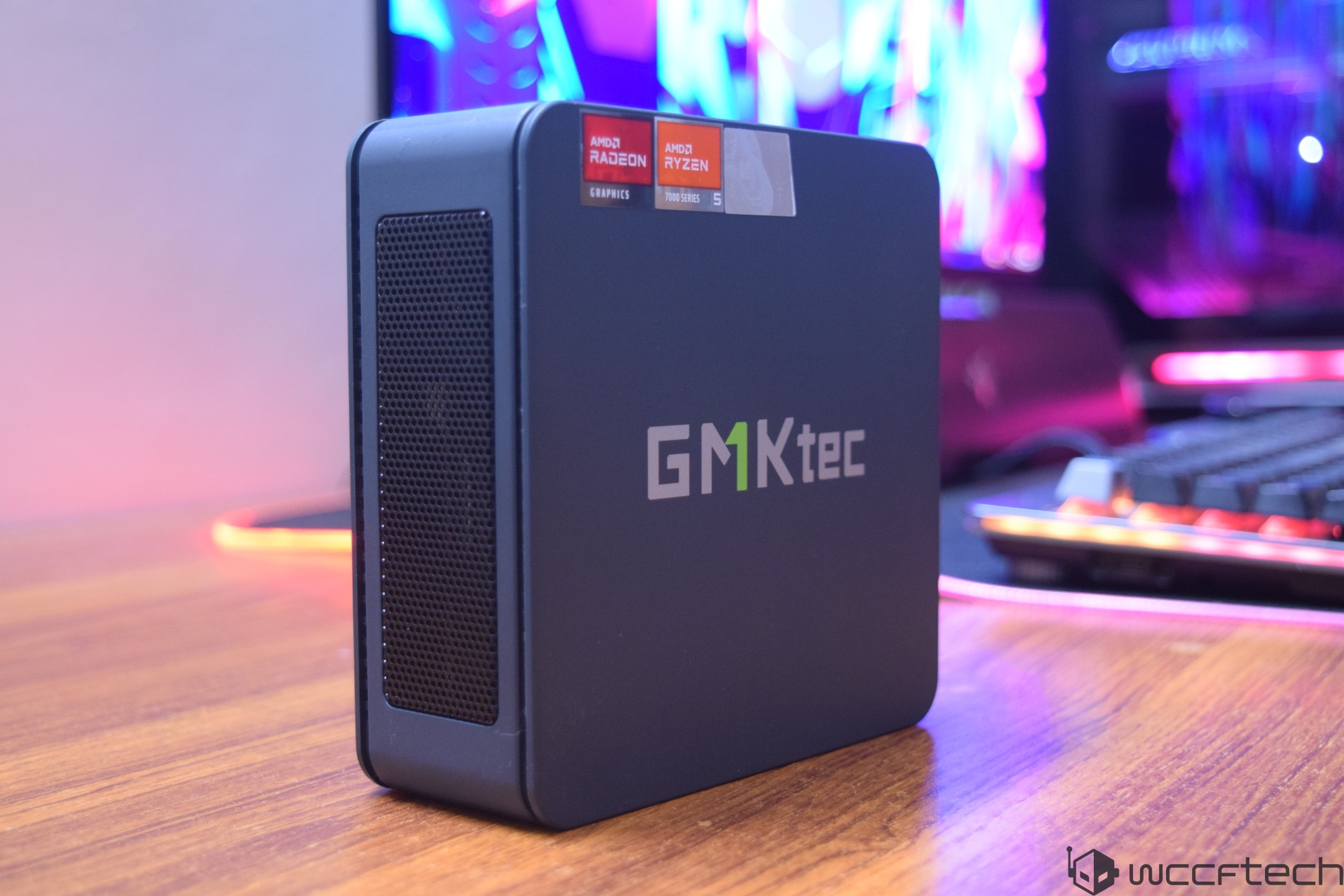
GMKtec M6 Ultra Mini PC (2025): a compact Zen 4 desktop that blends power, modern graphics, and serious upgradability at a mainstream price. Built around AMD’s Ryzen 5 7640HS and paired with fast DDR5 memory, this small form factor system targets home offices, creators, students, and casual gamers who want desktop-class responsiveness without the tower.
Key highlights
– Processor: AMD Ryzen 5 7640HS with 6 cores and 12 threads, up to 5.0 GHz boost, 16 MB L3 cache, 6 MB L2 cache
– Graphics: Radeon 760M iGPU based on RDNA 3 with 8 compute units, up to 2.6 GHz
– AI acceleration: integrated NPU rated at 10 TOPS for on-device AI tasks
– Memory: dual-channel DDR5-4800, available with 16 GB or 32 GB and upgradeable to 128 GB
– Storage: two M.2 2280 PCIe Gen3 x4 slots, up to 8 TB each (16 TB total). One slot populated with a 1 TB SSD
– TDP control: configurable 35–54 W (45 W default). Tested at 65 W performance profile for headroom
– Price: typically ranges from $289 to $389, depending on configuration
Performance and graphics
The Ryzen 5 7640HS delivers snappy day-to-day performance and strong multi-threaded muscle in a mini PC footprint. With RDNA 3 graphics, the Radeon 760M supports modern APIs and AMD features like FSR 2, FSR 3 with Frame Generation, AFMF, and Anti-Lag 2, giving you smoother visuals in supported titles and enhanced performance for esports and lighter AAA gaming at sensible settings. The built-in NPU enables efficient, on-device AI workloads such as background blur, transcription, and select creative tools without hammering the CPU or GPU.
Memory and storage flexibility
Dual SO-DIMM slots let you scale from 16 GB up to 128 GB of DDR5-4800 memory, ideal for virtualization, large spreadsheets, code compiles, or creative apps. Two PCIe Gen3 x4 M.2 2280 slots provide ample storage expansion, with up to 16 TB total capacity. The reviewed configuration includes a fast 1 TB NVMe SSD out of the box.
Ports and connectivity
Front:
– 3.5 mm combo audio jack
– USB4 Type-C
– 2 x USB 3.2 Gen 2 Type-A
– LED-backlit power button and reset jack
Rear:
– HDMI 2.1 and DisplayPort 1.4 for modern, high-resolution displays
– DC power input
– USB 2.0 and USB 3.2 Gen 2 Type-A
– Dual 2.5 GbE LAN ports for high-speed networking, NAS access, and advanced routing setups
Thermals and acoustics
The M6 Ultra uses a thoughtful dual-fan layout: one fan cools the memory and SSD area, while a larger fan targets the CPU. Generous ventilation along the sides, rear, and bottom helps move heat efficiently. You can tune the power profile to match your priorities, from quiet, power-sipping operation to higher sustained performance when you need it.
Design and unboxing
The unit arrives in a clean, silver package featuring the GMKtec branding. Inside, you’ll find a quick-start guide, warranty documentation, a power cord, HDMI cable, and a robust 120 W power adapter. The chassis itself sports a compact, dual-tone design that looks at home on a desk, shelf, or behind a monitor.
Who is it for?
– Home office and productivity users who want desktop speed in a discreet, energy-efficient box
– Students and remote workers who need a reliable, portable workstation
– Creators who benefit from DDR5 bandwidth, upgradeable memory, and dual NVMe storage
– Casual gamers and esports players who value modern RDNA 3 graphics features and upscaling
– Tinkerers who want dual 2.5 GbE for networking projects, servers, or multi-WAN setups
Why the GMKtec M6 Ultra stands out
– Zen 4 performance with configurable power for either quiet efficiency or extra headroom
– RDNA 3 graphics and AMD’s latest upscaling and latency reduction technologies
– Exceptional expandability in a mini PC: up to 128 GB RAM and 16 TB total storage
– USB4 connectivity and dual 2.5 GbE ports rarely found together at this price
– Competitive pricing in the $289–$389 range, offering strong value for a 2025-ready mini PC
Bottom line
The GMKtec M6 Ultra packs a modern AMD platform, fast memory, meaningful AI acceleration, and serious I/O into a compact, stylish chassis. With its flexible power tuning, generous upgrade paths, and robust connectivity, it’s a smart small form factor choice for work, play, and everything in between.Tiny PCs, big performance. Today’s mini PCs pair 45–65W laptop CPUs with surprisingly capable integrated graphics, making real 1080p gaming possible in a palm‑sized box. We ran a mix of popular esports titles and demanding AAA games at 1080p to see how the latest iGPUs stack up across a wide range of systems and power limits.
What we tested across the stack
– AMD RDNA 3: Radeon 890M, 780M, 760M
– AMD RDNA 2 and Vega: 680M, Vega 8, Vega 7, Vega 6
– Intel integrated graphics: Arc 8 Xe in Core Ultra chips, Iris Xe in 12th/13th Gen, and Iris Xe‑LP
– A legacy discreet reference: GeForce GTX 1060 6 GB for context
Mini PCs in the mix included AMD‑based systems like Beelink SER9 with Ryzen AI 9 HX 370 and high‑speed LPDDR5X‑8000 memory, several Beelink SER7 models with Ryzen 7 7840HS at both 65W and 54W, GMKtec K12 and M6 Ultra with Ryzen 7000‑series HS chips, and Geekom A8/A7 plus Minisforum UM690/Venus and others carrying 8945HS/7940HS/6900HX/6800H class processors. On the Intel side, we looked at Core Ultra 9/7 machines such as the Minisforum AtomMan X7 Ti, GT1 Mega AI, and ACEPC WizBox AI F1M with Arc 8 Xe iGPUs, alongside Core i9/i7 12th–13th Gen boxes like Geekom GT13 Pro, IT13 2025, XT12 Pro, Beelink SEi13 Pro, GTi12 Ultra, EQi13 Pro, and more.
1080p integrated graphics, ranked by real‑world playability
– Radeon 890M leads the pack. In systems like the SER9 with LPDDR5X‑8000 memory, a 3.1 GHz iGPU clock, and frame generation enabled, the 890M sets the bar for 1080p integrated performance. Fast memory and higher iGPU clocks noticeably boost frame rates.
– Radeon 780M is the sweet spot. Found in many 60–65W mini PCs, it delivers consistently smooth 1080p in esports and can tackle AAA games with tuned settings or upscaling. Power limits matter: the same chip at 65W outpaces 54W variants.
– Intel Arc 8 Xe in Core Ultra chips is competitive with upscaling. At 65W, enabling XeSS quality modes narrows the gap to top AMD iGPUs and can approach the older GTX 1060 6 GB in select titles.
– Radeon 760M offers strong mid‑tier value. It trails 780M but stays ahead of older 680M, making it a smart choice for budget‑friendly 1080p esports boxes.
– Radeon 680M remains capable. The RDNA 2 iGPU still plays esports comfortably at 1080p and handles many AAA titles with compromises or FSR.
– Older iGPUs like Vega 8/7/6 and Intel Iris Xe/Xe‑LP sit at the bottom. They’re fine for lighter games and 720p/900p targets, but they’re no match for modern RDNA 3 parts.
Why some mini PCs punch above their weight
– Memory speed is critical. LPDDR5X at 6400–8000 MT/s can shift 5–20% more performance versus slower RAM because iGPUs share memory bandwidth with the CPU.
– Power budgets change the story. The same chip at 65W consistently outperforms 35–45W configurations, sustaining higher clocks and avoiding throttling.
– Modern upscalers help. AMD FSR, Intel XeSS, and frame generation can turn borderline 1080p experiences into smooth gameplay without a discrete GPU.
– Cooling design matters. Better thermals maintain boost clocks longer, especially during AAA sessions.
Notable systems and what they’re best for
– Top‑tier iGPU performance: Beelink SER9 (Ryzen AI 9 HX 370, LPDDR5X‑8000 OC), Geekom A8 (Ryzen 9 8945HS @60W), Beelink SER7 and GMKtec K12 with 780M at 65W
– Balanced gaming and productivity: GMKtec M6 Ultra (Ryzen 5 7640HS @65W with 760M), Geekom A7 (Ryzen 9 7940HS @60W)
– Value 1080p esports and multimedia: Geekom AS6/A6 and Minisforum UM690/Venus with 680M RDNA 2
– Intel AI‑era contenders: Minisforum AtomMan X7 Ti and GT1 Mega AI with Core Ultra 9 185H at 65W, ACEPC WizBox AI F1M with Core Ultra 7 155H at 65W
– Intel productivity‑first builds: Geekom GT13 Pro (Core i9‑13900H @45W), Beelink SEi13 Pro and IT13 2025 (13900HK @65W), GTi12 Ultra (12900H @65W), XT12 Pro (12900H @35W), plus i7‑13620H/12650H systems from Beelink, Geekom, and EYERTEC
Key takeaways for choosing a 1080p mini PC
– For the best integrated gaming today, target Radeon 890M or 780M at 60–65W with fast dual‑channel LPDDR5X memory. You’ll get smooth esports performance and playable settings in many AAA titles.
– Want the most for your money? Radeon 760M gives you excellent 1080p esports performance and solid AAA capability with upscalers.
– Prefer Intel? Look for Core Ultra models with Arc 8 Xe at higher TDPs and plan to use XeSS for the best results.
– If you’re shopping older platforms, 680M is the minimum for comfortable 1080p esports; Vega and early Iris Xe are best for lighter workloads or lower resolutions.
Bottom line
Mini PCs have crossed a threshold where integrated graphics can deliver real 1080p gaming in a tiny footprint. With the right combination of GPU architecture, fast memory, and a generous power envelope, systems built around Radeon 890M and 780M—and the newest Arc 8 Xe—offer a compelling blend of performance, efficiency, and size for gamers and creators alike.GMKtec M6 Ultra Mini PC review: compact power for everyday computing
If you’ve been hunting for a compact desktop that handles day-to-day work with ease and still has enough muscle for light gaming, the GMKtec M6 Ultra deserves a serious look. This tiny system centers on AMD’s Ryzen 5 7640HS, a six-core Zen 4 processor paired with Radeon 760M graphics based on the RDNA 3 architecture. It delivers a responsive, modern computing experience in a 45–65W envelope, with the option to run a 65W performance profile for extra headroom.
Performance you can count on
– CPU: Ryzen 5 7640HS brings six Zen 4 cores and strong single-threaded speed, ideal for multitasking, office apps, web work, and light creative tasks.
– GPU: The integrated Radeon 760M is comparable to the older 680M and ends up slightly faster thanks to RDNA 3 optimizations. That means smoother casual and esports gaming at 1080p with tuned settings, plus hardware acceleration for modern media formats.
– Power profiles: Designed to operate comfortably between 45W and 65W, with a 65W mode available for sustained performance.
Portable and well-connected
Despite its small footprint, the M6 Ultra doesn’t skimp on I/O. It’s built to be a grab-and-go desktop that slides into a backpack without sacrificing connectivity.
– USB4 for high-speed peripherals, external storage, and docking
– Dual 2.5GbE LAN ports for fast networking, link aggregation, or multi-network setups
– Multiple USB 3.2 Gen2 ports for accessories and fast data transfer
– Compact chassis that’s easy to transport and simple to set up anywhere
A smart value play
One of the biggest selling points is the price. The barebones configuration comes in under $300, and a sensible 16 GB RAM + 1 TB SSD version is around $330. For a modern Zen 4 system with RDNA 3 graphics and USB4, that’s excellent value for students, home offices, makers, and frequent travelers.
Where it fits in the mini PC landscape
– Mainstream sweet spot: The M6 Ultra is tailor-made for everyday users who want a fast, modern PC without the bulk. It’s great for productivity, media, and casual gaming.
– If you need more GPU: Systems built around Radeon 780M or Intel Arc 8 Xe at 60–65W deliver a step up in gaming performance, but typically cost more and may draw additional power.
– If you’re upgrading from older iGPUs: It’s a clear upgrade over older Vega-based solutions and aligns well with the 680M while adding RDNA 3 features and efficiency tweaks.
Who should buy it
– Remote workers and students who need a reliable, quiet, and portable desktop
– Home users looking for a capable media PC with fast networking
– Tinkerers who value USB4, dual 2.5GbE, and solid CPU performance in a tiny box
– Gamers who mostly play lighter titles and are happy dialing in settings for 1080p
Bottom line
The GMKtec M6 Ultra hits the mainstream bullseye. With a Zen 4 Ryzen 5 7640HS, RDNA 3 Radeon 760M graphics, USB4, dual 2.5GbE, and a remarkably low price for the specs, it’s a compact PC that feels fast, travels well, and doesn’t break the bank. If you want a small desktop that simply gets the job done—and does it for less—the M6 Ultra is an easy recommendation.