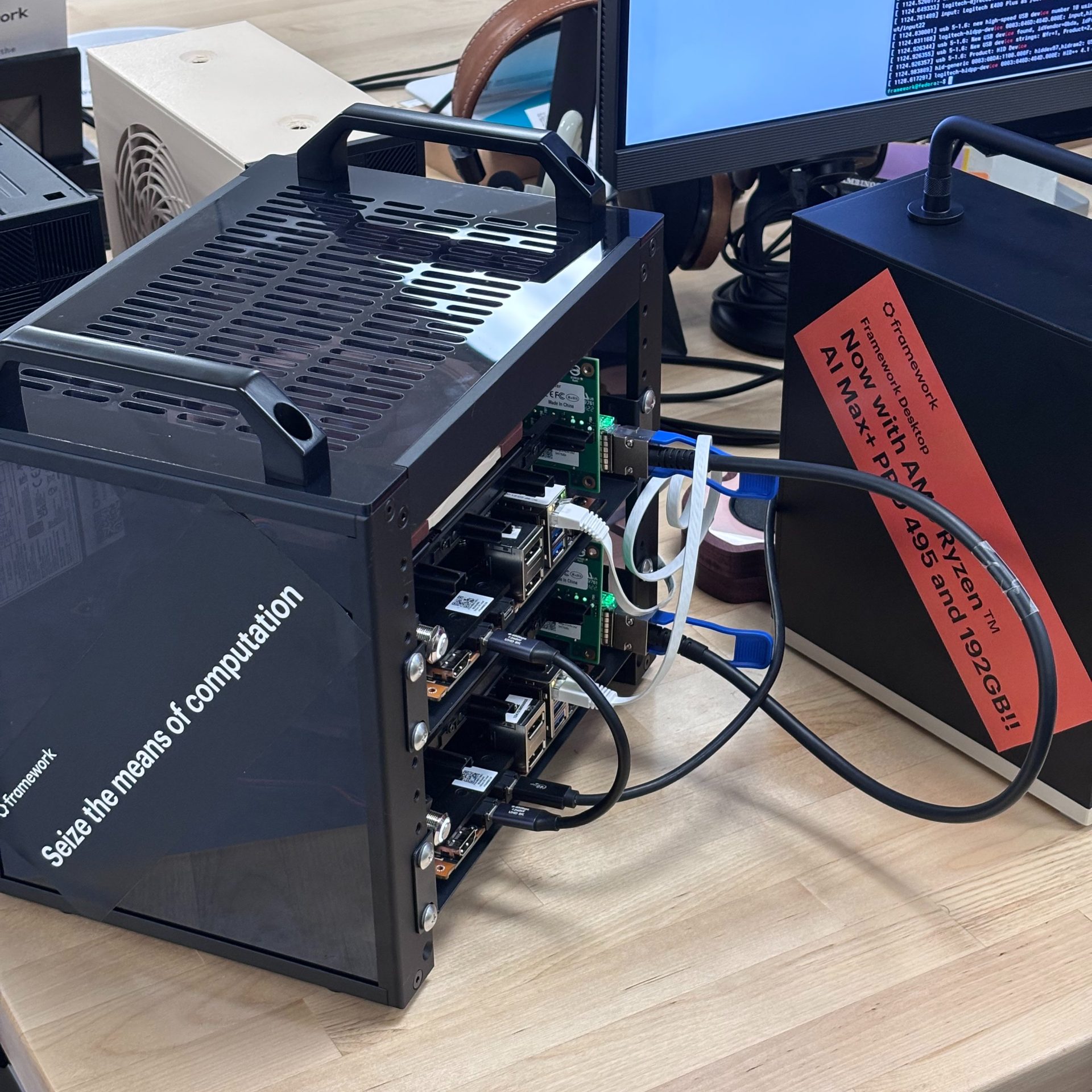
Framework previews Ryzen AI MAX+ 495 desktop with 192GB unified memory for local AI workloads
Framework has offered an early look at its upcoming Desktop PC powered by AMD’s Ryzen AI MAX+ 495, a high-end chip designed for demanding local AI, workstation, and enthusiast computing workloads. The biggest highlight is its massive 192GB of unified LPDDR5X memory, giving the compact system enough headroom to run large AI models locally, including DeepSeek V4-Flash at Q8, with additional capacity left for extended context length.
The new Ryzen AI MAX+ 495 appears to build on AMD’s Ryzen AI MAX+ PRO 395 platform while pushing performance further. It keeps the same 16 Zen 5 CPU cores but raises clock speeds to as high as 5.2GHz. Graphics performance also gets a boost with the Radeon 8065S integrated GPU, featuring 40 RDNA 3.5 compute units running at up to 3.0GHz.
For users focused on AI development, machine learning experimentation, and large language model workloads, the memory configuration is the most important upgrade. Framework’s Ryzen AI MAX+ 495 Desktop supports 192GB of unified memory running at 8533 MT/s, delivering up to 273GB/s of bandwidth. Compared with earlier Ryzen AI MAX+ 395 systems, which topped out at 128GB and 256GB/s of bandwidth, the new model offers 50% more capacity and a modest increase in memory speed and bandwidth.
That larger memory pool is especially important for local AI inference. Many large language models are limited not only by compute performance but also by available memory. With 192GB available to the CPU and GPU as unified memory, Framework’s new Desktop is positioned as a compact machine for running larger models without relying on cloud infrastructure or external accelerators.
Framework is also making practical hardware improvements to the system. One of the notable changes is an open-ended PCIe x4 slot, allowing users to install larger PCIe cards directly into the desktop. This design choice gives the machine more flexibility for networking, storage, capture cards, accelerators, and other expansion hardware.
To demonstrate the potential of the PCIe expansion setup, Framework showed a concept cluster using two 50GbE network interface cards. These NICs support RDMA over Ethernet, also known as RoCE, enabling very low-latency communication between systems. In this configuration, two Framework Desktop units could effectively combine their resources, making it possible to work with up to 384GB of memory across two machines using tensor parallelism.
Framework also plans to offer a pre-built version of the Ryzen AI MAX+ 495 Desktop with a Linux distribution installed out of the box. That should appeal to developers, AI researchers, and power users who want a ready-to-run environment for local model deployment, coding, and workstation tasks.
Pricing will likely be one of the biggest questions. Framework has already indicated that rising LPDDR5X memory prices will make the 192GB model significantly more expensive than current 128GB configurations. The company is encouraging buyers to consider 32GB, 64GB, or 128GB models if they want a more budget-friendly option.
Existing Ryzen AI MAX+ 395-based systems from Framework start around $3,500, and similar systems from other manufacturers are generally in the same range. Given the move to 192GB of high-speed unified memory, the Ryzen AI MAX+ 495 Desktop is expected to land above $5,000 when it becomes available later this year.
With its 16-core Zen 5 processor, upgraded Radeon 8065S graphics, 192GB unified memory, Linux-ready configuration, and improved PCIe expansion, Framework’s Ryzen AI MAX+ 495 Desktop is shaping up to be one of the most interesting compact AI PCs on the horizon. For users who want to run large AI models locally without building a traditional workstation or buying enterprise-grade hardware, this system could become a compelling option.