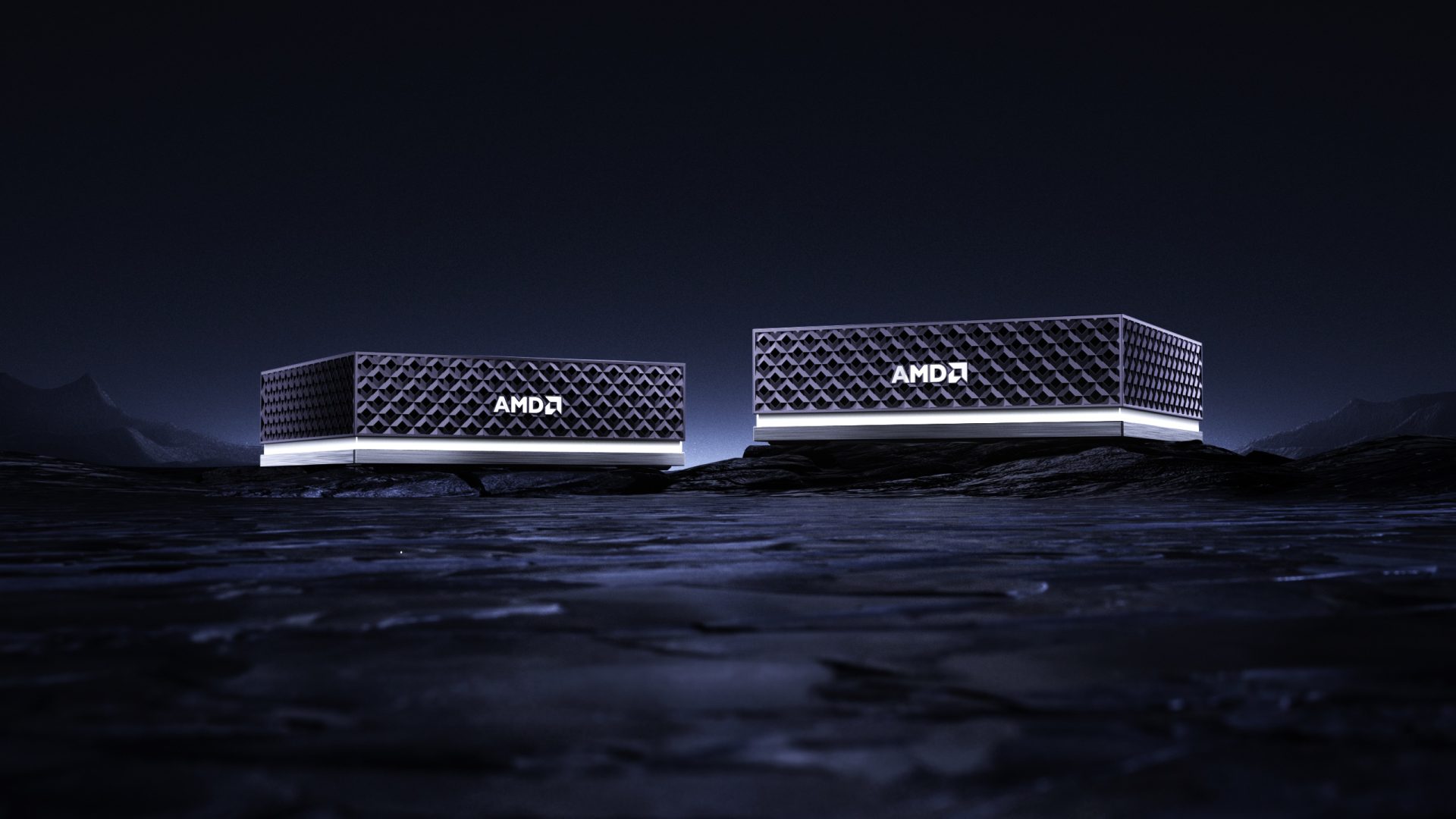
AMD Ryzen AI Halo developer platform launches for pre-order in June at $3,999
AMD is preparing to open pre-orders for its Ryzen AI Halo developer platform this June, bringing a compact but powerful local AI system aimed at developers building agentic AI applications, generative AI workflows, and workstation-class AI tools.
Priced at $3,999, the Ryzen AI Halo platform is positioned as a premium AI mini PC for users who want to run large models locally instead of relying heavily on cloud compute. AMD is also highlighting its value against NVIDIA’s DGX Spark, which currently costs more, with Ryzen AI Halo coming in around $680 lower.
The platform is built for developers who need serious AI performance in a small form factor. AMD says Ryzen AI Halo can run models with up to 200 billion parameters, giving developers enough room to build, test, and operate advanced AI agents directly on the device.
At the center of the system is AMD’s Ryzen AI MAX+ 395 processor, part of the Ryzen AI MAX 300 family, also known by the Strix Halo codename. This chip combines a Zen 5 CPU, RDNA 3.5 graphics, and an XDNA 2 neural processing unit in one integrated architecture.
The Ryzen AI MAX+ 395 includes 16 cores and 32 threads, a Radeon 8060S integrated GPU with 40 RDNA 3.5 compute units, and a 50 TOPS XDNA 2 NPU for AI acceleration. The system supports up to a 120W TDP and is paired with 128GB of LPDDR5X-8000 unified memory, giving it the memory capacity needed for large language models and other demanding AI workloads.
Storage is also generous, with a 2TB PCIe Gen4x4 drive included. That makes the machine useful not only for AI testing and inference, but also for local development environments, model storage, image generation tools, coding assistants, and visual computing workloads.
Despite the high-end hardware, the Ryzen AI Halo developer platform is compact. It measures just 5.9 inches by 5.9 inches by 1.7 inches, making it smaller than many traditional mini PCs and easy to place on a desk, in a lab, or inside a development setup.
Connectivity includes three USB Type-C ports, with one used for power input, along with Wi-Fi 7, Bluetooth 5.4, 10Gbps Ethernet, and HDMI 2.1b. This makes it suitable for modern development environments where fast networking and flexible display output are important.
Software support is another major part of AMD’s pitch. Ryzen AI Halo will support AMD ROCm, including the latest ROCm 7.2.2 suite. AMD is also optimizing the platform for popular developer and AI applications such as LM Studio, ComfyUI, and VS Code.
The system is expected to support Day 0 compatibility for leading AI models, with optimizations planned for models and tools including GPT-OSS, FLUX.2, SDXL, and others. This focus on software readiness is important because local AI hardware is only as useful as the tools and frameworks that run smoothly on it.
AMD is targeting developers who want to reduce dependence on the cloud. The company argues that not every AI agent, workflow, or task needs a frontier-scale cloud model. Many daily AI operations can be handled locally, especially for testing, iteration, automation, coding, and smaller agentic workloads.
According to AMD’s own comparison, Ryzen AI Halo can offer strong token-per-dollar value. The company claims users who move suitable AI workloads from cloud services to local hardware could save up to $750 per month.
AMD estimates the monthly electricity cost for Ryzen AI Halo at around $16.20, based on a sustained 150W draw, which it describes as a worst-case scenario. In contrast, cloud AI usage can add up quickly, especially when running large token volumes for several hours each day.
Using AMD’s example, cloud services could cost roughly $750 per month depending on token throughput and daily usage. Based on that calculation, the $3,999 Ryzen AI Halo system could pay for itself in around six months. Over three years, AMD suggests total ownership cost may land around $4,500 to $4,600, compared with more than $25,000 for comparable cloud-based usage.
Performance comparisons are also part of AMD’s marketing push. Against NVIDIA’s DGX Spark, AMD claims Ryzen AI Halo delivers competitive local AI performance, broader operating system support, and the benefit of its built-in 50 TOPS NPU.
AMD lists several claimed token-per-second advantages, including 7% higher GPT OSS performance on a 120B model, 12% higher Qwen 3.5 performance on a 122B model, 4% higher Qwen 3.6 performance on a 35B model, and 14% higher GLM 4.7 performance on a 30B model.
AMD is also comparing Ryzen AI Halo with Apple’s Mac Mini M4 Pro. The company says its platform offers twice the maximum memory configuration, support for models up to 200B parameters, and broader generative AI capabilities. AMD claims Ryzen AI Halo is, on average, up to four times faster than the M4 Pro-based Mac Mini in selected AI workloads.
The 128GB unified memory configuration is one of the key advantages for local AI development. Large language models often require significant memory, and having more unified memory allows developers to run bigger models without splitting work across external hardware or relying on remote compute.
AMD is also planning a more powerful follow-up. After the June 2026 pre-order launch of the Ryzen AI Halo system with the Ryzen AI MAX+ 395, AMD expects to introduce an updated variant around Q3 2026. This version will reportedly use the Ryzen AI MAX+ 495 and increase memory capacity to 192GB, enabling support for models larger than 300 billion parameters.
That future upgrade could make the platform even more attractive for developers working with larger LLMs, complex AI agents, and multi-model workflows.
At $3,999, Ryzen AI Halo is not a budget mini PC. However, it is designed for developers, AI researchers, advanced creators, and businesses that want local AI performance in a compact workstation-class system. For users who spend heavily on cloud AI services, AMD’s value argument is simple: pay once for the hardware, run more workloads locally, and reduce long-term operating costs.
With Ryzen AI Halo, AMD is making a clear push into the growing local AI computing market. By combining Zen 5 CPU power, RDNA 3.5 graphics, XDNA 2 AI acceleration, 128GB of fast unified memory, ROCm support, and compact desktop design, the company is aiming to give developers a serious alternative for building and running AI applications on-device.
Pre-orders for the AMD Ryzen AI Halo developer platform are scheduled to begin in June 2026 at $3,999.