NVIDIA RTX Spark hands-on: the new wave of AI laptops and mini PCs coming to Windows
NVIDIA’s RTX Spark platform made a strong appearance at Computex, giving us an early look at a new class of Windows PCs built around the company’s first true client-focused system-on-chip. From ultra-thin creator laptops to compact desktop systems, RTX Spark is clearly being positioned as a major push into AI PCs, gaming laptops, and professional creator machines.
The RTX Spark chip is a complete SoC designed for Windows devices. It combines a 20-core Arm CPU based on NVIDIA’s Grace architecture with a Blackwell GPU that supports the latest RTX features. NVIDIA claims the platform can deliver up to 1 PFLOP of AI performance, backed by 128GB of unified LPDDR5X memory. That combination makes RTX Spark especially interesting for local AI workloads, content creation, 3D rendering, development, and high-end productivity.
Several major PC makers are already preparing RTX Spark laptops and mini PCs, including Dell, ASUS, HP, Lenovo, MSI, and Microsoft. At Computex, multiple systems were shown in near-final designs, giving a clear picture of what buyers can expect when the first RTX Spark PCs arrive later this year.
Dell XPS 16 Creator Edition with RTX Spark
Dell is bringing RTX Spark to its XPS 16 Creator Edition, a slim 16-inch laptop aimed at creative professionals and power users. The design keeps the premium XPS look, with a clean space gray finish and the XPS logo centered on the lid.
Connectivity includes three USB Type-C ports, HDMI, and a MicroSD card reader, which should be useful for creators working with cameras and external storage. Dell is also using a Tandem OLED display with TrueBlack HDR 600 certification, giving the laptop strong appeal for video editors, designers, and anyone who needs deep contrast and vivid color.
Cooling vents are placed on the sides and rear, suggesting Dell is paying close attention to thermal management in such a thin chassis.
ASUS ProArt laptops and mini PC with RTX Spark
ASUS is giving its creator-focused ProArt lineup a major upgrade with RTX Spark. The company showed two laptops and one compact desktop system.
The ASUS ProArt P16 H7607 is a 16-inch laptop equipped with an ASUS Lumina Pro OLED display. The panel runs at 4K resolution with a 120Hz refresh rate and up to 1600 nits of brightness. Buyers will be able to choose between Neo White and Nano Black color options. Despite the large screen, the laptop is only 12.9mm thin and weighs 1.77kg, making it highly portable for a powerful creator system.
ASUS also has the ProArt P14 H7407, a smaller 14-inch version with similar display technology. It measures 13.9mm thick and weighs around 1.48kg. Both ProArt laptops include ASUS creative software designed to support local AI agents and smoother AI-assisted workflows. The display also has an anti-reflective coating that helps reduce fingerprints.
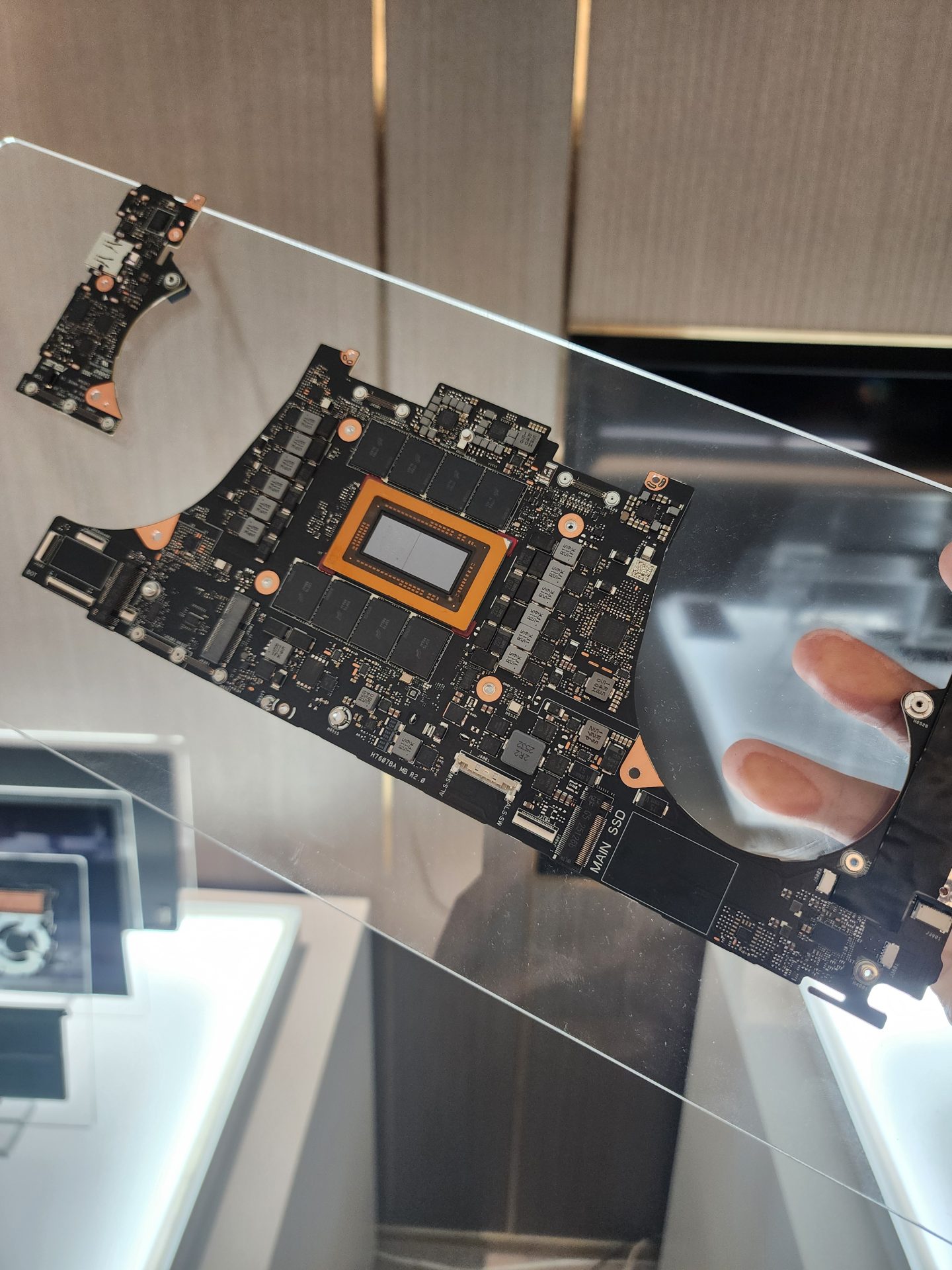
ASUS gave a closer look at the internal board design as well. The ProArt laptops include dual USB4 ports, HDMI, USB Type-A, a headphone jack, and two M.2 SSD slots. The RTX Spark SoC sits at the center of the board and is surrounded by eight LPDDR5X memory modules for a total of 128GB unified memory. ASUS is using a 12-phase power design and a dual-fan cooling system with several copper heatpipes.
The ASUS ProArt Mini PC is another standout. It uses a compact 150 x 150 x 51mm chassis and includes 128GB of memory, 10GbE LAN, USB connectivity, PCIe Gen5 support, and a 140W Elite Thermal cooling solution. ASUS plans to offer the mini PC in black and white color options.
HP OmniBook RTX Spark laptops
HP is preparing two RTX Spark laptops: the 16-inch OmniBook Ultra 16 and the 14-inch OmniBook X 14.
The OmniBook Ultra 16 is described as one of the thinnest RTX Spark AI PCs, measuring just 15.73mm. It features a premium design with a latticeless keyboard, haptic touchpad, quad speakers, and a redesigned hinge system. The display is a 3K OLED panel with DisplayHDR TrueBlack 1000 support.
HP is also including a compact 140W GaN USB Type-C charger, which should make travel easier. Cooling is handled by two slim blower fans and two large heatpipes that directly contact the chip. HP has moved the thermal exhaust toward the rear to help improve heat dissipation.
The OmniBook X 14 offers many of the same features in a smaller body. It has a 13.53mm thin chassis, a 5MP IR camera, a 3K OLED display, up to 1100 nits of HDR brightness, and the same 140W GaN charger. For users who want RTX Spark performance in a more compact Windows on Arm laptop, this could be one of the more appealing options.
Lenovo Yoga Pro 9n with RTX Spark
Lenovo’s RTX Spark entry is the Yoga Pro 9n, a 15-inch laptop with an OLED display. The design focuses on productivity and multimedia, with front-facing speakers, a large trackpad, and a wide range of ports.
The Yoga Pro 9n includes four USB ports, split between two USB Type-C and two USB Type-A ports. It also has HDMI, a microphone jack, a power button, a MicroSD card reader, and a camera shutter switch. Around the rear, Lenovo has placed exhaust vents with two fans underneath, helping manage the heat from the RTX Spark platform.
MSI Prestige N16 Flip AI+ with RTX Spark
MSI is bringing RTX Spark to a flexible convertible design with the Prestige N16 Flip AI+. This 16-inch laptop has a 360-degree hinge, allowing it to switch between laptop, tent, stand, and tablet-style modes.
The system uses a full aluminum chassis with a premium anodized finish, rounded edges, and a sleek professional appearance. Ports include two USB Type-A, two USB Type-C, HDMI, a MicroSD card reader, and a combo headphone jack.
One of the most notable features is its large 99.9Wh battery, which is close to the maximum capacity typically allowed in laptops for air travel. MSI is also using an advanced cooling setup with an intra-flow vapor chamber, a large baseplate, heatpipes, and dual fans. The fans are designed to stay below 18 dBA during lighter workloads and under 29 dBA at full load, which could make the system attractive for quiet work environments.
Microsoft Surface Laptop Ultra with RTX Spark
Microsoft also has an RTX Spark-powered Surface Laptop Ultra. It is slim, clean, and premium, staying close to the design language expected from the Surface lineup.
The device includes 128GB of onboard memory, a strong selection of ports compared with many thin laptops, and an OLED display. As one of the first showcased RTX Spark Windows systems, the Surface Laptop Ultra may play an important role in showing how NVIDIA’s platform works inside Microsoft’s own hardware ecosystem.
Dell, HP, ASUS, and MSI RTX Spark mini PCs
RTX Spark is not limited to laptops. Several compact desktop systems were also shown, and these mini PCs could be especially useful for developers, AI researchers, 3D artists, and professionals who want powerful local AI performance without a full-size workstation.
Dell’s XPS RTX Spark Mini PC uses the same core chip as its laptop but appears tuned for higher power levels thanks to a larger cooling system. It includes four USB Type-C ports, HDMI, a power button, and LAN on the front. The rear adds two more USB Type-C ports and a MicroSD card reader. The chassis is larger than some compact AI desktops, with side vents to support better airflow.
HP’s RTX Spark Desktop Mini PC is a heavier compact system with large exhaust vents at the front and rear. It includes four USB Type-C ports, HDMI, Ethernet LAN, a front power button, and additional bottom vents for improved cooling.
MSI’s EdgeMesa N AI is the smallest RTX Spark mini PC shown. It uses a silver aluminum chassis with vents on the front, back, and bottom. Connectivity includes four USB Type-C ports, HDMI, and 10GbE LAN, making it a compact but capable option for AI and creator workloads.
RTX Spark AI and gaming demos
NVIDIA also demonstrated several RTX Spark workloads at Computex, with a strong focus on AI and content creation. Generative AI tasks ran quickly, and professional applications such as SolidWorks, Blender, and Unreal Engine appeared to perform smoothly. This is where RTX Spark’s unified memory and Blackwell GPU could make a big difference, especially for users running local AI models or heavy creative workloads.
Gaming was also shown, with titles including Alan Wake II, Indiana Jones and the Great Circle, Pragmata, and Fortnite. The systems were running with ray tracing and frame generation enabled, though detailed settings were not shown. Performance appeared smooth, but final judgment will need to wait for proper benchmarks with frame rates, power consumption, temperatures, and battery life.
Because RTX Spark is based on NVIDIA’s Blackwell architecture, it supports modern RTX technologies such as DLSS, ray reconstruction, and multi-frame generation. NVIDIA is also working with partners to bring next-generation gaming and AI experiences to the platform.
What RTX Spark means for Windows on Arm PCs
One of the biggest stories behind RTX Spark is its role in the Windows on Arm ecosystem. NVIDIA is working closely with Microsoft to improve scheduling in Windows 11, which should help the operating system better handle RTX Spark’s CPU and GPU architecture.
If these optimizations arrive before launch as planned, RTX Spark could become one of the most important platforms for high-performance Windows on Arm devices. The combination of Arm CPU cores, Blackwell RTX graphics, huge unified memory, and local AI acceleration gives NVIDIA a strong foundation to compete in premium laptops, mobile workstations, creator PCs, and compact desktops.
The first NVIDIA RTX Spark systems are expected to arrive this fall. Until full reviews and benchmarks are available, questions remain around gaming performance, battery life, thermals, pricing, and software compatibility. Still, based on the Computex showcase, RTX Spark looks like one of the most ambitious new PC platforms heading to the Windows market.


