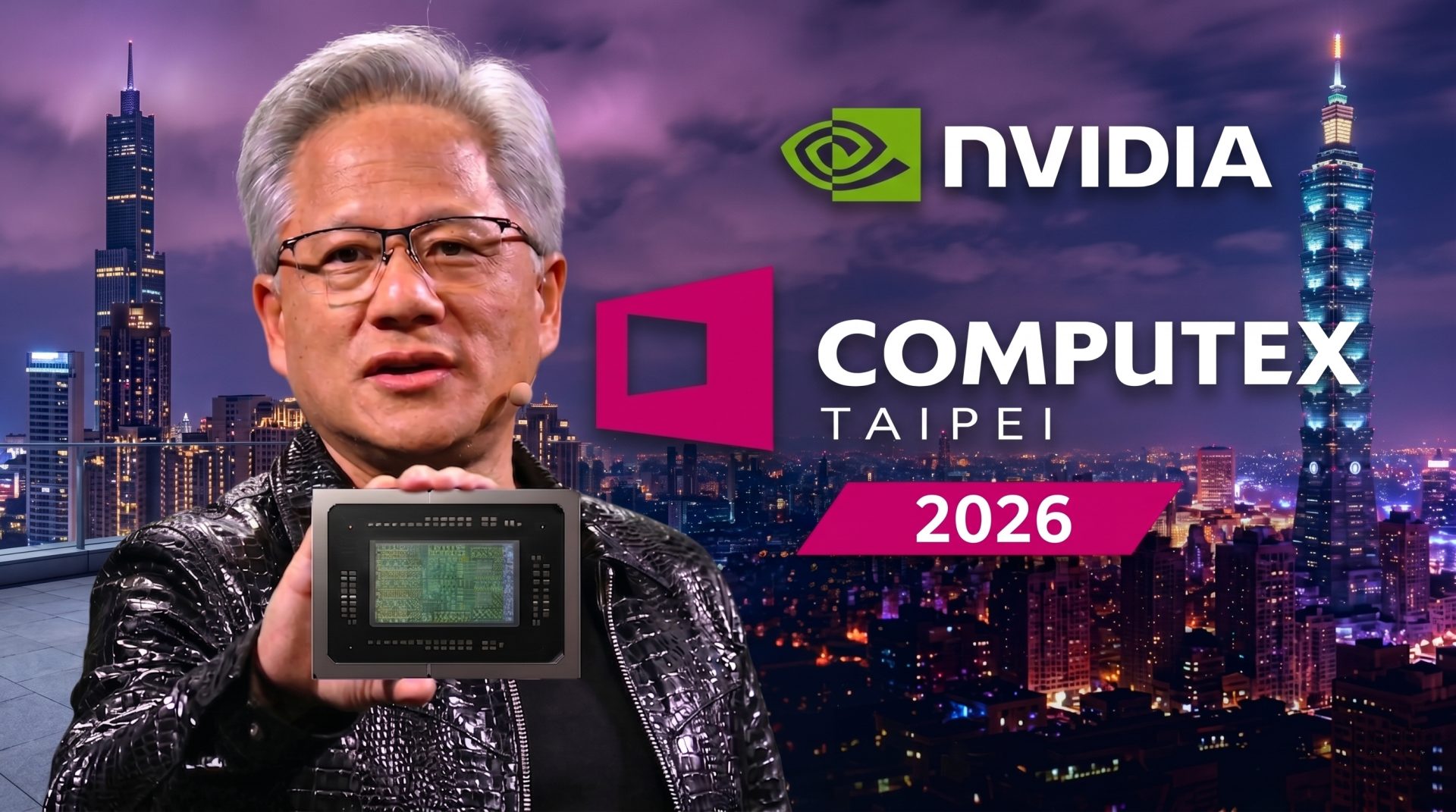
Nvidia Computex 2026 Preview: N1X Laptop Chip, AI PCs, Vera Rubin, Jetson Thor, and What Gamers Should Expect
After a quiet and underwhelming CES 2026 for many consumer tech fans, Computex 2026 could be the event that brings real excitement back to the PC hardware world. Nvidia is expected to be one of the biggest names at the show, with major attention on its long-rumored N1X laptop chip, new AI computing platforms, and updates around its next-generation data center strategy.
The spotlight will likely be on Nvidia’s push into AI PCs, Arm-based laptops, local AI workloads, robotics, and edge computing. Gaming may still appear in the conversation, but it is unlikely to be the main event this time.
Nvidia N1X laptop chip could be the biggest PC hardware reveal of the show
Nvidia, Arm, and Microsoft recently stirred up speculation with teaser posts on X using the phrase “A new era of PC.” The posts also pointed toward Taipei Music Center, strongly suggesting that a major Computex announcement is coming.
The expected star of the event is Nvidia’s N1X laptop APU, a high-performance Arm-based chip believed to be related to the GB10 Blackwell platform used in Nvidia’s compact AI systems. If the rumored specifications hold true, N1X could be one of the most ambitious laptop chips ever released.
The chip is expected to feature 20 Arm CPU cores and 6,144 CUDA cores in a single package. It will reportedly use unified memory over a 256-bit LPDDR5X memory bus, allowing the CPU and GPU to access the same memory pool. That design could make N1X especially powerful for AI workloads, creative software, and next-generation Windows laptops built around local artificial intelligence.
On paper, the GPU configuration sounds similar to an RTX 5070-class part in terms of CUDA core count. However, laptop power limits matter. N1X will likely run at far lower power than a desktop graphics card, so users should not expect full desktop RTX 5070 gaming performance. The real-world results will depend heavily on cooling, power targets, software optimization, and how well Windows on Arm handles demanding applications.
Why N1X could matter more for AI than traditional gaming
The most exciting part of N1X may not be raw gaming performance. Instead, its biggest advantage could be local AI processing.
Because the chip uses unified memory, laptop makers may be able to offer configurations with very large memory pools. That means the GPU could access far more memory than a traditional mobile GPU with fixed VRAM. For users running large language models, AI image generation, video generation, coding assistants, and advanced productivity tools, this could be a major breakthrough.
Large local AI models often need huge amounts of memory. A laptop with a large unified memory configuration could run powerful AI models directly on-device instead of relying entirely on cloud services. This would benefit privacy, reduce latency, and allow AI tools to work even without constant internet access.
Nvidia also has a key software advantage. CUDA remains one of the strongest ecosystems for AI development and creative AI applications. While competitors have made meaningful progress, Nvidia’s long-standing support for AI frameworks, developer tools, and optimized software could give N1X laptops a strong day-one advantage.
Major laptop brands are expected to join the N1X launch
Several major PC makers are expected to prepare laptops based on Nvidia’s N1X platform. Dell, Lenovo, and ASUS have already been associated with leaks, teasers, or early hints suggesting upcoming models. HP has not made much noise publicly, but it would not be surprising to see the company join the lineup as well.
ASUS may be preparing a creator-focused ProArt laptop using the new chip, which would make sense given the expected AI and GPU-heavy focus of N1X. A laptop like that could appeal to video editors, 3D artists, developers, AI researchers, and professionals who want workstation-class AI performance in a portable machine.
Pricing remains unknown, but these systems are unlikely to be cheap. High-end AI laptops with large memory configurations already sit near premium workstation pricing. If N1X laptops arrive with 128GB or similarly large memory options, prices could easily move above the current premium laptop range.
Vera Rubin will show Nvidia’s full AI infrastructure vision
Beyond laptops, Nvidia is expected to spend plenty of time discussing Vera Rubin, its next-generation AI and data center platform. Vera Rubin represents Nvidia’s broader effort to control more of the AI computing stack, including GPUs, CPUs, networking, systems, and software.
The platform combines Rubin GPUs with Vera CPUs and other infrastructure technologies designed for large-scale AI training and inference. Nvidia’s goal is to offer a complete AI factory approach, where companies can deploy tightly integrated systems for different workloads.
Computex 2026 may not bring a completely new data center hardware launch, but it should provide more details about Nvidia’s roadmap, partner ecosystem, supply chain, and availability timelines. Expect the company to emphasize how Vera Rubin fits into the future of artificial intelligence, cloud infrastructure, enterprise computing, and high-performance data centers.
Physical AI and Agentic AI could become major talking points
Nvidia has been building toward physical AI for years, and Computex 2026 may be where that strategy becomes much more visible. Physical AI refers to artificial intelligence that can understand and interact with the real world through robots, sensors, autonomous machines, and industrial systems.
Agentic AI is another fast-growing area. These systems are designed to reason, make decisions, use tools, and complete tasks with less human intervention. When combined with physical AI, agentic systems could power robots, factory automation, self-driving machines, smart warehouses, and advanced edge devices.
Nvidia is expected to highlight platforms such as Jetson Thor, which is designed for robotics and real-time AI at the edge. Edge AI is becoming increasingly important because many real-world systems cannot depend on distant cloud servers for every decision. Robots and autonomous machines need fast local processing to react safely and reliably.
At Computex, Nvidia will likely showcase partnerships, developer tools, and practical examples of how its hardware can support robotics, autonomous machines, industrial AI, and intelligent edge computing.
Gaming may take a back seat at Computex 2026
For PC gamers, Computex 2026 may be a more complicated event. Nvidia is still a dominant force in gaming graphics, but the company’s focus has clearly shifted toward AI, data centers, and edge computing.
Recent reporting changes have grouped Nvidia’s gaming business differently, which reflects how closely the company now connects gaming GPUs, AI acceleration, and edge workloads. That does not mean gaming is unimportant, but it does suggest that traditional GeForce announcements may not be the headline this time.
There is also lingering discussion around DLSS 5, which has faced criticism from some gamers. Unless Nvidia has made major progress addressing concerns, the company may avoid spending too much time on controversial software updates during the keynote.
As for new gaming hardware, expectations should remain modest. The most important consumer-facing product at the show is likely to be N1X. A refreshed Blackwell gaming GPU lineup appears to have been delayed, partly due to memory supply issues. There have also been rumors about the possible return of the RTX 3060 in some form, but major GeForce desktop GPU reveals do not seem likely at Computex 2026.
Computex 2026 could mark Nvidia’s next big PC shift
Nvidia’s Computex 2026 presence looks set to focus on a broader definition of personal computing. Instead of simply pushing faster gaming GPUs, the company appears ready to position AI PCs, Arm-based laptops, local AI processing, robotics, and edge computing as the next major growth areas.
The N1X laptop chip could be the announcement that draws the most attention from consumers. If Nvidia can combine strong Arm CPU performance, powerful Blackwell graphics, large unified memory, and mature CUDA support, it could create a new class of AI-focused Windows laptops.
Still, there are questions. Windows on Arm performance, software compatibility, gaming optimization, battery life, thermals, and pricing will all determine whether N1X becomes a true breakthrough or a niche premium product. The hardware sounds impressive, but execution will matter.
For now, Computex 2026 looks far more promising than CES for anyone following PC hardware. Nvidia is expected to arrive with a clear message: the future of computing is not just about frames per second, but about AI performance, local intelligence, autonomous systems, and powerful new laptop designs built for the next era of PCs.