NVIDIA RTX Spark: A New AI PC Platform Built to Challenge the Future of Windows Computing
NVIDIA is preparing a major push into the next generation of AI PCs with RTX Spark, a new client platform developed in collaboration with Microsoft, Arm, MediaTek, and other ecosystem partners. Unveiled at GTC Taipei 2026 by CEO Jensen Huang, RTX Spark is designed to bring data-center-inspired AI performance into laptops, mini PCs, and eventually broader desktop systems.
At first glance, RTX Spark may look like another AI-focused system-on-chip for personal computers. But NVIDIA’s ambition appears much bigger. The company is not simply trying to add AI acceleration to a traditional PC. It wants to redefine what a personal computer can do when CPU, GPU, memory, networking, and software are designed around generative AI, local inference, creative workloads, gaming, and professional applications.
RTX Spark builds on the foundation of DGX Spark
Before RTX Spark, NVIDIA introduced DGX Spark, a compact AI-first workstation built around the Grace Blackwell platform. DGX Spark was designed for developers, researchers, and creators who need serious AI capability in a smaller and more accessible machine than a full data-center system.
DGX Spark features 128 GB of LPDDR5X memory, Grace CPU cores, Blackwell GPU architecture, and an AI software stack made for large models and accelerated workloads. In simple terms, it takes ideas from NVIDIA’s powerful Grace Blackwell data-center systems and adapts them into a smaller form factor.
RTX Spark brings that concept closer to everyday client PCs. It uses a related chip design, referred to internally as a lighter configuration of the GB10 Superchip. While DGX Spark targets AI workstations and personal AI cloud setups, RTX Spark is aimed at laptops, mini PCs, and future Windows-based systems for creators, developers, gamers, and AI users.
What makes the NVIDIA RTX Spark chip special
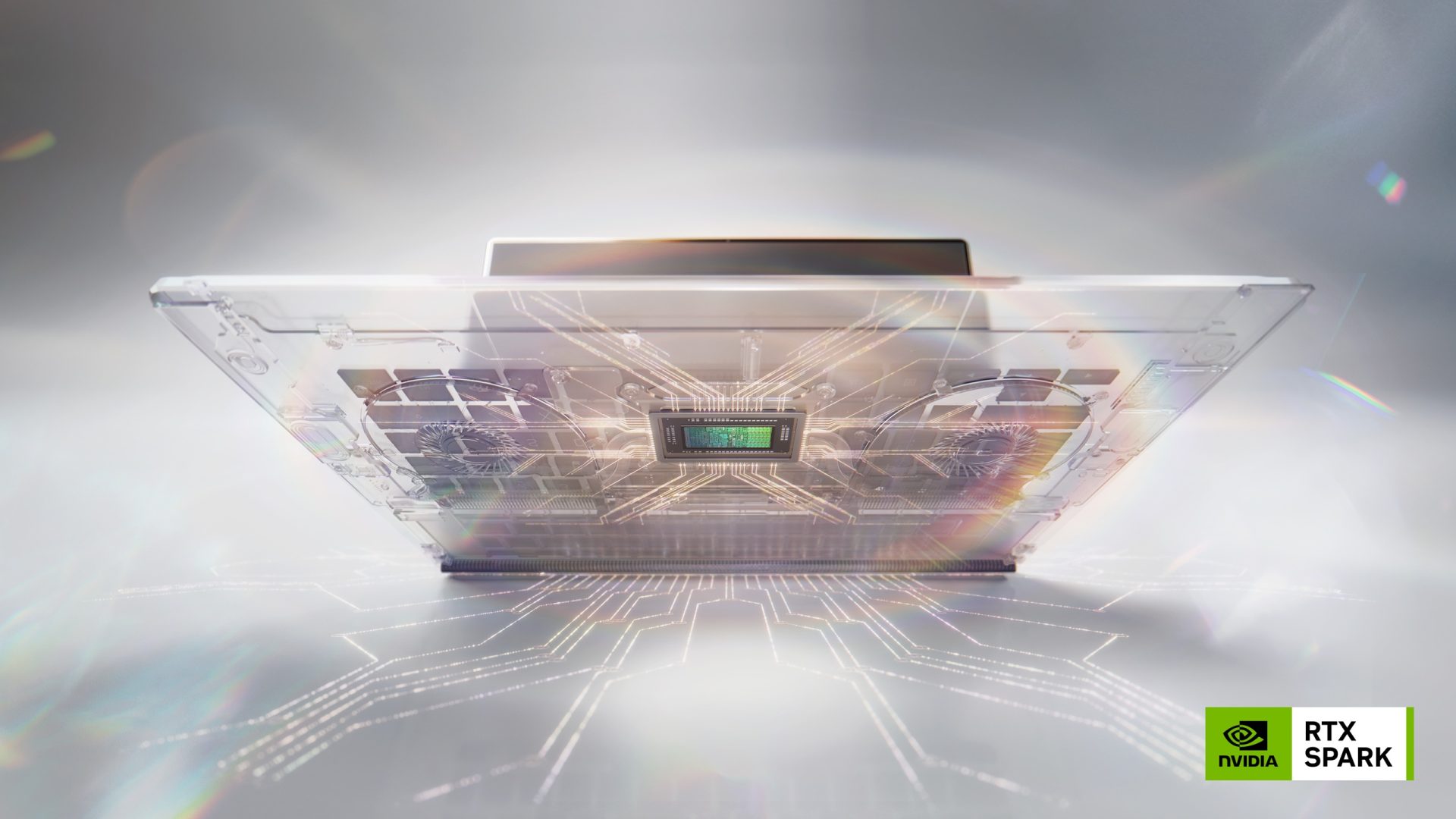
The heart of RTX Spark is a highly integrated SoC based on NVIDIA’s Grace Blackwell design philosophy. It combines CPU and GPU components on a single advanced package using TSMC’s 3nm process technology and 2.5D packaging.
The chip is made from two main dielets. One contains the CPU and memory subsystem, while the other houses the GPU. These components are connected through a high-bandwidth, low-power chip-to-chip interface based on NVIDIA’s NVLink technology.
The CPU side uses Arm v9.2 architecture with 20 cores custom-designed by MediaTek. These cores are arranged into two clusters of 10 cores each. Every core has private L2 cache, while each cluster includes 16 MB of L3 cache, for a total of 32 MB of L3 cache.
The GPU side is based on NVIDIA’s Blackwell architecture. Since it sits on the same package as the CPU, it functions as an integrated GPU, but it is far more powerful than the kind of integrated graphics normally found in laptops. It includes fifth-generation Tensor Cores, RTX ray tracing hardware, CUDA support, NVFP4 support, DLSS, Reflex, G-Sync, ACE, and other RTX technologies.
NVIDIA claims the GPU can deliver up to 31 TFLOPs of FP32 compute and up to 1,000 TOPS of NVFP4 AI performance. It also includes 24 MB of L2 cache for the GPU.
Unified memory is one of RTX Spark’s biggest advantages
One of the most important parts of RTX Spark is its unified memory architecture. The platform supports up to 128 GB of LPDDR5X memory running at speeds up to 9400 MT/s. That enables up to 301 GB/s of raw memory bandwidth, with up to 600 GB/s aggregate bandwidth over the chip-to-chip interface.
Because CPU and GPU share a coherent memory pool, the GPU can access a much larger memory space than a traditional laptop graphics chip. NVIDIA says users will be able to manually allocate a large portion of system memory to the GPU directly through Windows, without needing to enter the UEFI BIOS.
On a 128 GB system, up to 111 GB of memory can be dedicated to the GPU. That could be especially important for local AI models, large creative projects, data science workloads, 3D rendering, and applications that benefit from large GPU memory capacity.
The SoC also includes 16 MB of system-level cache, acting like L4 cache for the CPU and helping improve power-efficient data sharing across multiple engines inside the chip.
Designed for AI, creators, gaming, and professional workloads
NVIDIA is positioning RTX Spark as more than just an AI processor. The platform is built to handle a wide range of demanding PC workloads, including generative AI, LLM inference, model fine-tuning, data science, rendering, visualization, game development, and RTX gaming.
The technology stack is a major reason NVIDIA may have an advantage in the AI PC market. RTX is already widely used across desktops and laptops, and NVIDIA has years of experience with GPU drivers, CUDA, TensorRT, DLSS, RTX ray tracing, and professional creative software acceleration.
Windows support will be critical. Previous Arm-based Windows PCs have often struggled with app compatibility, driver maturity, or performance consistency. NVIDIA’s challenge is different: the company already has a huge GPU software ecosystem, but its Grace CPU has not yet been broadly tested as a mainstream Windows client processor.
Early demonstrations reportedly included applications and games such as Blender, Unreal Engine, LLM Studio, OpenClaw, Alan Wake II, Fortnite, and Indiana Jones. NVIDIA has claimed up to 10x faster AI performance and up to 2x faster generative AI performance in internal testing.
However, gaming numbers should be treated cautiously for now. NVIDIA has not provided full FPS data or detailed graphics settings. Some demos used DLSS Frame Generation, and because RTX Spark is based on Blackwell technology, it is expected to support newer RTX features such as advanced ray reconstruction and multi-frame generation.
Connectivity, displays, and security
RTX Spark is also designed as a full PC platform, not just an AI accelerator. The GB10-based design supports PCIe, USB, Ethernet over PCIe, and multiple display outputs.
Systems can drive up to four displays at once, including three DisplayPort outputs and one HDMI output. Display support includes up to 4K at 120 Hz through DisplayPort Alt Mode and up to 8K at 120 Hz through HDMI 2.1a.
Security features include dual secure root support, dedicated security processors, and support for both firmware TPM and discrete TPM. The complete chip has a 140W TDP, which suggests RTX Spark will be aimed at premium laptops, compact desktops, and powerful mini PCs rather than ultra-low-power thin-and-light systems.
Scalability is another key part of the platform. Multiple GB10-based systems can be connected through NVIDIA ConnectX networking, allowing users to scale performance, memory capacity, and bandwidth for larger AI models. The ConnectX NIC connects through a PCIe Gen5 x8 interface, while systems communicate using Ethernet.
A multi-generation roadmap through 2030
NVIDIA is not treating RTX Spark as a one-time experiment. The company has already outlined a multi-generation roadmap for the platform.
The first generation, arriving in fall 2026, will combine Grace CPU architecture, Blackwell GPU architecture, and LPDDR5X memory.
The second generation is planned for 2028 and is expected to move to Vera CPU architecture, Rubin GPU architecture, and LPDDR6 memory.
The third generation is planned for 2030 and will use Rosa CPU architecture and Feynman GPU architecture.
Each generation is expected to include at least two performance tiers, including a higher-end design and a lower-end configuration. This suggests NVIDIA wants RTX Spark to scale across different types of PCs, from premium laptops and compact AI machines to more powerful workstation-class systems.
First RTX Spark laptops are coming in fall 2026
The first wave of NVIDIA RTX Spark laptops is scheduled to launch in fall 2026. NVIDIA has announced several partner designs, including:
MSI Prestige N16 FLIP AI
Dell XPS 16
Lenovo Yoga Pro 9n
ASUS ProArt P14
HP OmniBook Ultra 16
Microsoft Surface Laptop Ultra
Pricing remains one of the biggest questions. NVIDIA has mentioned configurations with up to 128 GB of memory, and current DGX Spark-style systems have focused on 128 GB models. If RTX Spark laptops launch primarily with high-capacity memory configurations, they may sit firmly in the premium price range, especially given ongoing memory supply pressures.
More flexible RAM and storage options would help make RTX Spark more accessible to creators, students, developers, and power users who want AI performance without paying workstation-level prices.
RTX Spark mini PCs and desktops are also planned
RTX Spark will not be limited to laptops. NVIDIA also plans to bring the platform to mini PCs, with designs expected from Acer, ASUS, Dell, Gigabyte, HP, MSI, and Lenovo in fall 2026.
These compact PCs could become attractive options for local AI development, content creation, home labs, compact gaming setups, and personal AI servers. Over time, NVIDIA may also expand the ecosystem into more traditional desktop PCs, filling the gap between small RTX Spark systems and larger DGX workstation-class machines.
Why RTX Spark matters
RTX Spark represents NVIDIA’s most serious attempt yet to reshape the PC around AI. Instead of relying on a traditional CPU-first design with a separate GPU, the platform combines Arm CPU cores, Blackwell graphics, unified high-capacity memory, and NVIDIA’s AI software stack into a single integrated system.
If NVIDIA can deliver strong Windows performance, reliable app compatibility, competitive battery life in laptops, and attractive pricing, RTX Spark could become one of the most important AI PC platforms of the next several years.
The idea is simple but ambitious: bring powerful local AI, RTX gaming, creative acceleration, and workstation-class capabilities into PCs that fit on a desk or inside a laptop bag. With a roadmap already stretching to 2030, NVIDIA is making it clear that RTX Spark is not just another chip announcement. It is the beginning of a long-term PC strategy.