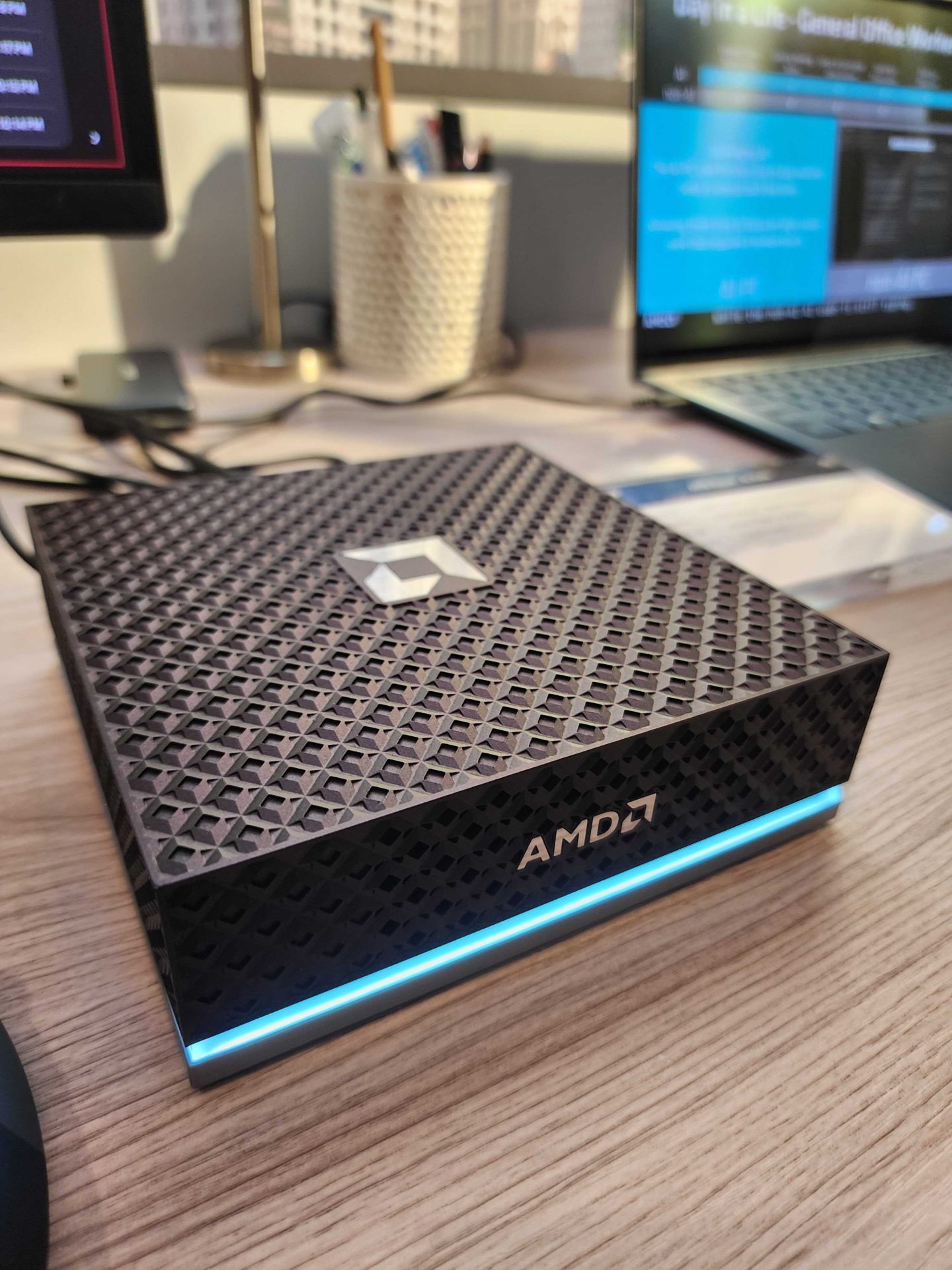
AMD Ryzen AI Halo AI PC launches at $3,999 with Strix Halo power for local AI workloads
AMD has officially entered the compact AI workstation race with the launch of its Ryzen AI Halo AI PC, a small but powerful developer-focused system designed to run demanding generative AI workloads locally. Priced at $3,999, the new machine brings AMD’s Strix Halo platform to a ready-made mini PC form factor, targeting developers, AI creators, researchers, and small-form-factor PC users who want high token throughput without relying heavily on cloud services.
At the center of the Ryzen AI Halo system is AMD’s Ryzen AI MAX+ 395 processor, part of the Ryzen AI MAX 300 family. This chip combines a high-performance Zen 5 CPU, RDNA 3.5 integrated graphics, and an XDNA 2 neural processing unit, giving the system a strong mix of general compute, graphics acceleration, and dedicated AI processing.
The Ryzen AI MAX+ 395 features 16 cores and 32 threads, making it a serious option for CPU-heavy development workloads. It also includes the Radeon 8060S integrated GPU with 40 RDNA 3.5 compute units, along with a 50 TOPS NPU for AI acceleration. The chip can operate with a power envelope of up to 120W, allowing AMD to pack substantial performance into a compact desktop design.
The system is also equipped with 128GB of LPDDR5X-8000 memory and 2TB of PCIe Gen4 x4 storage. That large unified memory pool is one of the key selling points for AI developers because it allows the machine to handle larger local AI models than many traditional compact PCs. AMD says the Ryzen AI Halo platform can run models up to 200B parameters, positioning it as a strong option for users who want to experiment with large language models and generative AI applications on their own hardware.
Despite the performance-focused hardware, the Ryzen AI Halo mini PC is extremely compact. The chassis measures just 5.9 inches by 5.9 inches by 1.7 inches, making it smaller and shorter than many premium desktop systems in its class. Connectivity includes three USB Type-C ports, with one used for power input, along with Wi-Fi 7, Bluetooth 5.4, 10Gbps Ethernet, and HDMI 2.1b.
On the software side, AMD is positioning the Ryzen AI Halo as a developer-ready local AI platform. The system supports AMD ROCm, including the ROCm 7.2.2 software stack, and is optimized for popular AI and development tools such as LM Studio, ComfyUI, and Visual Studio Code. AMD also highlights support and optimization for models and workflows involving GPT-OSS, FLUX.2, SDXL, and other leading AI frameworks.
AMD is clearly aiming this machine at users who want an alternative to cloud AI services or higher-priced dedicated AI workstations. The company compares the Ryzen AI Halo against NVIDIA’s DGX Spark and Apple’s Mac Mini with M4 Pro, claiming advantages in local AI flexibility, operating system support, memory capacity, and token value.
Against NVIDIA’s DGX Spark, AMD says the Ryzen AI Halo provides broader OS support, a 50 TOPS NPU, and stronger value in LLM token generation. AMD’s internal figures show the Ryzen AI Halo ahead in several token-per-second tests, including up to 7% faster performance in GPT-OSS 120B, 12% faster in Qwen 3.5 122B, 4% faster in Qwen 3.6 35B, and 14% faster in GLM 4.7 30B.
The pricing also gives AMD an important talking point. With the Ryzen AI Halo listed at $3,999 and NVIDIA’s DGX Spark currently priced around $4,679, AMD’s system comes in roughly $680 lower while still targeting similar developer and AI experimentation workloads.
Compared with Apple’s Mac Mini M4 Pro, AMD emphasizes memory capacity and larger model support. The Ryzen AI Halo offers up to twice the maximum memory configuration of the Mac Mini M4 Pro and can run models up to 200B parameters, while AMD claims the Mac Mini M4 Pro is limited to models below 100B. AMD also says the Ryzen AI Halo can be up to four times faster on average in certain generative AI workloads.
One of AMD’s biggest arguments for the Ryzen AI Halo is long-term cost savings. The company says not every AI workflow requires a frontier cloud model, and many repetitive agent tasks, coding assistants, content workflows, and local automation jobs can be shifted from the cloud to a local AI PC.
According to AMD’s estimates, developers using local AI could save around $750 per month compared with certain cloud-based AI usage patterns. The Ryzen AI Halo requires the upfront $3,999 hardware purchase, plus estimated electricity costs of around $16.20 per month under a sustained 150W workload. AMD describes that power figure as a worst-case scenario.
By comparison, AI cloud services could cost roughly $750 per month depending on token usage. AMD’s example assumes workloads ranging from 31 million tokens per month at 36 tokens per second to 385 million tokens per month at 446 tokens per second, based on eight hours of usage per day.
Using those numbers, AMD claims the Ryzen AI Halo could pay for itself in about six months. Over three years, the total cost of ownership for the local system could land around $4,500 to $4,600 including electricity, while comparable cloud usage could exceed $25,000.
AMD is also preparing a future upgrade for the Ryzen AI Halo platform. A newer variant based on the Ryzen AI MAX+ 495 is expected around Q3 2026. That version is planned to include 192GB of memory and support for 300B+ parameter models, giving developers even more headroom for large-scale local AI experimentation.
The Ryzen AI Halo arrives at an important time for the AI PC market. Developers and advanced users are increasingly looking for powerful local machines that can run AI models without constant cloud dependency, while businesses are paying closer attention to privacy, recurring cloud costs, and workflow control.
At $3,999, AMD’s Ryzen AI Halo is not a budget mini PC, but it is designed to be a compact local AI workstation with serious hardware behind it. With the Ryzen AI MAX+ 395, 128GB of high-speed memory, ROCm support, strong connectivity, and a small desktop footprint, AMD is making a direct push into the growing market for personal AI development systems.